
HardLove
Turkish ChiChi and American Theodore erupt from the audience in a fevered dance and kiss, making the SoHo Playhouse’s intimate bar feel thrillingly complicit.
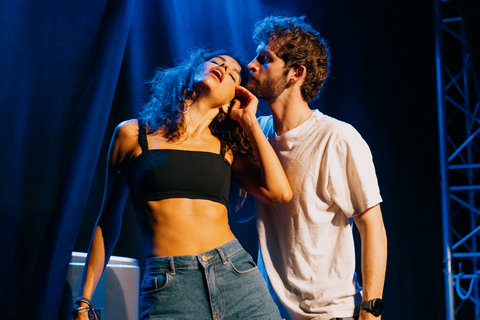
Miray Beşli and Chandler Stephenson in a scene from “HardLove” at the SoHo Playhouse (Photo credit: Aaron West)
What we so casually—so cavalierly—call sexual “chemistry” is in fact a gossamer lattice of impulses, intuitions, and subterranean longings: a volatile fusion of the mental, the physical, and the emotional that resists analysis even as it demands it. Turkish playwright Anıl Can Beydilli’s HardLove—adapted with admirable suppleness by Esin İleri and Miray Beşli for a Turkish–American co-production now returned to the SoHo Playhouse after a warmly received 2025 Edinburgh Fringe run—dives headlong into this unruly terrain. The result is an hour-long chamber drama of formidable daring, a work that mines one fevered night of intimacy for all the awkwardness, revelation, and occasional absurdity that such encounters so often conceal beneath their lacquered surface.
There are evenings at the theater when one senses that every spectator is, in effect, watching a wholly different play, even as we sit shoulder to shoulder in the same dim chamber. HardLove belongs unmistakably to that elusive category. It is a work that refuses to remain onstage; instead, it seeps into the private fissures of one’s own memory, desire, and bias. To witness it is to watch the drama refracted through the peculiar lens of one’s personal history—a rare and bracing theatrical alchemy.
Beydilli’s premise, deceptively simple—“One night. No rules.”—contains within it the seed of its own undoing. For who among us arrives anywhere, let alone in the charged arena of sexual possibility, without a caravan of expectations trailing behind? The play luxuriates in this contradiction. Its characters yearn for a kind of cosmic neutrality, a blank slate for pleasure, yet each arrives already freighted, their desires entangled with ancient disappointments.

Miray Beşli and Chandler Stephenson in a scene from “HardLove” at the SoHo Playhouse (Photo credit: Aaron West)
Our would-be lovers—ChiChi, played with arresting volatility by Beşli, and Theodore, rendered with earnest, understated charm by Chandler Stephenson—enter not from the wings but from within the audience itself, where they dance, grope, and kiss with a heedlessness that is equal parts titillating and disarming. It is an audacious beginning, and director Jee Duman immediately binds performers and spectators in a complicity of observation: we, as voyeurs, are already implicated in their desire before we have even taken our seats. The downstairs theater at SoHo Playhouse, always an intimate venue, becomes in this production almost claustrophobically proximate—an inspired choice for a story preoccupied with proximity’s perils and pleasures.
Duman is ably assisted in realizing Beydilli’s vision by a cadre of incisive designers whose contributions enrich the production’s every contour. Andreea Mincic’s costumes, deceptively simple in their “casual night out” idiom, possess a kind of dramaturgical cunning: they are designed to be slipped off with the same swiftness with which the characters shed their emotional defenses, garments perfectly calibrated for an evening that spirals between seduction and self-revelation. Samantha Tutasi’s scenic design, meanwhile, embraces a necessary claustrophobia—an environment that presses in on the characters just as their own insecurities and desires begin to crowd the air. Paige Seber’s lighting design, attuned to the delicate modulations of this not-quite-first-date, not-merely-a-hookup encounter, traces each emotional shift with painterly sensitivity, illuminating the evolving night with a glow that is by turns intimate, interrogatory, and tenderly unforgiving.
By the time they crash into Theodore’s sparsely appointed bedroom, economically conjured onstage with a bed, a rumpled sheet, and the faint aura of a bachelor’s haphazard domesticity—the audience becomes an architectural extension of Theodore’s space. The “bathroom,” for instance, is located not behind a door but out among us, making ChiChi’s reentrance to discover Theodore battling a bout of performance anxiety not simply comic but faintly mortifying in its refusal to let either character (or viewer) hide. They are still buoyed by alcohol and infatuation—those twin accelerants of impulsive decision-making. Their initial sexual encounter—rendered as a downstage facing, semi-stylized duet choreographed by Dougie Robbins—is both comical and painful in its earnest futility. They have, quite simply, disappointing sex, and the choreography’s deliberate orientation toward the audience underlines the essential performance inherent in that disappointment.

Miray Beşli and Chandler Stephenson in a scene from “HardLove” at the SoHo Playhouse (Photo credit: Aaron West)
What HardLove reveals, sometimes gently and sometimes with a sting, is the extent to which contemporary life has rendered genuine connection a herculean task. In a world mediated through screens—where we curate our feelings with filters and edit our reactions down to a single emoji—the act of facing another human being in real time becomes an exquisite form of vulnerability. ChiChi and Theodore, cut off from the digital safety valves that might otherwise cushion their missteps, flounder before one another in ways that feel almost painfully familiar. They do not need practice at sex so much as practice at presence—at the delicate, unnerving art of truly encountering another person.
What follows is an extended, spiraling negotiation of desire, expectation, identity, and vulnerability—a nocturnal odyssey of questionings and confessions triggered by ChiChi’s postcoital admission that their chemistry may not be quite the combustible force she had anticipated. ChiChi is the tempest to Theodore’s gentle orderliness: she, all mercurial intensity and sacred erotic fantasies; he, by his own sheepish admission, more “cuddler” than conqueror. Yet Beydilli’s script refuses such tidy binaries. As the conversation deepens, so too do the fractures in their carefully curated self-presentations. Beşli and Stephenson peel back these layers with admirable patience, revealing how easily erotic desire bleeds into existential yearning, and how the pursuit of pleasure so often exposes the fissures of identity more swiftly than the pursuit of truth.
Yet the play slyly asks whether this portrait of two flawed souls thirsting for connection is, in fact, the whole story. Might ChiChi, all kinetic charisma and mercurial desire, be less a wounded seeker than a practiced manipulator? Is Theodore’s trusting softness the mark of an open heart—or the mark of a target? The possibility that ChiChi is a homeless, narcissistic opportunist preying on Theodore introduces a destabilizing ambiguity. If Theodore is being fooled, might the audience be fooled as well? Are we so seduced by ChiChi’s glittering self-invention that we, too, have mistaken fireworks for hearthfire? And yet such readings never settle fully; the play refuses to confirm any single interpretation.
By the time the play reaches its understated yet piercing climax, the question is no longer whether ChiChi and Theodore are “right” for one another—though that question lingers—but rather what it means for any of us to seek connection in a world where desire is both compass and mirage. HardLove distills the fragile thrill of two strangers attempting to divine each other’s contours—emotional, physical, moral—and uses that single night’s encounter as a prism through which larger anxieties of belonging, expectation, and becoming refract. In the end, this bold, darkly funny, and unexpectedly tender work stands as a testament to the theater’s capacity to anatomize intimacy without anesthetizing it: a funny, poignant hour that leaves its audience pondering not only these two characters but the mysterious machinery of desire itself.
HardLove (through December 12, 2025)
The Huron Club at the SoHo Playhouse, 15 Vandam Street, in Manhattan
For tickets, visit http://www.sohoplayhouse.com
Running time: 60 minutes without an intermission


Leave a comment