
Crooked Cross
American premiere of Sally Carson's 1935 play predicting the rise of Nazism through the eyes of one ordinary Bavarian family.
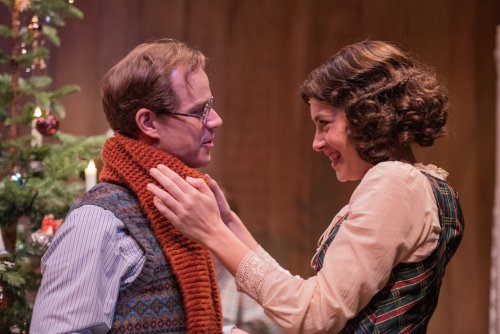
Samuel Adams as Moritz Weissmann and Ella Stevens as Lexa Kluger in a scene from the Mint Theater Company’s production of the American premiere of Sally Carson’s “Crooked Cross” at Theatre Row (Photo credit: Todd Cerveris)
Sally Carson’s only play Crooked Cross (1935) now being given its American premiere by the Mint Theater has an interesting history. In the early thirties, Carson, a publisher’s reader in England, took a trip to Bavaria and was upset by what she saw. She wrote and published her first novel Crooked Cross (a reference to the Swastika) in 1934 dealing the tumultuous period in Germany from Christmas 1932 to June 1933 in which time Hitler was elected chancellor and Jews were prohibited from public life. She then adapted the book as a play which was presented at Sir Barry Jackson’s Birmingham Repertory Theatre in 1935 and at London’s Westminster Theatre in 1937. Before her early death from breast cancer in 1941, she had published two sequels to her novel.
Long out of print, the book was republished in April of this year when it came to the attention of artistic director Jonathan Bank who had trouble tracking down the play. He discovered it had a huge cast and that Carson herself had self-censored her novel for pro-German English audiences. The Mint’s production has reduced the cast to nine and added back language cut from the novel, but all of the words spoken from the stage of Theatre 4 at Theatre Row Theatre are still Carson’s.

The Cast of the Mint Theater Company’s production of the American premiere of Sally Carson’s “Crooked Cross” at Theatre Row (Photo credit: Todd Cerveris)
The play begins with a party scene introducing all of the major characters. Beginning in December 1932 in the fictional Bavarian town of Kranach, outside of Munich, the Kluger family is celebrating their usual Christmas with parents Rosa and Hans, unemployed sons Helmy and Erich, and daughter Lexa. She is about to get engaged to Dr. Moritz Weissmann who has been invited with his father retired Professor Weissmann who is going blind. The family appreciates Moritz as he operated on Hans without cost recently.
Unfortunately, the peaceful setting is soon going to be shattered. Although Moritz’s late mother was Catholic, his father is Jewish and they have a Jewish sounding name, though Moritz was brought up Catholic. Helmy gets a job with the National Socialists and Erich who is only seasonally employed teaching skiing at the nearby Grand Hotel revels in becoming a Nazi storm trooper in a uniform that makes him feel important. When Moritz is fired from his job at the hospital ostensibly for giving a lecture to the Communists, Lexa and his June marriage is put off as he now has no income. Helmy and Erich think that it is bad for the family if Lexa is to be seen with a Jew and they caution her to break it off with him. However, she continues seeing him behind their backs. Hitler is elected to power and more and more atrocities occur in the town against people presumed to be Jewish. While the parents are hesitant to join the party although the election has swayed their opinion, the play progresses towards its tragic conclusion in June 1933.
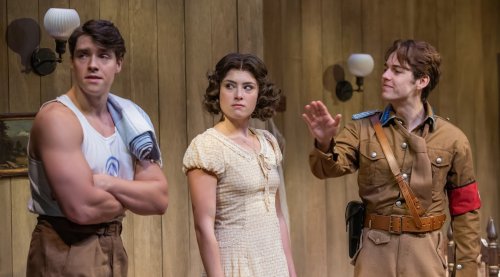
Jakob Winter as Erich Kluger, Ella Stevens as Lexa Kluger and Gavin Michaels as Helmy Kluger in a scene from the Mint Theater Company’s production of the American premiere of Sally Carson’s “Crooked Cross” at Theatre Row (Photo credit: Todd Cerveris)
The play is more important historically than as a literary work. Its prescience in predicting in 1934 the Nazi rise to power through one ordinary family is now timely with the rise of anti-Semitism in the U.S. again and the spread of MAGA ideology. We watch how the Klugers are slowly swept up in the Nazi philosophy which improves the unemployment and bad economic conditions. As Helmy tells his parents, “You don’t understand how we feel, Father. You had a decent chance when you were young. Everything was easier then. You lived fully, had the best out of life… It’s we that have had to be young in the rubbish of the last years, since the war.” Earlier he declared “The Party – and the future of it – it’s given me everything that’s made my life normal again, made it something to begin to be a little proud of again, some sort of stability.” You can almost hear disaffected young men in America saying this today.
Unfortunately, Crooked Cross’ dramaturgy is more than a bit shaky. Told in nine scenes, the play still seems like chapters of a book with big gaps between the scenes and each scene revealing a single piece of new information. There is no backstory: have Helmy, Erich and Lexa finished their education? What did they study to be? What has Lexa been doing while her brothers were loafing? How is it that the whole family knew Moritz was half Jewish but Lexa didn’t? She is wise enough to know that teaching skiing to the rich women at the Grand Hotel is not the only source of Erich’s previous income. How does Moritz stay so cool and collected in the face of what is going on all about him? What did Herr Kluger do before his leg injury? It is possible that Carson cut too much of her novel in adapting it for the stage.
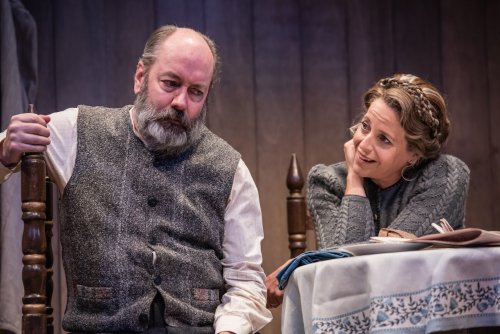
Liam Craig as Hans Kluger and Katie Firth as Rosa Kluger in a scene from the Mint Theater Company’s production of the American premiere of Sally Carson’s “Crooked Cross” at Theatre Row (Photo credit: Todd Cerveris)
Bank’s direction lacks urgency and tension as the fears mount up. True, the family’s leaning in the direction of Nazism is in slow increments but even when atrocities begin to be reported, there is no rising temperature. The acting of the young people is rather callow though this is partly attributable to the thinness of the characterizations. Most of them are one-dimensional: Gavin Michaels’ Helmy is frustrated, Jakob Winter’s Erich is pugnacious, Jack Mastrianni as family friend Otto is timid. Both Ella Stevens’ Lexa and Samuel Adams’ Moritz are too cool in the face of adversity. Doesn’t he know what is coming after he loses his job and his passport? Katie Firth as Frau Kluger seems rather naïve while Liam Craig as her husband is rather bland.
Alexander Woodward’s four sets, the homes of the Klugers and the Weissmans, the Munich hotel’s New Year’s Eve party, and the local mountain by moonlight, mainly revealed on a revolving stage are suitable but rather underwhelming, while the mountainside scene including Joey Moro’s view of the Nagelspitz near the Austrian frontier has more atmosphere. However, Hunter Kaczorowski’s period costumes from the bulky sweaters to the storm trooper uniforms are redolent of Middle Europe in the thirties. Christian DeAngelis’ lighting lacks mood and variations for time of day. The sound by Sean Hagerty could be turned up a notch to let us really hear what is going on in the streets outside their windows.
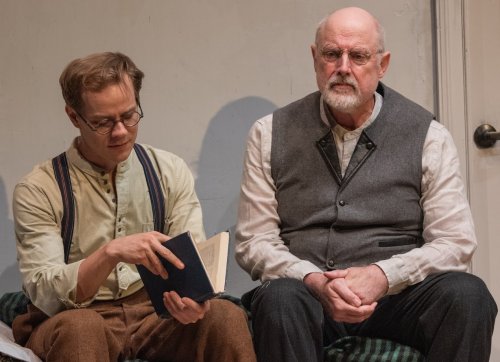
Samuel Adams as Moritz and Douglas Rees as Professor Weissmann in a scene from the Mint Theater Company’s production of the American premiere of Sally Carson’s “Crooked Cross” at Theatre Row (Photo credit: Todd Cerveris)
Sally Carson’s Crooked Cross is a worthy addition to the Mint Theater mission to rediscover plays from the past that have been lost or forgotten, in this case, introducing a 1935 play to America that has not been seen here before. However, not every lost or forgotten play is a masterpiece. While Crooked Cross holds a historic role in predicting the rise of Nazism in an ordinary German family, its low-key development undercuts the drama inherent in the story and seems to evolve too slowly for its own good.
Crooked Cross (through November 1, 2025)
Mint Theater Company
Theatre Row, 410 W. 42nd Street, in Manhattan
For tickets, visit http://www.minttheater.org
Running time: two hours and 15 minutes including one intermission


Leave a comment