
And Then We Were No More
Tim Blake Nelson's latest is a smart play of ideas that is more cerebral than emotional.
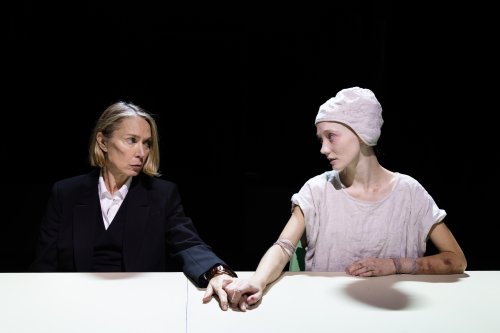
Elizabeth Marvel and Elizabeth Yeoman in a scene from Tim Blake Nelson’s “And Then We Were No More” at La MaMa E.T.C. (Photo credit: Bronwen Sharp)
As a playwright Tim Blake Nelson has always been interested in moral and ethical problems in such play as The Grey Zone, Eye of God and Socrates. His latest play And Then We Were No More now at La MaMa E.T.C. is also about such knotty questions but this one is set in the near future. A dystopian drama, And Then We Were No More investigates a justice system no longer interested in mercy but in an algorithm which makes all decisions. Mark Wing-Davey’s production featuring acclaimed actress Elizabeth Marvel is glacially cool in the manner of sci-fi movies that have something serious on their mind. The play has some resonance for the times we are living through now.
In a society that has given up personal freedoms for total safety, the justice system has been turned over to a corporation in which verdicts are predetermined by an algorithm. Those deemed beyond rehabilitation are sentenced to death. A new machine offers a painless death in return for having one’s history wiped out if one so chooses. A Lawyer (Marvel) who has not worked in six years since the changes to the judicial system is called to the fortress which houses the mechanism and assigned to represent an unusual client: The Inmate (Elizabeth Yeoman) who has pleaded guilty to poisoning her two children, her husband and her mother had previously elected to be put to death painlessly. Now she has changed her mind but as she has been found beyond rehabilitation she will be put to death in any case. The lawyer is asked to represent her in a case with a predetermined verdict, though she initially wants to have nothing to do with the new judicial system.
In her one meeting with The Inmate, the Lawyer discovers that her client has been in a previous penitentiary where she was cruelly experimented on in the name of science and may have been given a lobotomy. As a result she has been traumatized and only speaks in garbled sentences but is able to make herself clear. Ironically, the justice system has revived The Inmate twice after suicide attempts in order to carry out the sentence of the court. The Lawyer’s case is that since The Inmate has been damaged by the treatment she has received while in prison she was not in her right mind when she elected to be put to painless death. In fact, in her current condition she is not subject to the will of the court.
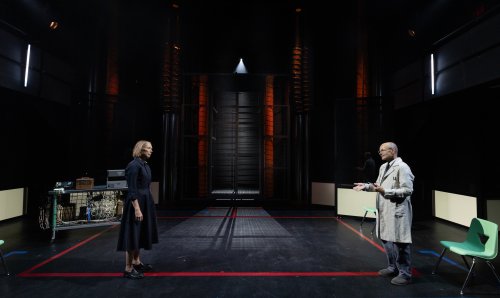
Elizabeth Marvel and Henry Stram in a scene from Tim Blake Nelson’s “And Then We Were No More” at La MaMa E.T.C. (Photo credit: Bronwen Sharp)
During the trial, the audience stands in for the 100 member jury also selected by the computer algorithm. One of the few moments of levity is when the court refuses to allow the Lawyer to announce the name of The Inmate but silences her with a loud piercing sound each time she attempts to reveal it to the jury. While all this has been going, we have been watching the machine assembled in the background, one that has not been used before. In a somewhat unneeded shorter second act we find out how the verdict in the court case has affected the main officials.
The entire production has been staged in a cool, deliberately impassive style which depicts a world of no compassion or mercy. Even the acting of most of the performers is entirely unemotional even though the topic would be assumed to trigger reactions. Best is debuting artist Yeoman as The Inmate, frenzied, mostly incoherent but getting her point across. Her difficult dialogue suggests tremendous stamina in learning her lines. Playing a woman whose crimes are heinous, she creates sympathy for what she has suffered and the condition it has left her. Something one would have thought impossible, she upstages veteran actress Marvel in their two scenes together.
Marvel adds another feather to her cap as the angry Lawyer who wants nothing to do with the new system. Her crisp, clipped delivery put her in command of all but her scenes with The Inmate. Unemotional at all times, she does put over her indignation for the new system which goes only by the rules. Both Scott Shepherd as the government Official and Jennifer Mogbock as the Analyst who represents the corporation who invested in the Machine. are so cool and impassive that they might as well be played by robots, a deliberate choice. Henry Stram as the Machinist who operates the death machine is allowed to show more emotion. The other actors playing Guards and Engineers are given no lines and also go about their jobs entirely emotionless.
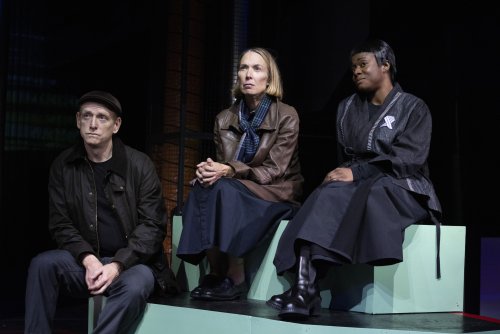
Scott Shepherd, Elizabeth Marvel and Jennifer Mogbock in a scene from Tim Blake Nelson’s “And Then We Were No More” at La MaMa E.T.C. (Photo credit: Bronwen Sharp)
David Meyer’s powerful scenic design creates a monolith-like building of the future (nicknamed The Fortress) with many towering pillars as well as a huge machine with its orange pipes like an enormous dragon or monster. The costumes by Marina Draghici in mainly dark colors except for the off-white for the Inmate and The Machinist’s white lab coat are successful in depicting a colorless world of the future. Reza Behjat’s moody, atmospheric lighting keeps much of the set in darkness through several of the scenes, while others are brightly lit to reveal the terror of the machine. Henry Nelson and Will Curry’s music and sound design is much in evidence in the course of the play.
Tim Blake Nelson’s And Then We Were No More is a smart play of ideas that is more cerebral than emotional. With its cool, dispassionate approach to its explosive topic, it misses some of its possibilities but does fully explore its intellectual arguments. In Mark Wing-Davey’s deliberately emotionless production one is brought face to face with the George Orwellian world that we are increasingly living in. Actresses Elizabeth Marvel and Elizabeth Yeoman make this a play not to be missed despite its appeal only to the mind.
And Then We Were No More (through November 2, 2025)
Stop the Wind Theatricals
Ellen Stewart Theatre, La MaMa E.T.C., 66 E. 4th Street, in Manhattan
For tickets, visit http://www.LaMaMa.org
Running time: 90 minutes including one intermission


Leave a comment