
Try/Step/Trip
Brathwaite turns his brush with the justice system into a ritual of survival; step summons ancestors, music shapes worldviews, and a Black man claims himself.
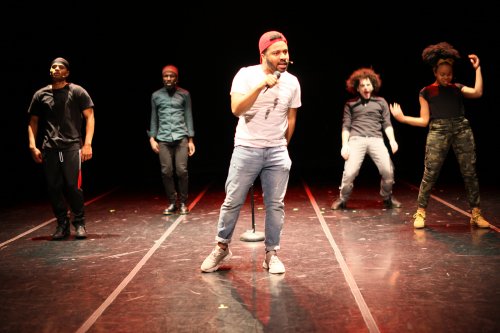
A scene from Dahlak Brarthwaite’s “Try/Step/Trip” at The Jeffrey and Paula Gural Theatre at A.R.T./New York Theatres (Photo credit: courtesy of the producer)
Dahlak Brathwaite seemed, by every outward measure, to be ascending. Freshly graduated from the University of California, Davis, he had already secured a rare kind of cultural visibility, appearing twice as a spoken-word poet on HBO’s Def Poetry Jam, a platform that, at the time, functioned as both a seal of legitimacy and a launching pad for young artists finding their voices in public. The trajectory appeared clear, even inevitable—until it was abruptly, violently interrupted. A routine traffic stop became a rupture: a police officer discovered hallucinogenic mushrooms in Brathwaite’s car, and in an instant, the narrative of promise collided with the machinery of law enforcement.
Confronted with the real possibility of incarceration, Brathwaite entered a court-mandated drug rehabilitation program. It was 2008, a year that would mark not a detour but a profound inflection point. Rather than sealing that experience away, he has spent the years since returning to it with the persistence of an artist unwilling to let formative trauma calcify into silence. Through music, poetry, and layered acts of storytelling, Brathwaite has continued to metabolize that moment—revisiting it, reframing it, and transforming it into a body of work that understands personal history as something not merely survived, but continually reinterpreted.
Brathwaite’s Try/Step/Trip arrives bearing the marks of the road: a work burnished by repetition, sharpened by travel, and deepened by the many rooms—literal and psychic—it has occupied beginning in the mid 2010s. For roughly a decade, when its earliest impulses first surfaced in the raw, searching material of Brathwaite’s solo work Spiritrials, and continuing through a long succession of residencies, workshops, revisions, and reimaginings—the piece has been patiently, insistently shaped, announcing itself now at its 2026 New York premiere not as a sudden debut but as the culmination of years of lived inquiry and artistic return. The six-person ensemble has shifted slightly along the way, but Brathwaite remains its gravitational center, anchoring the piece with a narrative architecture that feels at once meticulously engineered and emotionally lived-in. This is not merely a story he tells; it is a story he has been circling for years through music, poetry, movement, and performance, each iteration adding sediment rather than redundancy. What emerges is a layered excavation of one facet of the Black experience within the criminal justice system—specifically, a court-mandated drug rehabilitation program—that manages to feel both rigorously specific and expansively universal.
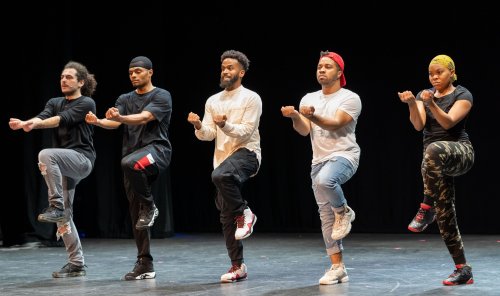
A scene from Dahlak Brarthwaite’s “Try/Step/Trip” at The Jeffrey and Paula Gural Theatre at A.R.T./New York Theatres (Photo credit: courtesy of the producer)
There is something quietly radical in Brathwaite’s willingness to tell this story again and again. He has rendered it as a one-man show; here, he disperses it across an ensemble, allowing the narrative to refract through multiple bodies and voices. Gratitude feels like an appropriate response—not only for the generosity of the sharing, but for the insistence that this story belongs on institutional stages right now, particularly venues that too often profit from the surface aesthetics of Black art while resisting its deeper reckonings. Try/Step/Trip implicitly challenges that economy. “This tale so old,” Brathwaite begins, framing repetition not as stasis but as necessity. The work argues that certain stories must be told repeatedly—not to dull their edges, but to sharpen our capacity to hear them, absorb them, and, ideally, alter the conditions that make them eternal.
For this Under The Radar engagement at A.R.T./NY’s Jeffrey and Paula Gural Theatre, the ensemble proves itself an embarrassment of riches. Each performer radiates an individual force, yet together they function as a cohesive, breathing organism. Roberta Uno’s direction complements Brathwaite’s multifaceted virtuosity with intelligence and generosity, shaping the evening to highlight the ensemble’s strengths without ever fracturing its unity. Jasmine T.R. Gatewood as Mary deploys her striking voice with both precision and emotional transparency, sustaining even the most lyrical moments in embodied truth. Freddy Ramsey Jr. as Samples, Max Katz as Steve and Dante Rossi as Pastor move fluidly among multiple roles, their commitment total, their transformations seamless, lending the piece a sense of communal storytelling rather than star-driven display.
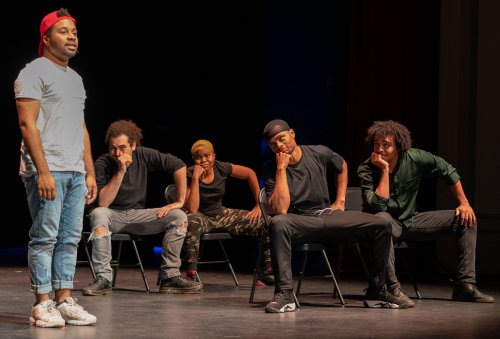
A scene from Dahlak Brarthwaite’s “Try/Step/Trip” at The Jeffrey and Paula Gural Theatre at A.R.T./New York Theatres (Photo credit: courtesy of the producer)
Tyrese Shawn Avery as Anonymous is Brathwaite’s delightful avatar—a figure who is clearly the younger Brathwaite, then sometimes merges into the ensemble, then sometimes becomes a conduit for the live musical score. Richard Perez Jr and Krystal Renée support the vocal and choreographic numbers as members of the ensemble. Brathwaite’s presence is felt everywhere, if not as the character of the Conductor (the DJ at the sampling machine) and sharing the narrating duties, then as an active part of the ensemble. There isn’t a moment when he is not physically onstage: if not actively participating in a given moment, then in the musicality of the movement, in the cadence of the verse, in the way space is conceived as both site and memory. His poetry, his physical vocabulary, and his compositional instincts align into a single, coherent language, supported by music co-composed with Teak Underdue that pulses with urgency and restraint in equal measure.
The choreography by Toran X. Moore is exquisitely attuned to both context and cast. Moore’s steps and motifs create a full canvas of movement that breathes with the beat and bends to the demands of the narrative. Try/Step/Trip announces itself through a distinct physical vocabulary, one that is not merely stylistic but historical and communal: step, the percussive dance form forged and refined within historically Black colleges and universities. Here, the body becomes both instrument and archive—feet striking, hands clapping, chests resonating in rhythms that carry lineage as much as sound. The choice of step is not ornamental; it is foundational, lending the work a muscular, collective language that insists on presence, discipline, and shared breath, and that roots the piece in a tradition where movement functions simultaneously as music, memory, and social bond. Rooted firmly in Black dance, the choreography adapts itself to the tonal shifts of each song and scene, turning the evening into a literal and figurative adventure. At 90 minutes, the piece demands stamina and precision from its performers, and the ensemble meets that challenge with discipline and collective resolve.
Step, braided seamlessly into the musical score, evolves into an embodied metaphor for the rigid architectures and repetitive rituals of both the court system and group rehabilitation. The synchronized strikes and regimented patterns echo institutional order—counted, enforced, unyielding—while the bodies executing them strain, subtly and visibly, against uniformity. In this physical language, Anonymous’s predicament is made legible not through exposition but through motion: the dance articulates his oscillation between resistance and compliance, between the instinct to assert an individual rhythm and the pressure to fall in line with the collective. Step becomes the medium through which the work renders that tension palpable, allowing the audience to feel, in muscle and cadence, the cost of belonging under coercion.
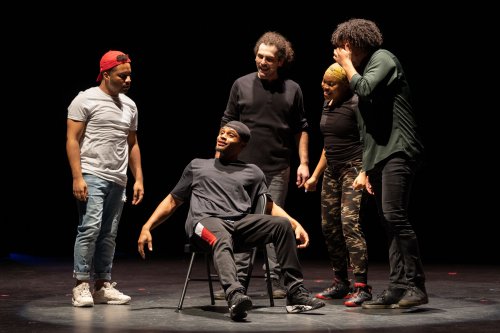
A scene from Dahlak Brarthwaite’s “Try/Step/Trip” at The Jeffrey and Paula Gural Theatre at A.R.T./New York Theatres (Photo credit: courtesy of the producer)
All of these elements—the narrative, the verse, the music, the movement—interlace into a palpable physical path. Sim Carpenter’s lighting and Dana Rebecca Woods’ costumes complete the visual composition, framing the bodies onstage with clarity and intention. Brathwaite’s poetry moves at an expert pace, propelling the action forward while allowing space for reflection, and by the final moments, a cautious glimmer of hope is permitted to surface—not as a facile resolution, but as a hard-won possibility.
Through this escalating choreography of bodies and stories, the work reveals how these cycles repeat themselves, sanctified by habit and spectacle, even as it gestures toward the fragile hope that they might, at last, be broken. Beyond its undiminished relevance, there is something in Brathwaite’s formula that insists on repetition as an ethical act. This is a story meant to be retold, and Brathwaite, clearly, is prepared to keep telling it until we learn how to listen.
Try/Step/Trip (through February 1, 2026)
2026 Under the Radar Festival
The Jeffrey and Paula Gural Theatre at A.R.T./New York Theatres, 502 West 53rd Street, in Manhattan
For tickets, visit www.art-newyork.org
Running time: 90 minutes including one intermission


This piece was so amazing. Go see it if you can.