
The Faggots and Their Friends Between Revolutions
The stage transfigures Mitchell’s words; sung by 15 voices decades on, they shed myth for ritual—spiritually vibrant, culturally electric, urgently alive.
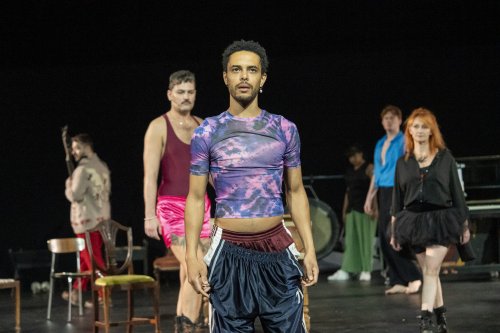
Themba Mvula (center) and ensemble in a scene from Philip Venables and Ted Huffman’s “The Faggots and Their Friends Between Revolutions” at the Park Avenue Armory (Photo credit: Stephanie Berger)
In the cavernous expanse of the Park Avenue Armory, where spectacle often arrives inflated to mythic proportions, The Faggots and Their Friends Between Revolutions materializes as a frequently mad, occasionally mystical, and resolutely LGBTQIA+ fantasia. Adapted from Larry Mitchell and Ned Asta’s 1977 queer fable-book—part manifesto, part utopian parable—this incarnation, shaped by composer Philip Venables and director Ted Huffman (who first unveiled it to British audiences in 2023), announces itself with a great deal of theatrical flourish. For all its conjurations and incantatory ambition, it is ultimately a work whose whimsy gleefully shines on the backs of this diamond’s many facets.
The creators lean heavily on the collaborative energies of their ensemble of 15 actors-musicians-storytellers, a troupe whose improvisatory contributions helped generate the work’s collage-like structure. Together they narrate—sometimes straightforwardly, sometimes elliptically—the tale of a once-sylvan world undone by “a mysterious infection of the mind,” a psychic blight that transmogrifies certain inhabitants into “the men.” These men, embodiments of a repressive, paper-generating patriarchy, stand in stark relief to the faggots (i.e. gay men) and their women comrades who will ultimately challenge and overthrow them. It is the sort of allegorical framing that wears its politics with disarming clarity, if at times with a touch of overfamiliar earnestness.
But a synopsis, however faithful, barely hints at the unruly eclecticism of what unfolds. Venables’ score is a lively, fragmentary patchwork, most comfortable when flirting with neo-baroque ornamentation but equally willing to dart into dissonant or whimsical eddies. The staging oscillates between seemingly spontaneous dance, ritualized stillness, and bursts of stylized combat. Spoken, sung, and chanted text pours forth, helpfully supertitled as if to remind us that the torrent is quite intentional. An audience sing-along on the nature of madness—an interlude that feels both wry and earnest—momentarily collapses the distance between performers and observers. Meanwhile, individual musical solos, as brief as lightning strikes, shimmer from harp, piano, organ, violins, accordion, flutes, and even a harpsichord, like archival treasures being lifted from a trunk and promptly returned.
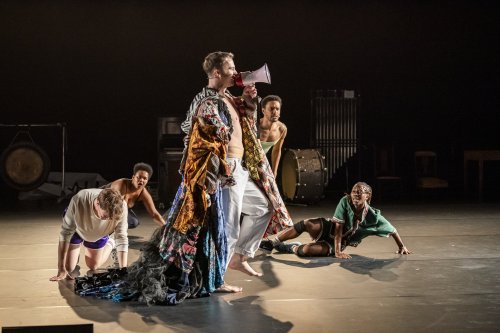
Colin Shay (center) and ensemble in a scene from Philip Venables and Ted Huffman’s “The Faggots and Their Friends Between Revolutions” at the Park Avenue Armory (Photo credit: Stephanie Berger)
What Venables and Huffman ultimately conjure is not merely an adaptation but a corporeal manifestation of Mitchell’s utopian dreamscape—a vision of collective tenderness and insurgent camaraderie given sinew, muscle, and breath. In their hands, the notion of loving communal action becomes something palpably kinetic, unfolding across the stage with an almost devotional intensity. The performers, functioning as a kind of polymorphous queer guild, seamlessly exchange the mantles of instrumentalist, singer, narrator, and dancer; the transitions between these identities are executed with a virtuosity so liquid, so uncannily unbroken, that one begins to suspect some secret mechanism of alchemical transformation at work.
One moment in particular encapsulates the ensemble’s extraordinary unity: nearly every performer, regardless of background or technical proficiency, lifts a violin to his or her shoulder. Those whose acquaintance with the instrument is tentative contribute a single unwavering drone note, while their more adept colleagues embroider the texture above. The cumulative effect is both fragile and transcendent, a sonic emanation that feels less like music played than a communal breath exhaled in harmony.
Elsewhere, the production’s restless stylistic curiosity becomes a source of continual surprise. A lute song that would not feel out of place in Britten’s catalog melts imperceptibly into a languorous bossa nova, as though the centuries themselves had decided to dissolve their boundaries. And when one of Venables’ baroque-tinged semi-pastiche interludes blossoms into a courtly dance, the choreography has the air of a ritual remembered across lifetimes.
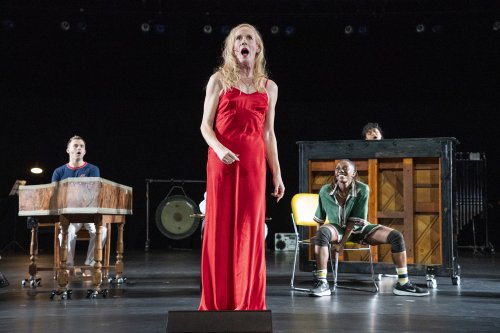
Collin Shay, Kit Green, Yandass and Yshani Perinpanayagam in a scene from Philip Venables and Ted Huffman’s “The Faggots and Their Friends Between Revolutions” at the Park Avenue Armory (Photo credit: Stephanie Berger)
Our primary Virgil through this queer underworld is Kit Green, a lanky, flaxen-haired comic presence whose bone-dry delivery becomes a necessary counterweight to the text’s more saccharine recurrences. Green’s sardonic underplaying provides moments of grounding in an otherwise vaporous textual landscape. Among the ensemble’s more kinetically exuberant performers is Yandass, a veritable sparkplug whose energetic traversals of the stage lend the proceedings a welcome jolt. Countertenor Collin Shay, meanwhile, embraces his role as the bellowing avatar of the Ramrod nation with an operatic ferocity that borders on the mythological. Huffman’s staging, supported by choreographer Theo Clinkard, ensures that even when the dramaturgy descends into symbolic murk, the individual performer remains a point of orienting clarity.
Clinkard also shoulders the responsibility for the show’s costuming, assembling what appears to be a deliberately mismatched trove of ostentatious garments, as though sourced from a queer commune’s attic or a very particular church rummage sale. These pieces, donned and shed throughout, contribute to an atmosphere of perpetual transformation—a visual argument, perhaps, for the fluidity and improvisation at the heart of queer communal life. Their charming shabbiness reinforces the production’s anti-dominant ethos, signaling a cheerful refusal of mainstream theatrical polish.
The physical environment conjured by set designer Rosie Elnile is equally suggestive of process over product: a wide, bare expanse outfitted with wardrobe racks, scattered chairs, and rehearsal-room detritus. It is a space that does not pretend to be anything other than a space of making—provisional, collaborative, open-ended. Lighting designer Bertrand Couderc washes these environs in twilight hues, as if the world we witness exists in a permanent liminal hour, on the cusp of revelation or dissolution.
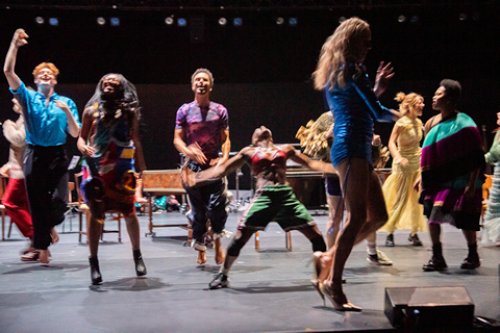
The ensemble in a scene from Philip Venables and Ted Huffman’s “The Faggots and Their Friends Between Revolutions” at the Park Avenue Armory (Photo credit: Stephanie Berger)
Through it all, the word “faggot”—the slur reclaimed, re-polished, and hurled with pride—resounds again and again, hundreds of times, in fact, until repetition transforms stigma into spell work. The production takes care to emphasize Mitchell’s original impulse to retrieve a word historically wielded as a weapon and reforge it as an emblem of solidarity and defiance. Whether this reclamation achieves emotional resonance or merely accumulates through brute insistence will depend on each viewer’s own relationship to language and identity.
Taken in aggregate, the piece can admittedly veer toward the baffling, the chaotic, even the willfully ungoverned. But such disarray is suffused with an exuberance that refuses to curdle into mere confusion. Delivered with unfiltered energy, almost reckless generosity, and a panache that borders on the delirious, the work becomes not simply compelling but indelibly so—its moments of strangeness and beauty lingering long after the final gesture has dissipated into the air. In the end, the 90-minute piece emerges as a mosaic of charm, obviousness, perplexity, and occasional delight. It is as likely to beguile as it is to bewilder—or, for some, to induce a gentle but unmistakable boredom. Perhaps that variance is inevitable for a work that so resolutely speaks to and from a specific community, a specific lineage of liberation and imagination. The Faggots and Their Friends Between Revolutions does not so much argue its case as revel in it; whether one joins in the revelry may depend on how closely one’s sympathies align with those of its exuberant, unruly tribe.
The Faggots and Their Friends Between Revolutions (through December 14, 2025)
Factory International (Manchester) & Park Avenue Armory
Wade Thompson Drill Hall, 643 Park Avenue, in Manhattan
For tickets, visit www.armoryonpark.org
Running time: 90 minutes without an intermission


Leave a comment