
The Baker’s Wife
After 50 years and so many revisions, Gordon Greenberg’s CSC revival makes it hard to see why this musical was ever deemed broken; Schwartz’s score glistens.

Ariana DeBose as Geneviève and Scott Bakula as Aimable with the cast of the Classic Stage Company’s production of Stephen Schwartz’s musical of “The Baker’s Wife” at the CSC Theatre (Photo credit: Matthew Murphy and Evan Zimmerman)
A remarkable “second chance” is underway at Classic Stage Company, a kind of patient archaeological labor applied to one of American musical theater’s most famously unlucky artifacts. The Baker’s Wife—that much-maligned, much-resurrected score—has at last found a production capable of justifying the stubborn devotion it has inspired among theater artists for nearly half a century. This is the musical that refuses to stay dead, the so-called “flop with a hundred lives,” revived repeatedly on both sides of the Atlantic by those who sense, correctly, that something precious lies buried beneath its historical wreckage. What director Gordon Greenberg’s production finally accomplishes is not revisionism but clarification: it explains, calmly and persuasively, why the show has never been allowed to disappear.
The tortured history of The Baker’s Wife has by now hardened into legend. In the mid-1970s, Stephen Schwartz—fresh from the improbable triple triumph of Godspell, Pippin, and The Magic Show—joined forces with Joseph Stein, whose authorship of Fiddler on the Roof had already secured him a permanent place in the canon. The result should have been a commercial inevitability. Instead, the project collapsed into one of Broadway’s most notorious development disasters: a six-month tryout tour in 1976 that resembled less a rehearsal process than a slow-motion siege. Two directors, two choreographers, and two leading ladies were chewed up and discarded along the way, while producer David Merrick, in one of his more destructive moods, seemed determined to test how much chaos a single show could absorb before imploding. Topol, the original London cast Tevye, as well as the star of Fiddler’s film incarnation, was fired after eight months on the Baker’s Wife pre-Broadway tour due to behavioral issues. He was replaced by Paul Sorvino until the tryout’s total demise, but that demise was not without recording an “original cast” album for posterity.
The casualties were not merely professional. Patti LuPone’s memoir devotes a chapter to The Baker’s Wife that reads like an exorcism; open it and you half expect smoke. More chilling still is the fate of Jo Mielziner, the legendary scenic designer whose career effectively ended with the show and who died while rushing to yet another meeting about its problems. This is a musical that has long carried the aura of a curse, its beauty inseparable from the damage it inflicted. To encounter it now, in a production so lucid and assured, feels less like a revival than a rescue.

Alma Cuevo as Therese, Savannah Lee Birdsong as Simone, Judy Kuhn as Denise, Sally Murphy as Hortense, Hailey Thomas as Nicole and Samantha Gershman as Inez in a scene from the Classic Stage Company’s production of Stephen Schwartz’s musical of “The Baker’s Wife” at the CSC Theatre (Photo credit: Matthew Murphy and Evan Zimmerman)
Greenberg’s staging provides the show with what it has always lacked: a coherent, hospitable environment in which its many virtues can breathe. Jason Sherwood’s scenic design presents a Provençal town square that appears to have been gently dismantled and reassembled as memory—its upper levels peeled away, masonry and greenery scattered with studied care. The effect is as intimate as it is picturesque, a space that invites observation rather than spectacle. Bradley King’s lighting bathes the scene alternately in radiant sunlight and soft nocturnal glow, punctuated by lamplight that suggests both community and secrecy. Catherine Zuber’s costumes are scrupulously period without being fussy, attentive to character rather than nostalgia, while Jason Crystal’s sound design achieves the rare feat of transparency, allowing Schwartz’s score to register with unforced clarity.
The familiar indictment of The Baker’s Wife—too little plot, too many songs—cannot be dismissed outright. The story is slender, almost novelistic in its modesty. Aimable, a middle-aged baker, arrives in a village that has been deprived of decent bread since the death of its previous baker. His baguettes are nothing short of revelatory, and the townspeople respond with near-religious fervor. They welcome not only his bread but his much younger wife, Geneviève, whom Aimable adores with a guileless, almost embarrassing intensity. Trouble arrives in the form of Dominique, a handsome stud chauffeur whose interest in Geneviève exceeds the bounds of courtesy. Though she married Aimable as a refuge from an earlier disappointment, Geneviève initially resists Dominique’s advances—until, gradually and disastrously, she does not.
Once Geneviève flees with her lover, the plot pivots less on pursuit than on absence. Aimable collapses into despair, anesthetizing himself with brandy and turning his bakery into a site of culinary sabotage. The town, deprived once again of bread, discovers the depth of its dependence and organizes a collective mission to retrieve the errant wife. The second act, particularly in its early passages, bears the strain of this narrative thinness, lingering perhaps too long on the communal consequences of Aimable’s breakdown. Yet the show’s pleasures are rarely narrative ones; they are musical, psychological, atmospheric.

Ariana DeBose as Geneviève and Scott Bakula as Aimable with the cast of the Classic Stage Company’s production of Stephen Schwartz’s musical of “The Baker’s Wife” at the CSC Theatre (Photo credit: Matthew Murphy and Evan Zimmerman)
Schwartz’s score is dense with riches, beginning with “Chanson,” that quietly devastating opening number about the tectonic shifts concealed beneath the surface of village life. Judy Kuhn delivers it with luminous restraint as the long-suffering wife of Bob Cuccioli’s emotionally parsimonious café owner, investing a single line—“I like marriage… not necessarily mine”—with an entire philosophy of disappointment. Around her, the ensemble forms a gallery of sharply etched figures: Arnie Burton’s schoolmaster, armed with a creed of rationalism and the only copy of the daily newspaper in town; Alma Cuervo’s censorious spinster, who diagnoses moral collapse with prosecutorial relish; Kevin Del Aguila’s irrepressible drunk; Nathan Lee Graham’s sanctimonious Marquis, shepherding three improbably identical “nieces.”
The supporting cast continues to deepen the village’s moral ecology. At this critic’s performance, Sally Murphy’s role of Hortense was ably covered by Samantha Gershman giving a moving specificity to a psychologically battered wife who slowly discovers the sound of her own voice, while Manu Narayan’s skeptical husband provides a necessary counterweight to the town’s collective hysteria. Will Roland’s priest, peering out from the confessional with gimlet-eyed acuity, observes his flock with a blend of irony and weary compassion. This is one of those rare productions in which the ensemble does not merely support the leads but threatens, delightfully, to steal the evening through accumulation.
If the production falters at all, it does so in a curious imbalance at its center. Ariana DeBose sings Geneviève with elegance and control, masking her character’s dissatisfaction behind a carefully maintained smile until it fractures under the pressure of desire. Her rendition of “Meadowlark”—the show’s most famous number, (a now theater-concert mainstay made famous during Patti LuPone’s legendary 1980 midnight cabaret—Patti LuPone at Les Mouches—that ran for 27 consecutive Saturday nights at the height of her reign in Evita) and one whose survival through Merrick’s infamous attempts at suppression feels almost miraculous—is exquisitely shaped, a miniature drama of decision-making disguised as a childhood parable.

Ariana De Bose as Geneviève and Kevin William Paul as Dominique in a scene from the Classic Stage Company’s production of Stephen Schwartz’s musical of “The Baker’s Wife” at the CSC Theatre (Photo credit: Matthew Murphy and Evan Zimmerman)
DeBose honors the song’s introspective architecture, allowing its doubts to unfold rather than be proclaimed. DeBose also treats us to a quietly devastating “Gifts of Love,” a song of reflective melancholy in which Geneviève attempts—haltingly, and with only partial conviction—to inventory the graces of her life. It unfolds less as a declaration than as an inward reckoning, each phrase betraying the strain of gratitude performed rather than fully felt, until the number becomes a study in emotional imbalance: a woman naming her blessings even as the music gently exposes how little they have managed to console her.
The difficulty lies not with Geneviève herself but with the men between whom she is torn. Kevin William Paul is so damned appealing and ardent as Dominique (until the conquest is done), yet he stands little chance against her husband Aimable. Usually played by Scott Bakula, (also missing from this critic’s performance), Bill English is too handsome and improbably fit to be the shlemiel Marcel Pagnol envisioned in the prior film La femme du boulanger, and he radiates a confident warmth, making Aimable not merely sympathetic but profoundly attractive—emotionally, physically, morally. His demeanor and sculptural profile would be assets in any leading-man role; here they complicate the story’s central choice. Geneviève’s infidelity reads less as a moment of understandable weakness than as an act of near-incomprehensible folly.
English’s performance is, in fact, the production’s emotional anchor, regardless of any jitters stepping in for the much beloved Bakula. He imbues Aimable with a depth and steadiness that transforms what could be a stock cuckold into a figure of genuine tragedy. In “Any-Day-Now Day,” his stubborn faith in Geneviève’s return is played not for irony but for hope, and the result is quietly devastating. By the time Geneviève sings the aching “Where Is the Warmth?,” one is tempted to interrupt with a gentle admonition: the warmth, dear, has been standing in front of you all along.
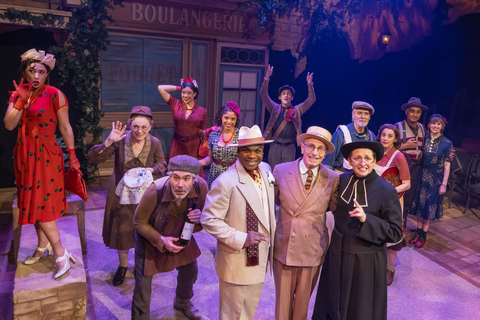
Kevin Del Aguila as Antoine, Nathan Lee Graham as the Marquis, Arnie Burton as the Teacher and Will Roland as the Priest (front row) in a scene from the Classic Stage Company’s production of Stephen Schwartz’s musical of “The Baker’s Wife” at the CSC Theatre (Photo credit: Matthew Murphy and Evan Zimmerman)
And yet the show earns its forgiveness. The final confrontation between Aimable and Geneviève is staged with restraint and emotional precision, its inevitability softened by the dignity both characters retain. Tears arrive not through manipulation but recognition. One leaves the theater grateful for the time spent in this imagined corner of Provence, among characters whose flaws feel less like devices than facts of life.
Greenberg’s greatest achievement is his refusal to inflate or apologize for the material. He treats The Baker’s Wife as what it is: a musical of sensibility rather than momentum, concerned with romance, regret, and the cost of impulsive desire. There is a deliciously vaudevillian, music-hall bustle to “Bread,” the ensemble number that marks the village’s first ecstatic encounter with Aimable’s handiwork. The song clatters and skips with comic precision, its rhythms suggesting both hunger and sudden abundance, and Stephanie Klemons’ dances here leans into that sense of organized chaos, shaping the townspeople’s delight into a playful choreography of anticipation, consumption, and communal relief. Paul’s dynamic rendition of “Proud Lady,” with its Brel-inflected toughness, certainly gets its desired effect. In revealing the show’s emotional coherence, Greenberg demonstrates that The Baker’s Wife was never broken beyond repair—only misunderstood. Here, at last, it feels whole.
The Baker’s Wife (through December 21, 2025)
Classic Stage Company
Lynn F. Angelson Theater, 136 East 13th Street, in Manhattan
For tickets, visit www.classicstage.org
Running time: two hours and 30 minutes including one intermission


Leave a comment