
MANO A MANO
Pinto crafts an operatic monodrama on toxic masculinity, skewering Anglo-Saxon myth with memoir, faux history, Banderas riffs, Romans, boxing, Jersey tales.
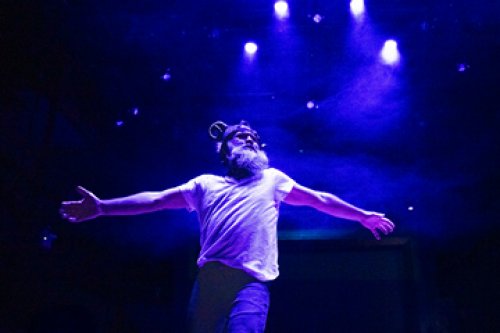
Paul Pinto in a scene from his operatic monodrama “MANO A MANO” at the Ellen Stewart Theatre at La MaMa Experimental Theatre Club (Photo credit: Steven Pisano)
To enter the performance space of Paul Pinto’s MANO A MANO is to find oneself seated not before a proscenium, but around a giant Arthurian round table, a scenic choice that immediately dismantles the distance between the observer and the observed. One is not merely an audience member; one is a guest at a grim, historical banquet where the main course is the fractured psyche of the British Isles. Pinto, a playwright-composer-performer of singular, manic energy, has crafted a libretto that functions as a rhythmic autopsy of masculinity, tracing a lineage of “headless alpha males” from the Trojan War to the contemporary boxing ring.
Director Kristin Marting stages a gladiatorial pageant of Western myth in which every sword stroke is also a punch line and every boast carries the aftertaste of blood. The evening announces itself as a kind of scholarly recital—Prologue, Introduction, Part One—but quickly mutates into something more feral: a one-man epic sung, shrieked, declaimed, and anatomized from this giant Arthurian round table littered with toy soldiers, stuffed animals, stress balls (modeled after the classic COVID balls), decorative skeletons and bric-a-brac.
Pinto inhabits all the roles: kings and goats, dragons and dandified knights, scribes and sacrificial lambs. At the outset, the decapitated head of Edwin of Northumbria—spotlit and mordantly lucid—lectures us on the fiction of “Britain” before there was Britain, less a chronicle of progress and more a tally of “blood upon blood upon blood.” It is a dizzying synthesis of the academic and the irreverent, a bravura curtain-raiser: a historiographic rant that spools from Brutus (the first wanker to canquer) to the Windsors, from patricide to “order (and by order I mean power),” in language that is at once bawdy and academically barbed. The head speaks of lineage as a slaughterhouse conveyor belt; history is a slow sword stroke, passing through neck after neck, until it reaches its own. It is a bold, linguistic assault that challenges the audience to find order in a narrative that Pinto insists is merely “passing through.”
Marting’s direction of this solo tour de force—Pinto inhabits at least eight distinct personas—demands a choreographer’s precision. The transitions are not merely character shifts but ontological leaps, facilitated by a trap door in the table from which a Bard emerges to offer “off-the-cuff and disarming” plot summaries of Sir Gawain and the Green Knight and Beowulf, delivered with frat-house glee and philological precision. The masterly direction balances these moments of meta-theatrical levity against the “physical and emotionally intense” wordless retelling of the play’s apex by an Old Sacrificial Goat. Marting is also co-credited with development of this stunning dramatic work.
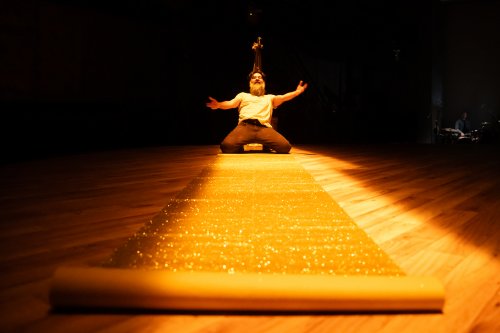
Paul Pinto in a scene from his operatic monodrama opera “MANO A MANO” at the Ellen Stewart Theatre at La MaMa Experimental Theatre Club (Photo credit: Steven Pisano)
The dramaturgy toggles between mock-lecture and mock-epic. Magic girdles become “magic underwear;” heroic swimming contests are litigated like barroom grievances. Pinto’s humor is elastic—anachronisms snap against medievalism, and the language pirouettes from Chaucerian parody to locker-room chant. Yet beneath the lampoonery lies a serious inquiry: What makes a king? What makes a man? And why does the story always require a dragon to blame?
Part One detonates with “Alpha Male (Beowulf’s Song),” a boasting recitation that plays like a TED Talk curated by testosterone. Beowulf struts down a runway dragging a microphone stand and a gold lamé scarf, serenaded by a shadow-chorus of women—“A girl I know / A blonde woman / The queen”—whose identities blur into conquest and projection. Pinto’s vocal writing is virtuosic and abrasive; the music veers from mock-anthem to electronic snarl. When Beowulf exults, “I kill anything that moves,” the line hovers between satire and confession. The goat that drops from the ceiling is absurd, yes, but also sacramental: patriarchy requires offerings.
Gawain’s “Reverie” shifts the temperature. Entangled in a rope, helmeted and unhelmeted by turns, an elderly knight recalls a nameless “dear one” with the halting narcissism of a man who mistakes possession for devotion. Pinto makes exquisite use of repetition—“whatever, I mean (I wasn’t picky)”—to suggest memory as erosion. The knight’s amnesia becomes both comic tic and tragic indictment. If Beowulf cannot stop killing, Gawain cannot stop forgetting.
The she-dragon’s love song, “I Guess I Lasted Longer Than Expected,” is the evening’s moral fulcrum. In a dim cave of sound, Pinto’s voice fractures into keening melisma and monkish patience. The dragon does not pillage; she remembers. Her fire claims “the memories of evils done for praise.” It is a devastating inversion: the monster is the archivist, the men the amnesiacs. One thinks of how often myth requires a feminine receptacle for masculine ruin.
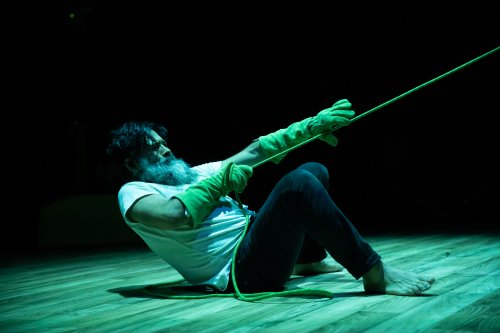
Paul Pinto in a scene from his operatic monodrama “MANO A MANO” at the Ellen Stewart Theatre at La MaMa Experimental Theatre Club (Photo credit: Steven Pisano)
The Scribe’s refrain—“One day I’ll remember & scribe it all down for the record”—becomes the evening’s lament for historiography itself: who writes, who forgets, who gets beheaded, who gets canonized. The playwright’s fascination with Beowulf St. Georgie and Elderly Sir Gawain—the former an “Alpha Male” doused in “Axe Spray,” the latter a “rusted” relic—serves as a poignant critique of the “ancient hate of military men” and is a tour de force of competitive insecurity. They compare swords, lovers, blackouts, and grudges like aging athletes recounting concussions. Pinto’s Scribe attempts to record their barroom banter, but the heroes speak too fast, their legacies already dissolving into the “ink” of a poem that will eventually “never refer to them again.” It is a biting commentary on the futility of seeking “order (and by order I mean power).”
Pinto’s stage picture—a single performer at a round table that becomes a map, a bar, a battlefield and burial ground, and archive—suggests that the audience is complicit in the feasting. We sit among the knights; we are the court that laughs. The piece’s interludes—instrumental meditations, invocations of boxing and death—stretch the form toward ritual. Sound, here, is not accompaniment but argument. It insists that listening, like remembering, is an ethical act. A riveting quartet encircles the audience, unleashing a feral dialogue of saxophone and percussion—an improvisatory tempest that seems less performed than conjured, vibrating through the air with a dangerous, exultant immediacy.
One of the production’s most arresting moments is the “meditation for Pauline Oliveros,” an interlude where the performer repeats the word “hands” with intimate urgency. Here, the designers and director strip away the Arthurian artifice to focus on the raw, human instrument. The voice moves from a whisper to a scream, a sonic representation of the struggle to remember oneself in a world preoccupied with beheading the “other.”
By the time the apex arrives—an extravagantly titled beheading involving Gawain, a she-dragon, and a Saxon “Not-Knight”—the satire has curdled into something nearly tragic. The beheading of the She-Dragon and Gawain by Beowulf is realized through the wordless performance of the Goat, accompanied by supertitles that erupt across the space. This choice by the creative team bypasses the limits of language to reach a primal, “Gwar-like” intensity. It is here that the She-Dragon delivers her heartbreaking insight: she has been “marked for men’s desire / marked for fuck or fire,” a sacrifice to the egos of “intrepid boatmen.” Pinto’s and Marting’s choice to have Pinto don “large horns” and remove his shirt for this sequence emphasizes the transition from man to beast, a metamorphosis central to Pinto’s vision. The Goat is not just an observer but a participant in the “bloodletting,” reminding the audience that no matter who the king is, we are all just “passing through our own cemeteries to graze on ours.”
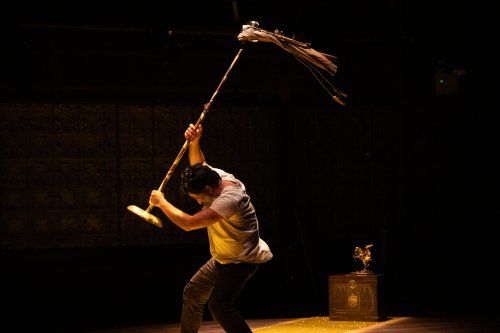
Paul Pinto in a scene from his operatic monodrama “MANO A MANO” at the Ellen Stewart Theatre at La MaMa Experimental Theatre Club (Photo credit: Steven Pisano)
Oscar Escobedo’s prop design in this production leans into the “ridiculous” to highlight the absurdity of the heroic archetype. We see Beowulf dragging a “super long gold lamé scarf” and wraps himself almost sensually around a microphone stand à la Iggy Pop and Elderly Sir Gawain dons an “armored helm, lots of plumage,” which the character himself admits he wears only because he lacks friends. Perhaps the most haunting prop is the corded electric razor that drops from the ceiling, its buzzing a mechanical memento mori that reappears in the final moments of the Coda.
Philip White’s sound design is an immersive, “sample-heavy” environment that bridges the gap between the medieval and the modern. A prerecorded chorus provides a haunting backdrop to Beowulf’s “boasting recitation,” which sounds more like a Red Bull-fueled midlife crisis than an epic poem. The soundscape also includes “boxing bells” and “instrumental meditations,” culminating in a “sonic bath” that allows the audience to sit in the stillness of the “fog.”
Jeanette Oi-Suk Yew’s lighting and projection design is essential in defining the show’s disparate tonal shifts, moving from the “ominous music” and single spotlight on King Edwin’s head to the “dramatic and blinding silhouette” of Sir Gawain. In Part Two, the lights transition into an “intense fiery light” focused on the She-Dragon’s decapitated head, which rolls around center-stage while delivering its final elegy. The use of darkness is equally potent, particularly during the “hands… my hands” meditation, where the screen on the back wall becomes a movie about hands with light shrinking to a pinpoint on the performer’s extremities.
In the final Coda, as a sole figure is illuminated from above, we are left with the elegy of “Beatrice,” another lament in which the feminine once again bears the cost of male transcendence. The buzzing razor returns, dangled like a sword of Damocles over the performer’s head. It is a quiet, devastating conclusion to a play that otherwise roars with the noise of battle. MANO A MANO is a masterful, if exhausting, interrogation of the myths we use to justify our violence, proving that Pinto is one of the few contemporary theater makers capable of turning a history lesson into a “fire-breathing” work of art. Pinto wields his scholarship and slapstick with equal ferocity, exposing the absurdity of the alpha myth while acknowledging its persistent seduction. Say what you want about the boorishness of toxic masculinity, in the hands of Pinto it’s pretty damn sexy.
MANO A MANO (through February 22, 2026)
thingNY
Ellen Stewart Theatre at La MaMa Experimental Theatre Club, 66 East 4th Street, in Manhattan
For tickets, visit www.lamama.org
Running time: 90 minutes without an intermission


Leave a comment