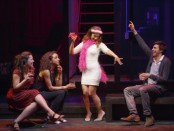
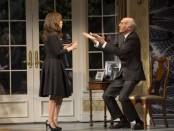
Joshua Harmon, the author of the bitingly engaging "Bad Jews," is back on the boards with "Significant Other," another modern morality tale. Again he displays his incredible ear and eye for the behavior of modern twenty and thirty-somethings. Love, its frustrations and great rewards, is the subject. The pangs of loneliness, self-imposed or otherwise come in for a good going over, too. [more]
His new play "Gloria" goes in another direction, a scathing satire of the media (magazine work, book publishing and television development) as well as the public’s frenzy for the details of high profile news stories. Evan Cabnet who has also piloted new plays by Theresa Rebeck and Christopher Shinn, has cast his crackerjack production with some astute newcomers to local stages (Catherine Combs, Jennifer Kim, and Ryan Spahn) as well as some accomplished New York veterans (Kyle Beltran, Jeanine Serralles, and Micahel Crane) in this always absorbing office drama. The cast is articulate and smooth-tongued as they should be playing people in the media. [more]
Norris is interested in examining issues so often argued in black and white terms by drawing out the—pun intended—shades of grey. However, while wryly entertaining and largely incisive, his new work suffers from some of the same missteps as does his aforementioned "Clybourne Park." Namely, he paints Chris—his ostensibly well-intentioned, under-informed, straight white male character—as so downright nasty that it is almost impossible to listen to any of his arguments, however logical some of them may be. While the action of the play operates under the guise of an engaging debate that includes various different perspectives, the scales are tipped and its presentation of arguments is uneven. [more]
Ms. Winkler’s writing is so simple but exquisite in its execution. In twenty minutes the sad lives of the girls are deftly dramatized with a compelling range of emotion. The direction of John Giampietro is a superb display of the art of stagecraft. The clever fantasy device of the cherry trees is skillfully blended into the narrative with boldness and precision. Lighting, sound and music are all utilized to great effect so that it is all visually quite stunning. [more]
Much of the play is directed using Brecht’s so-called alienation effect in which the audience is constantly reminded that this is all a play, a poor choice for a tragedy that wants to put both awe and fear into the hearts of its listeners. Tony Strages’ set design resembles a circus or vaudeville and much of the performance is played on that level. What is sacrificed is the seriousness of the theological and moral issues. There are continual shifts in tone which simply draw attention to themselves, rather than add to the meaning. [more]
Though "The Pavilion" is a play which addresses time as if it were a simultaneous occasion—past, present, and future all occurring at once—the story takes place in the present, at The Class of 1985’s 20 year reunion. Of particular interest, the story focuses on Peter (Dusty Brown) and Kari (Julie Voshell), high school sweethearts who had a storied romance which withered and deteriorated long before the events of the play. Funny at times and touching at others, Brown and Voshell have created a great on-stage relationship which is buoyed by excellent chemistry, and the different dynamics of the two actors gives way to some moments which are very sweet and others which are heartbreaking. [more]
Rajiv Joseph’s plays are filled with emotional or physical violence as in "Bengal Tiger at the Baghdad Zoo," "Gruesome Playground Injuries" or "Animal out of Paper." His new play, "Guards at the Taj," being given its world premiere by Atlantic Theater Company, has both. Set in India in 1648, this riveting drama which works on many levels has been directed by Amy Morton, best known for her New York performances in Steppenwolf transfers to Broadway ("August: Osage County" and "Who’s Afraid of Virginia Woolf?"), and features Omar Metwally and Arian Moayed who are always commanding. [more]
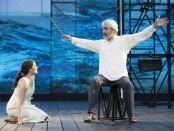
The first thing one notices on entering the Delacorte Theatre is how empty the large stage looks. In Riccardo Hernandez’s scenic design, except for a tiny desk on the right and a small pile of rocks on the left, the playing area is simply a large open expanse that is backed by scaffolding which offers a kind of balcony or catwalk and in front of which are hung curtains or screens. On this is projected dark, churning seascapes in streaming video. As the setting for the play is an island, this is initially attractive but as it continues throughout the play, it becomes both distracting and superfluous. The costumes by Emily Rebholz in black and white are also devoid of color. David Lander’s lighting occasionally turns the stage blue, green or red, but this comes as an intrusion to the rest of the concept of the production. Along with the lack of magic until almost the end of this long play, it appears as if Greif’s interpretation of the play were simply to keep things spare and unadorned. Unfortunately, this tale which calls out for enchantment and sleight of hand is not the play to do this with. [more]
Brown portrays a myriad of characters including her father, siblings, mother, and other family members seamlessly – giving the audience a taste of what the family dynamic was like. She recounts the joyful moments such as her parents meeting and falling in love as well as the sorrowful ones – the children discovering their mother’s drinking problem and then deciding how to share the responsibility when it came to an intervention. There is no doubt that this Irish family has personality – but the realness and strength emerges from the ashes. [more]
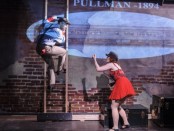
The recent national rallies to raise the minimum wage have made the Federal Theater Project’s 1936 "Injunction Granted" relevant all over again. This play created by the Editorial Board of the Living Newspaper Unit of the FTP depicting the conflict of labor versus capital in the U.S. over almost 300 years turns out to be powerful theater in this revival by Metropolitan Playhouse. The third of the FTP Living Newspapers to be revived by this theater following "One-Third of a Nation" and "Power," Alex Roe’s lively and inventive production uses six actors to play 200 characters in a vaudeville-like atmosphere. [more]
"Office Politics" written by Marcy Lovitch is not only an insightful production, but one that is timely and hits home for today’s society. Under Aimee Todoroff’s direction, Office Politics examines the impact of a racist comment in an office setting and the fight for justice to be served. The story line and overall message extends beyond the hierarchy of a typical corporate setting – where most times, major issues are swept under the rug to avoid excess attention – and shines the spotlight on the effects that ignorance and stereotypes have on an individual and the life she is fighting for every day. [more]
This compelling and moving solo play recounts Yoel's gradual coming out that starts in 1986 when he was ten in Caracas. Comical and dramatic incidents in his childhood, harrowing events during his high school and college years, and his arrival in New York City at the age of twenty-one are vividly presented. [more]
A simple message is at the center of Sheldon Bull’s new play" Mallorca." As timeless as the theme may be, this doesn’t necessarily mean it is self-evident. Surrounding the dysfunctional friendship of four men, in some way every character in this play has left an important aspect of his life unattended. [more]
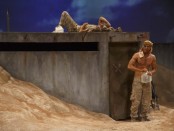
“Don’t step on the sand,” cautions the usher as she hands out programs and directs patrons to the their seats at The Gym at Judson. Indeed, the stage and floor is filled with sand that’s been artfully arranged into a barren vista of mounds and dunes. There is a concrete staircase leading to the roof of a small structure. Above is a rectangular screen where later images of the sky and a forest are projected. There is a concrete block with a pole in it on stage. Unfortunately Raul Abrego’s impressive set is the most outstanding feature of playwright Daniel Talbott’s cryptically titled and exasperating 90-minute War Is Hell fantasia, "Afghanistan, Zimbabwe, America, Kuwait. " [more]
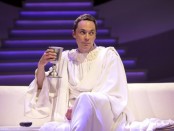
This 90-minute intermission-less play is a comic and occasionally serious address to the audience by God who often sits on a large white couch as he revises The Ten Commandments. Some are kept and some are replaced by new ones during his arch analysis of human history. Angels Gabriel and Michael who also go out into the audience to take questions assist God. [more]
Directed by Anna Bamberger, "Devoted Dreams" is a mind-boggling production. It would seem as if the objective was almost to minimize this production as much as possible, as a challenge to play against the mythical and high-concept subject matter. Despite the short-sighted production values, there are also structural problems in the script which were not concealed in the slightest by the casting decisions and certainly didn’t help the actors. Though it is true in some cases that less is more, in this particular situation the concept might as well be thrown out the window. [more]
Can an obnoxious, sadomasochistic nerd be the central character of a play? This is the thought that will run through your mind as you watch Jesse Eisenberg’s third play, "The Spoils," being given its world premiere by The New Group. As it turns out if you knew Ben, the latest role Eisenberg has written for himself, you would probably run the other way. However, staged by The New Group’s artistic director Scott Elliott,"The Spoils" is absorbing theater and you sit riveted to see if Ben will get what he deserves. [more]
Robert Askins’ hilarious and engrossing new play is set in Texas just like his Hand to God also produced by MCC Theater at the Lucille Lortel Theatre in 2014 and now on Broadway. And just like "Hand to God," this comedy-drama is about needy, unfulfilled people, but this time it is about adults, rather than damaged teenagers. He writes full rounded characters and clever, believable dialogue that reveals the speakers at all times. Here and in "Hand to God," he also deals with fresh subject matter not seen on our stage before. While nothing really shocking happens on stage in Permission, it is most definitely for adults – and prudes should stay home. [more]
For those who saw Fiasco Theater’s inventive and clever version of "Into the Woods" at the Roundabout’s Laura Pels Theatre earlier this year, you know what a delightful take this company has on material that has previously been performed in a traditional manner. If you didn’t see their Into the Woods or their previous production of "Cymbeline," then you are in for an absolutely delightful treat with their latest production, "The Two Gentlemen of Verona," now at the Theater for a New Audience’s Polonsky Shakespeare Center. Performed with a cast of six talented and resourceful actors (five of whom were members of both the "Cymbeline" and "Into the Woods" casts) in a barebones production which hits all its marks, this early Shakespeare comedy is always hilarious, always surprising, always accessible and always romantic. [more]
Mr. LaBute achieved prominence by writing and directing the films "In The Company Of Men" (1997) and "Your Friends and Neighbors" (1998). These scabrous works were followed by the unsettling play "The Shape of Things" in 2001, where a young woman seeks to physically transform her nerdish boyfriend into the perfect man. In succeeding years New York City has seen the premieres of a succession of such idiosyncratic formulaic explorations of the relationships between men and women. Here, this shtick is weak and totally unrewarding. [more]
Set in Boston in 1984, "Nice Girl" is the story of Josephine “Jo” Rosen (Diane Davis), a 37-year-old secretary who lives with her mother. Davis’ Jo is the epitome of a “nice girl.” She keeps to herself, puts others first, and is afraid to say how she really feels in spite of clear emotional stress. Davis is an actress with immense emotional depth, and provides a varied and complex look at a protagonist whose self-inflicted pain, from an outsider’s perspective, is frustrating and also subtle enough that it feels totally conceivable. [more]
The Pearl Theatre Company’s express aim in reviving this curiosity according to translator Jess Burkle, responsible for this world premiere adaptation, is “to connect the experience of the play in the original French to American audiences in 2015.” Burkle’s method is to use “alliteration, idiom, and mixed metaphor” as “the key to getting us all to pay attention to Moliere’s glowing words.” Much of the problem with Hal Brooks’ production is that while all of the characters aside from Don Juan (who is clothed as a rock star) are dressed in 17th century costumes, the text is made up of contemporary language. [more]
Godwin's talent in seamlessly operating the puppets is an impressive sight and the use of old-fashioned materials, such as a slide projector to represent a lab was a nice choice in this age of advanced technology. The classic "mad scientist" imagery is perfect for evoking historic New York. Some choices are definitely not for the squeamish and audiences should prepare themselves for certain sights and sounds that will definitely prompt a reaction. [more]
Founded in 1968, this theater company is, “…committed to the discovery and nurturing of new voices, and the continued support and growth of artists throughout their creative lives.” Ensemble Studio Theatre's 35th Marathon of New One-Act Plays: Series A fulfills this noble goal with its enticing and often quite remarkable variety of works. Series B and Series C will follow and all will run through several dates in June. [more]
In addition to his superior writing achievement, Mr. Roberts also plays the complex old codger, Uncle Jim. He has written a grand vehicle for himself, and his performance is as tremendous as his writing. Blusteringly entering, carrying a garish blow-up sex doll, and resembling a grizzled Duck Dynasty figure with a big scraggly beard, wearing a cap, camouflage gear and orange sneakers, he instantly gets laughs. With a unique, guttural, singsong twang, he delivers numerous zingers, but soon the pathos and depth of this disaffected character is poignantly revealed. [more]
Perhaps the most unique aspect of this devised piece is the venue itself. Boarding the Lehigh Valley Barge off the docks of Red Hook, Brooklyn, is like taking a literal step off the land and a figurative step back in time. During normal business hours, the old barge is a museum dedicated to New York City’s rich maritime history. During the run of this production, however, the rickety, wooden fixture serves as the galley of a ghost ship. At the performance under review, thunder crackled in the distance and the makeshift stage bobbed in the Upper Bay’s stormy waters while the players carry on in costume designer Emily Blumenauer’s grungy, Victorian seafarer wear; if nothing else, "Blood Red Roses' is a chillingly atmospheric evening of theater. [more]
George S. Kaufman’s only solo effort, the 1925 satire, "The Butter and Egg Man" is a colorfully exaggerated snapshot of the nitty-gritty, seat-of-your-pants theater of a prolific decade when two men could do it all: casting, hiring designers, booking theaters and, of course, raising the dough. How things have changed! It’s the money, and the chicanery involved in raising it, that animates the plot of The Butter and Egg Man. The title, in fact, refers to the rich dilettante who can be duped into investing in a clunker, here played by a wide-eyed Ben Schnickel who makes Peter Jones a sweet guy from the sticks who finally finds a backbone and love. [more]
The press performance under review left audiences hanging on her every word, as Orlandersmith painted a picture of the challenging and draining relationship she had with her mother, including the arguments, the name-calling, the shame and her mother’s constant need for security and attention. Well-spoken and tuned into her emotions, Orlandersmith has a true ability to connect with a large room, making them feel every emotion and sensation that she was feeling. She didn’t sugarcoat one detail and her authenticity aided in processing each thought and feeling, and ultimately allowed Orlandersmith to rise above her past. [more]
If the casting of four powerhouse actors hadn’t been the case—including Proval’s "The Soprano"’s co-star Vincent Pastore--this play would not falter. Michael Ricigliano, Jr.’s writing is consistent and engaging, and the dialogue between the characters is so fluid and effortless that it feels like two real people having a conversation. Full of powerful social commentary, this is a dark, exciting, and at times violent story with a little bit of something for everybody. [more]
Director Joe Tantalo’s striking, minimalist production has no scenery and virtually no props. It marvelously relies on purely theatrical imaginative devices. Mr. Tantalo’s accomplished, choreographic staging and the performances achieved yield often intense experiences. [more]
Charlie is an amiable, 31-year-old struggling actor, writer and motivational speaker, who chickens out while calling a woman from a Village Voice personal ad. He soon becomes romantically involved with Carol, a successful lawyer, and later the temperamental Susan, a controlling singer. During these complications, we meet an assortment of colorful best friends, sidekicks, and view a satirically enacted commercial casting session. Most crucial is “Charlie’s Head,” which is the theatrical device of his subconscious being represented by another actor. This alter ego is always present, commenting on the action with the honesty and insight that Charlie is often unable to articulate. [more]
We associate Jacobean revenge tragedy with the reign of King James I. Each play’s atrocities seemed to dare the next playwright with an unspoken “Can you top this?” Playwright John Ford continued the genre under the next king, Charles I, coming up with new and even more lurid variations. Red Bull Theater which specializes in the plays of Shakespeare and his contemporaries is offering a staging of Ford’s rarely revived masterpiece "‘Tis Pity She’s a Whore." While artistic director Jesse Berger has piloted a solid production which is a good introduction to this unfamiliar play, it all seems a bit tame when the script seems to cry out for tremendous excesses. As always, however, with Red Bull productions, the diction in this revival is impeccable and totally intelligible. [more]
A play that has much opportunity to expose the relationship of casting director with actor, not merely across the table but across racial backgrounds and stereotypes begins as it promises. Enter Cobb, a large black man, anxiously awaiting the call of the casting assistant as he proceeds to unapologetically disturb the entire waiting room with his nervous behavior. The thought of playing Othello brings back memories of his youth and a single theater teacher unwilling to allow him to play any role other than that which he might be traditionally cast in for an assignment. As the character’s exposition is beginning to evolve, the casting agent interrupts us. We can tell the actor has an agenda to prove; that now as a grown man in this audition things will be different. [more]
Unlike D’Amour’s last New York play, "Detroit," a Pulitzer Prize finalist which had four characters and a tight arc, "Airline Highway" is diffuse and sprawling with a large cast of 16 actors ably piloted by director Joe Mantello. Set in the shabby, rundown Hummingbird Motel on New Orleans’ Airline Highway, the play introduces us to a colorful but down-and-out cast of characters just eking out a living: Krista, a now homeless stripper in her 30’s; Tanya, a 62-year-old hooker and drug addict; Terry, an African American handyman always in need of money; Francis, a 50ish poet who seemed to have missed his moment, and Sissy Nan Na, a transvestite bartender and karaoke wrangler on Bourbon Street of African American and Puerto Rican descent. The motel is managed by Wayne, in this late 50’s, always good for a soft touch or ready to tell his life story. [more]
As deftly adapted by British playwright Mike Poulton and vigorously directed by Jeremy Herrin, the plays on the stage of the Winter Garden vividly bring to life the British court and its intrigue during the early sixteenth century, from about 1529 - 1536. Poulton wisely leaves out Cromwell’s childhood and youth described in the first novel and begins with him as lawyer to Cardinal Wolsey where the real story begins. However, like the published books, many of the major events take place between the scenes and the characters meet up to discuss the outcome. These are not plays for those who have not read the novels or are not familiar with the historical events or characters as there are too many people and relationships to keep straight if one doesn’t. Nine of the actors play one character each, the rest play between two and four. [more]
Rodriguez, Brown and McNeill all go that extra mile to establish a connection - and make eye contact with every single audience member contained on the three sides of the theater. As they share their stories, the emotion and passion used to bring out the truth in each of these East Village residents is well translated from a period in time to the present day. While the historical elements are fascinating and provide context, the ultimate theme of acceptance, finding a guiding light to outshine the world's cruelty, and celebrating life creates a lasting impact. [more]
The ample set by John McDermott is an intelligent divide between interior and exterior life, the run down streets of Belfast and a humble, wooden and warm rectory. Contemplation goes on in both places, be it perils of war or morals. Famed film director Claudia Weill returning to the New York stage establishes this well. Each character has his or her place and is well defined. Weill has a clear vision of the conflict at hand. Impressive music, explosions and street noise punctuate the scenes artfully with sound design by Daniel Kluger. [more]
Set in South Wales in the 1950’s, "The Unexpected Guest" (first produced in London in 1958) is a mystery surrounding the events that led up to the death of Richard Warwick, patriarch to the Warwick fortune. In the opening minutes of the play, his lifeless corpse is discovered by Michael Starkwedder (Nicholas Viselli), a seemingly random stranger who—upon driving his car into a ditch—stumbled up to the Warwick Estate in search of assistance. Upon discovering the body, Michael is confronted by Laura Warwick (Pamela Sabaugh), now widow to Richard. [more]
Working from Simon Corble and Nobby Dimon’s 1995’s original concept, Patrick Barlow’s adaptation is a witty, tongue-in-cheek, homage that recreates the plot of the film, with comic flourishes. There are also verbal, musical and visual references to other Hitchcock films such as The Man Who Knew Too Much, North By Northwest, The Lady Vanishes, Vertigo, The Birds, Strangers On a Train, and Psycho. There’s an updated nod to Downton Abbey. [more]
The first problem is the attractive modern setting by Walt Spengler of the wedding breakfast of Claudius and Gertrude with a huge cake in the background. The issue is that the table and the cake remain on stage for the entire evening, a terrible distraction. Does this palace have only one public room? The next situation is that Pendleton has chosen to cut both ghost scenes so that the audience is never told that Gertrude had an affair with her brother-in-law or that Claudius poisoned his brother Old Hamlet. The problem that this creates is that young Hamlet has to be played as paranoid as we have no way of knowing what the off-stage ghost told him, nor do we know what is bothering him when he acts so badly to his mother and step-father. [more]
Though operating under the guise of a rather nonsensical comedy, Askins’ play is actually a sophisticated examination of how we handle grief. The text depicts two competing sides of a boy newly without a father and in the throes of puberty: while Jason appears too innocent to ever do anything wrong, the sock on his hand offers a convenient outlet for his bad behavior. Laced in this dichotomy are hints of schizophrenia, allusions to autoerotic stimulation, and a critique of the Christian notion that “unholy” behavior exists outside of the pure self and thus can be forgiven and eliminated. The question literally “at hand” is as follows: is the puppet actually possessed or is Jason mentally ill? If the latter, to what extent should the otherwise sweet boy be held responsible for the evil puppet’s actions? [more]
Like Laura Eason’s "Sex with Strangers" seen at The Second Stage last summer, "The Undeniable Sound of Right Now," her new play having its world premiere in New York in a joint production of Rattlestick Playwrights Theater and Women’s Project Theater, has a pulsating urgency that pulls you into it from the moment the lights come up. Director Kirsten Kelly, another long time Chicago resident along with Eason, has obtained dynamic characterizations from her cast of six including Jeb Brown, Margo Seibert and Daniel Abeles. While the play has a rather abrupt and unsatisfying ending as well as its clunky though accurate title, it brims with the authority of real life rather than theatrical artifice. [more]
"A la Carte: A Feast of New Plays" is a presentation of The Workshop Theater’s leading playwrights that consists of six short plays, all with the theme of food. Most of the works are comic though some are very moving. The styles all vary but the level of writing of each is solid, and contains interesting situations and characters. Cumulatively it’s an entertaining program that gives a wonderful showcase to the excellent cast of actors that have been assembled to portray these often rich roles. [more]
With its ravishing, precise dialogue, very fine structure, and expertly imparted exposition, Skylight, is a model of accomplished playwriting. Mr. Hare is known for his Leftist political beliefs with which he infuses his plays. Here, in early post-Thatcher Britain, he has his characters eloquently debate their clashing world views, along with differing personal takes on their relationship. [more]
Since Bedlam theatre company arrives on the radar in 2013, theatergoers have left their performances as devoted fans. Beginning with acclaimed productions of "Hamlet" and "Saint Joan" in the fall of 2013 and an extended run in the spring of 2014 with casts of only four actors, they returned last fall with a delightfully faithful and inventive stage adaptation of Jane Austen’s "Sense and Sensibility." The same four actors who appeared in Bedlam’s "Hamlet" and "Saint Joan" are back (along with Susannah Millonzi) in two alternate versions of the same Shakespeare comedy, one titled "Twelfth Night" and the other, "What You Will." Minimalist and clever to the nth degree, the "Twelfth Night" performance under review brought the audience to its feet at the end of the two (ingenious and intermission-less) hours. [more]
Director Paul Dobie’s staging gives the show a fast pace and well utilizes the small playing area, which is the upstairs cabaret theater of The Stonewall Inn, the historic gay bar on Christopher Street, where it is performed once a week on Thursday nights. It premiered there in October 2014 and ran through December 2014. It has returned to New York following engagements in Los Angeles and San Francisco. [more]
Shulman is a skilled story teller, creating characters that are real and complex: honorable people that make mistakes, some misguided, some well-intentioned or ruthless. People we all know, maybe even in our own families. Shulman makes the head of each household, two women, the focal point of the play. Noor, which means light in Arabic, is a widowed professor at the university with a 16-year-old daughter, Aisha, and a son, Nimer. She doesn’t wear a headscarf, and spends time alone with her late husband’s friend Salim (Alok Tewari), which is frowned upon in the community. Noor received an order from the Israeli government that her house is going to be taken down in 30 days. [more]
Through a series of five two-character scenes, Atik’s play charts the evolution (or lack thereof) of sex in humanity. While one segment depicts Adam and Eve fumbling through their first discovery of intercourse, another shows a pair of apocalypse survivors struggling to repopulate earth. In between, Atik includes a medieval couple’s epistolary romance, another couple’s post-breakup fling from “last week,” and a third’s inept attempt at exploring fetishes “next week.” Each with their own unique angle, Atik’s five self-contained shorts add up to a heartfelt, whimsical look at the reasons we pursue sex and the means we employ in order to have it. [more]
“Who Are You,” recorded by The Who, starts off "The Book of Moron." It’s a well-crafted 80-minute theater piece of observational stand up comedy written and performed by Robert Dubac. The title is a pun on the musical, The Book of Mormon and is representative of Mr. Dubac’s comic sensibility. Those who find him funny will have a great time at this show, and those who don’t, will have a tough time. [more]
In Doug Wright’s "Posterity" at the Atlantic Theater Company two monumental cultural figures of 19th century Norway lock horns in a battle of wits and sensibilities with tragic results. Wright, who seems to have a penchant for writing about real people (viz. "Quills," "I Am My Own Wife," and "Grey Gardens"), here, takes on Henrik Ibsen, monumental 19th century playwright, and sculptor Gustav Vigeland, forty years his junior. [more]
Bathsheba Doran’s new drama, "The Mystery of Love & Sex," now at Lincoln Center Theater’s Mitzi E. Newhouse, is yet another play whose title is a misnomer. The story is really about friendship and self-identity for a young college-age couple who grew up together in a Southern suburb. Along the way, the play brings in racism, sexism, homophobia and religious mania, as well as the confusions of youth, as the couple try to maintain their close relationship while falling in love with other people. Although director Sam Gold’s cast is made up of veteran actors Diane Lane and Tony Shalhoub and newcomers Mamoudou Athie and Gayle Rankin doing fine work, the play’s first act is entirely exposition and is basically used to set up the situation. This is a play that would do well to lose its intermission as it really doesn’t begin until its second act. [more]
The maternal ending was considered problematical in 1988, but seems less of a copout in 2015. In fact, the feminist thrust of the play has also dulled in the ensuing decades, making Ms. Wasserstein’s play far less effective as an instructive tool. " The Heidi Chronicles" has always been weighed down by too much polemic passed off as drama. What keeps this production afloat now is the incredible filigreed and witty lines that so quickly delineate each character’s foibles and feelings. [more]
Director Anna D. Shapiro, usually associated with heavier dramas from such authors as Kenneth Lonergan, Stephen Adly Guirgis, Tracy Letts, Bruce Norris and John Steinbeck, has surrounded David with an A-List of stage and screen stars (Jayne Houdyshell, Rita Wilson, Rosie Perez, Lewis J. Stadlen, Marylouise Burke, etc.), as well as some rising stars and performers to watch (Molly Ranson, Jonny Orsini, and Jake Cannavale). Part of her assignment is to direct the traffic of the very large cast (18 in all) of the Drexel clan on the four sets and keep out of the way of these pros doing what they do best. At this, Shapiro does a superb job. [more]
Dream sequences, fantasies, and confessional monologues add to the play’s eclectic form. There’s a rapid montage portion with racing NYC denizens including business workers, homeless people, drunks, and cutthroat landlords. The plot turns are often typical for this genre, but there are enough new ones that make it all seem fresh. Playwright Albarrán, who is in his 20’s, also plays the leading part. [more]
Whether or not I am convinced that Hillary Clinton needs to take a lover, and indeed how confident I am in Meek’s sexual aptitude for the task, the presentation was a great success triggering booming laughter thanks to a wit wholly unaccounted for in this age in America, a repartee most welcome to this writer. [more]
The play’s scenes alternate between the scientific research institute and the couple’s apartment. The theatrical device of having one set representing both places is well rendered by scenic designer David Zinn’s realistic and well-appointed set. Matt Frey’s lighting design and Ryan Rumery’s sound design contribute requisite razzle dazzle effects for the transitions from one setting to another. Mr Zinn also designed the purposeful costumes.
[more]
Though totally unknown to Americans, Ferenc Molnár’s "Fashions for Men" is another treasure newly unearthed by the reliable Mint Theater. Davis McCallum’s polished and period-perfect production is not only vastly entertaining and enlightening about the human condition, but it should go a long way to making this play more widely known to the theater-going public. While the play is set in a world that is long gone, its contemporary relevance is based on the fact that it dramatizes the human comedy which will always be in fashion. [more]
Frances Ya-Chu Cowhig’s eye-opening The World of Extreme Happiness reveals the urgent problems in contemporary China in which people from rural communities who move to the cities are second class citizens but where protest is quickly stifled, where the one-child policy causes girl children and women workers to be ignored, and the vast numbers of people in the factory cities have little access to education or money. Eric Ting’s powerful co-production for Manhattan Theatre Club and the Goodman Theatre of Chicago deserves to be seen for turning contemporary social science into the stuff of drama. [more]