
Off-Broadway
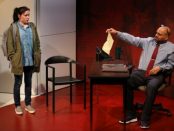
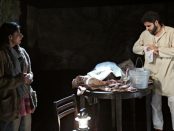
Casting of Brewer (best known for her several roles on "American Horror Story"), an individual with Down syndrome, is a real coup as she doesn’t have to be inventing a role she knows intimately. Her feistiness, timing and personality make Amy a three dimensional character from the time we first meet her. (A program note tells us that her understudy is another individual with Down syndrome, Edward Barbanell and when he plays the part the play is known as "Andy and the Orphans" in a rewritten version.) Another note reveals that Ferrentino’s heroine is based on her Aunt Amy who grew up with Down syndrome when the medical community had no idea how to deal with it except to institutionalize such people rather than to give them training and support. The play is a fitting tribute to Ferrentino’s aunt who the playwright never got to know as much as she would have liked. [more]
Good for Otto
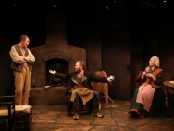
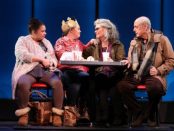
Except for the frustration level of the characters, there does not seem to be a movement towards change or catharsis which may partly explain why the play seems so long. Harris and Madigan retain their cool as therapists throughout until almost the end when they can’t hold in their emotions any more. The most dramatic story is that of 12-year-old Frannie beautifully and realistically played by young Rileigh McDonald. However, as written the role of her foster mother played by Rhea Perlman is a one-note tale and doesn’t give her much wiggle room to make it her own. [more]
Three Wise Guys
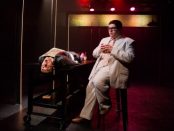
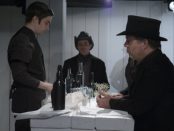
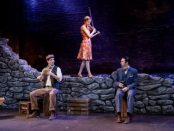
Just in time for Easter, TACT/The Actors Company Theatre has adapted and combined two Christmas-themed Damon Runyon short stories into the seasonally inappropriate, but nonetheless very charming, "Three Wise Guys." Gleefully peppered with Runyon’s distinctive demi-monde argot, or Runyonese, the comedic play depicts a Prohibition-era New York of principled crooks and hustlers who, in true Runyon style, end up having hearts much bigger than their ill-gotten bankrolls, which, of course, doesn’t mean they’re ready to commit to their matrimonially frustrated gal pals. Like another Runyon adaptation about some guys and dolls, the sparsely musical "Three Wise Guys" fancifully speaks to the, perhaps not so unreasonable, belief that those on the make are much more trustworthy than the ones who’ve already made it. [more]
Halcyon Days
One sits there for two hours numbed by the experience of watching the talented cast often vigorously playing for laughs that aren’t there. They are Rand Guerrero, Ralph Guzzo, William Laney, Chris McFarland, Hannah Jane McMurray, Sarah O’Sullivan, Tom Paolino and Gameela Wright. [more]
Subway Story (A Shooting)
"Subway Story (A Shooting" is the fifth and final installment of William Electric Black’s Gunplay Series, a sequence of plays “dedicated to all who have lost their lives to the senseless gun violence plague.” In this concluding chapter, ongoing gun violence, particularly its link to urban youths, is the prevailing theme. Black is a seven-time Emmy award-winning writer. His work often broaches societal-conscious issues. [more]
Kings
Despite some terrific acting, it’s hard to root for any of the four characters in Kings, even if the play is one long competition between all of them. This smart new work by Sarah Burgess ("Dry Powder") fails to introduce little that’s new about the present state of politicians and lobbyists--and their overly intimate relationships. But it’s also been put together with an admirable efficiency that spells it out clearly for those members of the audience who haven’t been paying enough attention to the daily headlines and all they entail. [more]
A Marriage Contract
Originally titled "A Test Case" when the play had its premiere in New York in 1892, it is one of Daly’s many adaptations of European successes, this one based on a German comedy of Blumenthal and Kadelburg. While "A Marriage Contract" is a charming evening and has much satire that is still relevant, its genre is that of drawing room comedy. While stylish and graceful, Alex Roe’s production is much too broad to be entirely successful. Several of the actors give over-the-top characterizations of recognizable types which somewhat unbalances the play. In the manner of the popular form of 19th century popular theater, the play is a bit too long for its content and could use a bit of trimming. Nevertheless, the production is entertaining though many of the surprises are telegraphed long in advance of their revelations on stage. [more]
Breitwisch Farm
Esperance Theater Company’s artistic director Ryan Quinn directed the production. Mr. Quinn’s inventive staging is vigorous and aesthetic yielding in visually charged sequences that energize the uneven writing. Watching the Super Bowl becomes a frenetic production number. [more]
Locked Up Bitches
All the good jokes get lost in the onslaught of cast members vying for their moments and looking for the audience’s approval, which admittedly was offered freely. "Bitches" becomes chaotic, crude and in your face, not to mention clichéd, the clichés hiding behind dirty jokes and blatant shtick. Raine clearly can’t rein in the cast’s enthusiasm even though they are portraying animals with animal passions. [more]
The Amateurs
Jordan Harrison’s "The Amateurs" is certainly an ambitious new play acted to the hilt by its cast of six. However, at times it bites off more than it can handle, at other times its anachronisms tear at the fabric of its story, and finally it goes out of its way to draw connections that the audience has already made. The play may need a stronger director than Oliver Butler has proved to be to pull this unwieldy drama into more satisfactory shape. [more]
The Loneliest Number
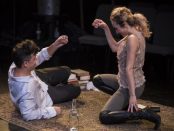
Author Lizzie Vieh’s brilliant play "The Loneliest Number" initially appears to be a slight off-beat comedy about a swinging couple’s encounters but after its first third evolves into a profound, suspenseful and searing exploration of relationships. Ms. Vieh’s dialogue is sharp, filled with well-crafted jokes and painful depth. A wistful description of a children’s Halloween parade with them in their costumes becomes an insightful reverie of desires. [more]
Edward Albee’s At Home at the Zoo: Homelife & The Zoo Story
Lila Neugebauer has directed these two one-acts to bring out their naturalism. In the past, "The Zoo Story" was usually performed with an odd, surreal quality. Neugebauer has given the conversations a flow that reveals this play to be about people, not walking symbols, a lesson Albee had thoroughly absorbed by the time he wrote "Who’s Afraid of Virginia Woolf?" [more]
Time No Line
In the moving and affirmative final sequence, journal entries from 1989 to 1990 are projected as text that details deaths of friends. Kelly is on the floor silently drawing shapes with white and then red chalk that becomes a configuration of human forms. One of the entries shown from that era reveals his HIV positive diagnosis. [more]
Terminus
In the semi-autobiographical "Terminus," part of a seven-play cycle set in the fictional town of Attapulgus, Georgia, playwright Gabriel Jason Dean unleashes this intriguing Southern Gothic setup which touches off a deeply felt personal story about racism in a place that is obviously more real to Dean than imagined. Unfortunately, as it goes along, Dean’s initially captivating ghost story exponentially loses steam, finally grinding to a halt well before Eller’s big, shameful secret is revealed at the play’s not-so-stunning conclusion. [more]
Relevance
But "Reference" is also about issues of gender, race, age, celebrity, politics, economics, and the inescapable impact of the Internet--and more specifically, social media--on the ways business is done today. That may sound like a lot to digest, or maybe even too ambitious by half--but what’s amazing about "Relevance" is how well it manages to fit all of that into a four-character play that speeds by in only 100 minutes. [more]
High Noon
Conceived by the Axis Company, this treatment oddly renames the characters which is just one of its many baffling qualities that perhaps seeks to comment on the present. It’s really "High Noon" in title only. Visually arresting it’s ultimately a showy exercise in mere stagecraft without resonance. [more]
A Walk With Mr. Heifetz
Although an interesting idea, James Inverne’s "A Walk With Mr. Heifetz" has lofty ambitions which it is unable to fulfill. While the advertisement proclaims that these two encounters “changed the world as we know it,” none of that comes through in the play. The thinness of the material and the two-dimensional characters fail to bring the story to life. Much more needs to be known or revealed to flesh out this intriguing but undramatized story. [more]
Katie Goodman’s Broad Comedy
Songs jostle with playlets, usually with topical references. This is a good lineage to be part of and "Broad Comedy," the bumpy new show at the SoHo Playhouse, succeeds mostly due to the ebullient cast which includes Goodman, Danielle Cohn, Molly Kelleher, Tana Sirois and Carlita Victoria, all sassy and at ease with their bodies, which are sometimes covered with costumes that make them into battling genitalia. (Watching a giant penis deflate is one of the best visual jokes of the evening.) [more]
X: Or, Betty Shabazz V. the Nation
Marcus Gardley’s "X: Or, Betty Shabazz V. The Nation" is a powerful indictment of forces within a movement which help to destroy it. Performed by The Acting Company under the direction of Ian Belknap, their artistic director, the play is riveting throughout while it follows its investigation where it may. It also requires a good deal of knowledge of the events of the 1960’s which many contemporary theatergoers may not come equipped to follow it. [more]
Platonov, or A Play with No Name
Director Jessica Burr’s fast-paced yet thoughtful staging includes over-lapping dialogue, rapid entrances and exits all over the space and striking visual flourishes. Ms. Burr’s tremendous grasp of stagecraft markedly benefits the play’s morose and draggier second half which contrasts with the frothier first part. The performances are uniformly delightful. [more]
In the Body of the World
"Body" dovetails Ensler’s personal agonizing battle with cancer and her involvement with a feminist group in the Democratic Republic of Congo where women have faced violence, rape and almost unending disruption of their lives. Ensler’s input was requested by Dr. Denis Mukwege, a Congolese gynecologist whose ministrations to the female victims of the sadism of soldiers and government officials paints a litany of one tragic event after another. [more]
Hangmen
The sense of good, old-fashioned suspense is heightened by director Matthew Dunster, who also helps delineate the spot-on performances by the four remaining cast members--and regulars at Harry’s pub, with distinctive personalities--Billy Carter, Richard Hollis, John Horton, and David Lansbury. And then there’s the ongoing rain and lightning--with marvelous effects by Ian Dickinson for Autograph, for sound, and Joshua Carr, for lighting. Together, they add significantly to the scare factor of the evening. [more]
[Porto]
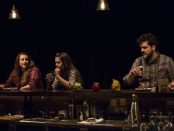
Stop me if you’ve heard this one before: three people walk into a bar where they are known by the drinks they order. Only in Kate Benson’s new play "[Porto]," the unnamed bar is in a gentrified neighborhood in Brooklyn, and is defined as a “boushy bar,” a portmanteau word made up of "bourgeois" and "douchey." We know that because it serves “serious food, serious beer, serious wine, serious spirits.” And what of the story the play tells? Like an episode of "Seinfeld," 'Friends" or "Girls," it will probably please Millennials most, those who are living the life of spending evenings in trendy bars to find companionship. The second play this year following "Miles for Mary" to transfer from Brooklyn’s Bushwick Starr to Manhattan, [Porto] is now at the WP Theater for an Off Broadway run. [more]
Pete Rex
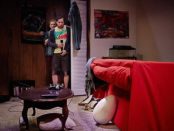
The homeowner Pete is wearing gym shorts and a T-Shirt and is a biology teacher with an Associate’s Degree who wanted to be a paleontologist. Bo is his childhood best friend. Pete has broken up with his long-term girlfriend Julie. She shows up, interrupting their pastime and informs them of the unexplained appearance of dinosaurs who are on the rampage and causing murderous mayhem. This is confirmed by the sound of television news broadcasts à la "Night of the Living Dead." [more]
Harriet’s Return: Based Upon the Legendary Life of Harriet Tubman
Employing an authentic and strong Southern dialect, Ms. Meadows sounds and looks like she really is a person in the 1840’s. This vocal expertise combined with Meadows’ altering of her physiognomy, beaming eyes and her charisma, achieves a performance of tremendous range and depth. She portrays Tubman’s relatives, associates and masters. Each characterization is rendered with precision and variance. Though the piece’s tone is by its nature serious, Meadows finds humor whenever possible. [more]
Miles for Mary
Playwrights Horizons has a real winner with the first entry in its new Redux Series bringing back worthy Off Off Broadway plays for a longer run Off Broadway. First up is "Miles for Mary," a company project from The Mad Ones, a New York City-based troupe dedicated to creating “ensemble-driven highly detailed theatrical experiences that examine and illuminate American nostalgia.” Seen previously at The Bushwick Starr during the 2016-17 season, "Miles for Mary" is a brilliant satire on group dynamics in an ongoing school fund-raising committee told in real time. While hilarity abounds as the committee does its pedantic and minimal work, an inevitable explosion is promised by the end and it is a doozie when it finally occurs. [more]
Against the Hillside
The production is not helped by William Carden’s heavy-handed direction. Scene transitions are punctuated by sound designer and composer Shane Rettig’s blaring, pulsing and overwhelming original electronic music. In near darkness, stage hands wearing black appear to rearrange furniture and set props. This all becomes formulaic and distracting. Carden’s physical staging is rudimentary and the actions flow weakly. Most unnerving is that Mr. Carden has the actors speaking rapidly and being overly emphatic for much of the time and this sets an artificial tone. [more]
Fill Fill Fill Fill Fill Fill Fill
Produced as part of the Flea’s Season of Women, Del Rosso’s freshman effort shows great promise. Under Marina McClure’s insightfully freewheeling direction the members of The Flea’s resident acting troupe, The Bats, takes the play and exuberantly runs with it with their usual unabashed energy and courage to expose themselves—right down to their underwear! [more]
Imperfect Love
We are never told the name of the play being rehearsed or who the characters in the play within the play are. In the second act, the performers dressed in their costumes for Gabriele’s play reveal that it is a Renaissance costume drama but we still learn nothing about it. Nothing much is revealed about Italian theater of the time though the play being rehearsed does not seem to be in the naturalistic mode of drama that was creeping into the legitimate stage in 1899. And why did the author pick that year? No clues are given. [more]
The Cult Play
Mr. Cusumano has crafted a scenario that though familiar is gripping. The timeless craving for lost souls seeking a purpose in life by handing over their existence to charlatans is freshly explored here. The dialogue is well-observed, sharp and occasionally very funny. The play is peopled by a collection of characters who are all identifiable and have finely drawn back stories. [more]
He Brought Her Heart Back in a Box
Whereas Kennedy became famous with plays that use myth, history, surrealism and Theater of the Absurd to tell their stories, this play tells a realistic tale in poetic form, its very brevity belying its depth of feeling. The play incorporates the styles of romantic drama, Elizabethan tragedy, old-fashioned operetta, a murder mystery, and recent history of the not so distant past. Events in the play were suggested by Kennedy’s mother and her own visits to her grandparents in the Jim Crow South. [more]
Fire and Air
Though the production has been designed by its director, John Doyle, there is no scenery to speak of, except for a gold framed mirror on the rear wall, another framed mirror angled and dangling above it, and five gold chairs. It all suggests the opulence for which Diaghilev and his Ballets Russes were known. Opulent, too, are the costumes designed by Ann Hould-Ward with everyone clad in black except for Nijinsky who is in colorful and playful ballet costumes. [more]
Hindle Wakes
Stanley Houghton’s once controversial "Hindle Wakes" explodes everything you have ever been taught about the double standard and the place of women in society. The irrefutable logic of the characters in this play can only leave you with one conclusion. Gus Kaikkonen’s superb production for the Mint Theater Company restores this forgotten play to its rightful place in British drama. Had the playwright not died prematurely the year after "Hindle Wakes"’ premiere, the play would most likely have not fallen into an almost 100 year eclipse. Ironically, the Me-Too movement reminds us that the philosophy that “boys will be boys” is both immoral and indefensible. [more]
Draw the Circle
... in Deen’s mad dash to portray Shireern’s elderly Indian father and mother--who live in Connectictut--her girlfriend, Molly, and so many other figures, including even a housecleaner at a Motel 8, where Shireen attempted suicide--he seems to have a different voice and demeanor for every one of them. He even--on his knees and with a little girl’s voice--plays Shireen’s five-year-old niece, Rabia. [more]
Cardinal
Greg Pierce, the author of "Slowgirl" and "Kid Champion," has often tackled hot button issues. Here in Cardinal being given its world premiere at Second Stage Theater, he takes on urban renewal, Chinese entrepreneurs, racism and amateurs in politics, all worthy of investigation, in comic fashion. However, in this satire his plot seems to reinvent itself in every other scene, with twists and turns you can’t see coming. The three sets of characters (Lydia and Jeff, Nancy and Nat Prenchel, owners of the Bread & Button Bakery, and Chinese businessman Li-Wei Chen and his son Jason) seem totally separate until he brings them together in a rather improbable finale. He also loads the deck with such plot complications as Lydia and Jeff beginning an affair (as she looks so much like her sister who he dated in high school and hasn’t gotten over.) [more]
Party Face
The best reason to see Isobel Mahon’s "Party Face" is to see the ever-lovely Hayley Mills who used to play mischievous teens and now is playing busy-body mothers. The play is diverting though it has nothing new to say about women and their contemporary roles. Under Amanda Bearse’s direction, the play also gives Klea Blackhurst another off-beat comic role in which she shines. [more]
Delta in the Sky with Diamonds or Maybe Not
Classic movies such as "It’s a Wonderful Life," "Miracle on 34th Street" and "Moonstruck" are citied in the play and author June Daniel White is clearly inspired by and seeks to emulate them in this fable. Those films resonate due to their appealing characters and well-crafted scenarios. "Delta in the Sky with Diamonds or Maybe Not"’s rambling plot is too ambitious as a stage play. [more]
The Thing with Feathers
Though there’s a major surprise lurking at the top of the second act, and though it’s about how sins of the past can impinge on the present, Scott Organ’s "The Thing with Feathers" is ultimately a play without many virtues. Early references to Emily Dickinson and poetry--the title apparently comes from a bastardization of a Dickinson poem--fail to lift the work out of the made-for-TV movie-of-the-week sensibility that keeps bringing it down. [more]
WinterWorks 2018: “Look Me in the Eyes”
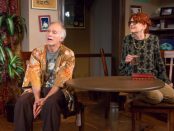
“I never met a peanut butter junkie” is one of the many sharp zingers in Fran Handman’s romantic park bench meetup, "A New York Encounter" (directed by Elowyn Castle) between an older man and woman. It’s in the well-trod, zany territory of Murray Schisgal, Elaine May and Herb Gardner, and it’s well-trod again here. The red-haired and vivacious Marie Wallace and the quirky James Nugent are priceless. [more]
Balls
Playwrights Kevin Armento and Bryony Lavery take the well-known facts that have been explored in documentaries and in the feature film "Battle of the Sexes" and shovel on a cascade of imagined sub plots, heavy-handed theatrical techniques and sociological trimmings. The opening voice-over prologue is a wry pseudo-scientific lecture about men and woman. This narrator sounds like Jane Lynch at her most sarcastic and it’s supposed to be funny but falls flat. The strident tone of the show is set. [more]
Jericho
The problem with Laura Braza’s production is the lack of chemistry between Vasile Flutur’s Jericho and Hannah Sloat’s Julie. While Jericho should be charming and seductive, Flutur is only sinister and arrogant. Sloat is convincing at the innocent young girl routine but less so as the self-sacrificing woman in love where she comes off as rather bland. Just as McDonald walked off with the honors as Julie’s friend Carrie in the last Broadway revival of "Carousel," Ginna M. Doyle is most believable as the friend here called Mary (Marie in Molnár’s version.) Vivacious and sparkling, Doyle lights up the stage every time she appears as a woman in love with an ambitious but conventional doorman who climbs the ladder of success. So too Jack Sochet as Jericho’s criminal friend, here called Tynk, devious to his last breath and as wily as a coyote, appears to be living inside of his character. [more]
A Kind Shot
And that’s essentially the problem with "A Kind Shot." Clocking in at 75 minutes, the “performance” feels more like a motivational speech than a theatrical event. It’s well-meaning and well-told, but other than the charismatic Mateer, there isn’t much else to it. The set, a masking tape outline of a shrunken basketball key, accomplishes so little visually that it begs the question, “Why bother at all?” Mateer completes the obvious motif with a flower-emblazoned basketball, which she dribbles around a bit and bangs off the wall as if she’s making shots. I’m all for audience imagination, but, come on, just hang up a basketball hoop. [more]
Diary of a Madman
Soviet born actor Ilia Volok is quite personable and definitely commands the stage; his performance is heroic but it is so intense and his accent is often intrusive. Comical and sensitive portions are overshadowed by the perpetual ranting. It’s 70 minutes of an actor’s bravura performance as he plays a character mentally unravelling and the plot gets sidetracked. There’s a lot of histrionics that don’t pay off. [more]
Pillowtalk
Kyoung H. Park's "Pillowtalk" mixes the mysteries of passionate, but flawed, love with the realities of racism in today’s society, specifically, Brooklyn, New York, where Sam (Basit Shittu), a hunky African American and former Olympic swimmer is married to Buck (JP Moraga), a sleek Asian American journalist. Both are in a constant battle with the White-dominated society which constantly undermines the lives of people of color. Park’s direction of his play is straightforward and “in your face” giving this rarely seen corner of society some needed exposure. [more]
Sheila
Murky, glacial and hypnotic, "Sheila" is a dreamy reunion drama among two 28-year-old women who haven’t seen each other in 10 years. It recalls the sort of off-beat female-centric play director Robert Altman might have staged in the 1980’s and then filmed. The script is collaboratively written by members of The Associates, the theater company who is presenting it. It comes across as a collaboration with a feminist slant rather than an organic play. Still, its 70 minutes have an enigmatic appeal. [more]
Until the Flood
Ms. Orlandersmith skillfully organizes the material into short monologues that are revelatory, insightful and often tinged with humor. Visually striking with her animated facial features and flowing dreadlocks, Orlandersmith subtly yet forcefully offers a series of rich characterizations. Varying her vocal inflections and altering her physiognomy she conveys the essence of each individual. It’s a riveting performance of range and depth. [more]
Disco Pigs
John Haidar’s energized production turns this material into a tour de force for Campbell and Lynch who are continually moving about spewing volumes of words, almost choreographed by movement director Naomi Said. Deeply in character, they seem to be living their adventures which include humor, fantasy and violence. However, American audiences will have difficulty with the thick Cork accents and Irish slang, as well as Pig and Runt’s private language which often resembles baby talk when it doesn’t sound like street poetry. [more]
The Undertaking
Dull, smug and interminable," The Undertaking" is a multimedia play written by Steve Cosson that explores the meaning of death. Jean Cocteau, Marcel Duchamp and Greek mythology are trotted out during this 80-minute hodgepodge. Mr. Cosson is also the director and his physical staging ranges from sedate to overdrive, with the actors incited to be manic. The ending, however, does have an affirmative simplicity. [more]
2018 LaBute New Theater Festival
With the support of film director, screenwriter and playwright Neil LaBute, the St. Louis Actors’ Studio has held an annual festival of one-act plays since 2013. This is the third year that the festival has been presented at 59E59 Theaters in New York City, and it’s a very enjoyable program. [more]
Mankind
Playwright Robert O’Hara’s fertile premise might have made for a provocative, sober sci-fi take on gender roles, sexuality and parenthood. Instead, it’s broadly conceived and lame. The flat dialogue is in the vein of Abbott and Costello with numerous jokes about “fathers” since there are no mothers. The “Dude, I’m pregnant” bit gets painfully recycled. [more]
Unexploded Ordnances (UXO)
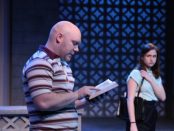
Shaw employs the gruff cadences of George C. Scott and Weaver has the calm and measured tone of Peter Sellers and both are thoroughly delightful. Their tremendous rapport is most evident in the phone scene from the film between the U.S. president and the Soviet leader: “How do you think I feel?” [more]
BrouHaHa
Washington, D.C.’s acclaimed Happenstance Theater is making is New York debut with its 2015 show "BrouHaHa," which has been seen previously in Baltimore, Maine and New Haven. Taking for its theme what would you do if the world were about to end, this “clownesque escapade collaboratively devised and performed by the ensemble” follows the company of six through a series of skits and journeys almost all of which lead to death but from which the actors bounce back. While the company members are extremely talented, the material lacks impact and structure and cries out for both a playwright and a director. Although intended to be comic, there are no laughs in this show though it may provoke smiles. [more]
Twelfth Night, or What You Will (Fiasco Theater)
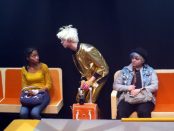
While not as memorable as several previous Fiasco Theater productions, this "Twelfth Night" takes a while to get where it is going. After winding up the plot in the first half, it settles down to sparkling comedy in its second. A bare-bones production, it focuses attention on the language and the music rather than the usually rich trappings. It is an easy production to follow without being distracted by extraneous interpretations or ideas. [more]
A Regular Little Houdini
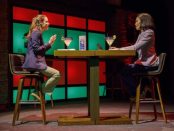
Daniel LLewelyn-Williams in “A Regular Little Houdini” (Photo credit: Sheri Bankes) In 1905, [more]
It’s a Wonderful Life: The 1946 Live Radio Play
As adapted for the stage by Anthony E. Palermo, it’s roughly half the length of the film. But it still tells the same story about George Bailey, who on Christmas Eve in 1946 intends to take his life, only to be saved by an angel named Clarence. While saying there’s “a Tom Sawyer quality to you, George,” Clarence still turns George around by showing him what “a different world” it is without him, as if he had never been born. And it seems to be amazingly complete--even while the focus of the presentation is on the live radio version, including a banner that says, W.I.R.T. (duh, for Irish Repertory Theatre) and several different “words from our sponsors,” such as “Lucky Strike” (“clears your lungs”) and “Carter’s Liver Pills.” [more]
Describe the Night
The themes of Rajiv Joseph’s latest political play are not only valid but relevant in today’s climate. However, "Describe the Night" is too convoluted for its own good and attempts to make connections where none actually exist. While the cast led by Danny Burstein and Zach Grenier give solid performances, they never seem to develop in any way even though the play covers 90 years. Such momentous events as the Stalinist Purges and the fall of the Berlin Wall are treated almost in passing without their real significance being explored. Ambitious and epic in scope, Describe the Night becomes tiresome rather than enlightening. [more]
Downtown Race Riot
Anton Chekhov once advised that if you show an audience a gun you are required to have it go off. Set on September 8, 1976, Seth Zvi Rosenfeld’s new play, "Downtown Race Riot," being given it world premiere by The New Group, never takes us to this forgotten event which happened in Washington Square Park but depicts the forces and people involved in the 100 minutes before the riot is to happen. This overheated melodrama which goes on a bit long takes on many important themes (racial hatred, drug addiction, petty crime, sexual identity, financial insecurity, etc.) without making any pertinent point about any of them. While the dialogue and the milieu are gritty, Downtown Race Riot recycles a great many stereotypes and clichés. [more]
Shadowlands
William Nicholson’s "Shadowlands" is one of those subtle plays that grows on you as it evolves and weaves its own spell. Based on a true story of one the most improbable love stories of the 20th century, it covers a range of human emotions that should catch you in its web. Under Christa Scott-Reed’s assured and astute direction, Daniel Gerroll gives a memorable performance as theologian and writer C.S. Lewis. A play of ideas on the meaning and varieties of faith, it is challenging as one has to follow its intellectual and spiritual arguments. However, for discriminating theatergoers, this is an added fillip for more than simple entertainment. [more]
Hold These Truths
With expressive and limber physicality, animated facial features, piercing eyes, and a smoothly resonant voice, Mr. de la Fuente vividly depicts Mr. Hirabayashi from youth to old age. Magnifying his towering performance, de la Fuente also plays a gallery of characters that include Hirabayashi’s parents, his friends, and American military personal as well as other incidental characters. His uniformly sharp characterizations are accomplished with ease, precision and depth. He is totally commanding during the play’s 90 minutes. [more]
Indians
In the central character of Buffalo Bill Cody, Michael Hardart plays only the one role. The play seems to be his coming to terms with the mythologizing of his achievements. Although twice he is given the line about fearing death in his makeup, there is no sense that he gains any self-awareness in the course of the play. As a result, he does not become a tragic hero with a fatal flaw. His bland, tame performance fails to hold the play and its many scenes together. [more]