
News Ticker
- December 16, 2025 in Broadway // Marjorie Prime
- December 14, 2025 in Broadway // Oedipus
- December 14, 2025 in Interviews // Conversation with Dominick LaRuffa Jr.
- December 14, 2025 in Off-Broadway // The Surgeon and Her Daughters
- December 14, 2025 in Features // A Seasonal Salon Worth Noting
- December 13, 2025 in Off-Broadway // BUM BUM (or, this farce has Autism)
- December 12, 2025 in Musicals // The Faggots and Their Friends Between Revolutions
- December 12, 2025 in Cabaret // Mary Foster Conklin — Mirrors Revisited (50th Anniversary)
- December 11, 2025 in Cabaret // Kathy Kaefer — Kiss Me Once: Stories from the Homefront
- December 11, 2025 in Off-Broadway // The American Soldier
- December 9, 2025 in Off-Broadway // This World of Tomorrow
- December 9, 2025 in Cabaret // A Noel Coward Celebration — Steve Ross & Friends
- December 7, 2025 in Off-Broadway // Diversion
- December 5, 2025 in Off-Broadway // Meet the Cartozians
- December 5, 2025 in Features // Tom Stoppard: An Appreciation
Archive
As part of its Fall 2019 Musicals in Mufti Cole Porter Series, The York Theatre Company has smartly revived this 1965 Ben Bagley - Cole Porter revue not seen in New York in 54 years. Pamela Hunt’s delightfully sophisticated production uses four talented performers at the height of their powers: Danny Gardner, Lauren Molina, Diane Phelan and Tony Award nominee Lee Roy Reams, with the estimable Eric Svejcar at the piano. Hunt has tweaked the show a bit eliminating five of the songs which have inappropriate lyrics for modern sensibility and handed Reams the role of speaking Bagley’s droll narration rather than dividing it up between the original five performers. Although the Muftis are performed concert style with book in hand, these performers appear to be letter perfect and hardly look at their sheet music.
[more]
Rocky execution aside, the play is not without humor, imagination, charm and whimsy, and the same can be said about the designs by Jessie Bonaventure (scenic), Johanna Pan (costumes), Kelley Shih (lighting), and Brian Heveron-Smith, (sound), all of which work well together to allow this tale to be told. The play’s wonderfully emotional climax which has Elle, Rebecca and Ethel casting off the shackles of their lives into the winds of an oncoming storm is absolutely jubilant and makes the entire evening worthwhile.
[more]
This is the latest edition of creator, writer and director Gerard Alessandrini’s enduring musical spoof skewering present and past NYC theater that he inaugurated- in 1982 and has had over 20 incarnations. Mr. Alessandrini’s erudite, affectionate and acerbic script once again lambasts Broadway while lovingly celebrating its history during its 20 numbers. “Theater isn’t art, unless it hurts.” It’s that aching sense of the collectively treasured memorable greatness of Broadway clashing with its mercenary concerns that enables each version of the show to resonate while entertaining. Plus, it’s very funny and offers a showcase for talented malleable performers.
[more]
The play captures emotions that many of us have felt, from unrequited love, to loss. Seldom are we allowed access to such a raw story and candidness. In a time where we shield each other from truths, this stark and unapologetic performance allows us to feel what Victor meant to Edgar.
[more]
Monica Bill Barnes totally changed the mood with her thoroughly delightful “The Running Show” which used physical contests as a metaphor for dance. Barnes stood in the midst of sixteen students from Hunter College as her creative partner, Robbie Saenz de Viteri acted as a sports announcer, egging the large group on as they performed complicated patterns of finger snapping. Saenz de Viteri was the backbone of “The Running Show,” his narration, in turn witty, humorous and deeply thoughtful, drove the action which included more competitions; Barnes trying to beat her turning record; and an appearance of a young ballet dancer, Charlotte Anub. She was clearly too young to dance on point, but she had a natural stage presence as she turned and performed basic pointe work, charming the audience. “The Running Show” left a positive buzz in the audience, casting a quiet spell.
[more]
As a writer, O’Dell seems to eschew melodramatic elements, including pat endings with fully resolved conflicts. This a work grounded in sober reality, a work that rejects the prevalent idea that “closure” is something that will surely erase all scars and “make whole” once more those who’ve lived through such traumatic incidents. If there’s any “message” that O’Dell offers, it’s that keeping silent about having been raped can only exacerbate the pain. At the same time, she suggests, women who’ve experienced such assaults need to be able to come out about them in their own time.
[more]
The problem with Vaynberg’s play, now being given its Off Broadway premiere, in which she plays the lead female role, is that it has so many interlocking plots that it can give you a headache trying to keep them straight. And as all of the actors play two and five roles it is difficult to always know who is who. While director Geordie Broadwater keeps the pace zipping along, this often makes it more of a strain to follow the convoluted plotting. Plus the extensive quoting from Tennyson’s Arthurian narrative poem, Idylls of the King (not identified until late in the play) doesn’t help a bit.
[more]
The final work, “Unveiling” by Sonya Tayeh, director of Tayeh Dance, known now as the choreographer of the Broadway hit 'Moulin Rouge!," used a trio which appeared to be about a female (the American Ballet Theatre star, Stella Abrera) an interloper interfering with a gay relationship between Robbie Fairchild (formerly of the New York City Ballet and the star of An American in Paris on Broadway and the West End in London) and Gabe Stone Shayer. What made “Unveiling” the hit that it proved to be was the music performed live by the super-humanly talented Moses Sumney who stood on a small platform singing, wailing, thumping, rattling and otherwise issuing a spectrum of gorgeous sounds that supported Tayeh’s complicated portrait.
[more]
A mulatto slave is sodomized with a large black dildo while in a canopy bed by his master’s wife who is decked out in Madonna-style dominatrix regalia. A white indentured servant fellates the boot of his black overseer after they’ve performed a balletic dance in their underwear. A snarling whip- wielding white overseer is abusive to a female black slave as she cleans his shack while twerking to Rihanna’s “Work.” Welcome to playwright Jeremy O. Harris’ overblown and overrated racial, social and sexual satire, "Slave Play." Striving for hilarity, it’s painfully unfunny. The wan shock value is more in the spirit of Mel Brooks than Jean Genet.
[more]
Numb from two straight-through hours of far-right speechifying emoted in perpetual semi-darkness, the audience at "Heroes of the Fourth Turning" then endures a ghastly aria of despair by a Lyme Disease-debilitated character. We also soon learn a deafening recurring sound that was thought to be innocuous, may have supernatural ramifications as the play ends on an unjustified cryptic note. The shooting and implied mutilation of a deer during the awkward prologue was an omen that this was going to be a lulu of a bad play. It’s symptomatic of the uneasy symbolism threaded throughout.
[more]
What is evident is that Zeller writes tremendous roles for actors. Frank Langella won the Tony Award back in 2016 for the title role of "The Father," and "The Height of the Storm" may well win others. The current production includes all but one of the British cast from Jonathan Kent’s London presentation and two-time Tony Award winner Jonathan Pryce and three-time Olivier Award winner Eileen Atkins give the kind of performances that legends are made of. As André, Pryce is like a lion in winter: confused, detached, incoherent at times, yet raging due to his loss of power, and completely bereft when his wife is not in the room. His anger is always palpable and makes him seem bigger than his actual stature.
[more]
"The Wrong Man" is a new musical by multi-platinum songwriter Ross Golan with "Hamilton"’s director Thomas Kail. Like "Hamilton," it began as a concept album and grew into a stage performance. Unlike Hamilton‘s epic sweep of history, this subject is contemporary and has a narrower focus, following the fortunes of one man, Duran, who is down on his luck in Reno, Nevada. The intimate setting of The Robert W. Wilson MCC Theater Space’s Newman Mills Theater is a good place to show off the production.
[more]
It is Ginger Grace as Amanda that is the crowning glory of this production. Though slender and frail looking, she is still a powerful, if bothersome figure, memories of a golden southern belle past clashing with her poverty-stricken present. Grace lives Amanda on the tiny Wild Project stage, making it seem large and teeming with life, although nothing really happens in "The Glass Menagerie," nothing that is except the dissolution of a family.
[more]
Despite the fine writing and acting, these two plays do not stand alone: we are given no backstory to understand the context for these relationships in the longer saga; both plays dealing with a character’s depression, they are too similar in the theme of being haunted by the past; and thirdly, as they are basically two-character plays, both are too long for the limited story and plot lines they contain. Unlike the first two plays, these use two different directors (Loretta Greco for "runboyrun," and Awoye Timpo for "In Old Age"), ironically making them seem quite similar in style.
[more]
The Mariinsky Ballet performed the U.S. premiere of “At the Wrong Time,” which had been choreographed by Alexander Sergeev and had its world premiere March 26, 2019 in St. Petersburg, Russia, at the Mariinsky Theatre. The curtain rose to display a piano. A young man, Vladimir Rumyanstev, turned out to be the pianist who was waiting for a ballerina. Once she arrived, the music could begin. Eventually there were three ballerinas and three partners. The women wore pointe shoes and brightly colored dresses that were cleverly designed by Daria Pavlenko to appear simple but that allowed easy movement. Their partners wore dark shirts and pants.
[more]
A downer by its nature, "Nothing Gold Can Stay" is playwright Chad Beckim’s heartbreaking 95-minute family drama depicting the ravages of rampant opioid addiction in the present day United States. It’s a bleak and accomplished take on the eternal subject of substance abuse. Mr. Beckim’s topical scenario is enforced by his skillful writing, the searing performances and the crisp production.
[more]
When the Gingold Theatrical Group’s revival of Bernard Shaw’s epic "Caesar and Cleopatra" begins, the characters are wearing white contemporary clothes and sitting on what looks like an excavation site which might give one pause. Like David Staller’s revival of "Heartbreak House" last year, his Caesar and Cleopatra tries to give this 1898 play a more contemporary relevance, but unlike Heartbreak House which pointlessly updated that play to W.W. II rather than the usual W.W. I setting, this modern approach works extremely well and proves to be quite charming.
[more]
Antoine de Saint-Exupéry’s "The Little Prince" (1943) has been studied, analyzed, and staged as any number of plays, ballets, musicals and an unsuccessful film. So, it was with great interest that I went to BalletX’s The Little Prince choreographed by fast-rising choreographer Anabelle Lopez Ochoa to a brilliant score composed and miraculously played by Peter Salem. BalletX, directed by the forward looking Christine Cox, is a modern ballet troupe stationed 90 minutes south of New York in Philadelphia. The troupe combines classical ballet with modern dance and, in the case of the Little Prince, mime, singing, speaking and twisty modern dance.
[more]

Still delightful, mainly due to Porter’s score, the book by Herbert Fields (who went on to write six more Porter shows) has its charms with its snappy Jazz Age dialogue which makes fun of the ugly Americans in Paris, loaded with money but making one faux pas after another while mangling the French language. The version being used by the York Theatre production is that of the 1991 Tommy Krasker/Evans Haile adaptation for the Cole Porter Centennial first performed at the French Institute/Alliance Française which reduces the cast from 100 to a manageable eleven. It also reallocates some of the songs and includes some of the songs cut both on the road and after the opening.
[more]
These four characters are, unfortunately, not interesting enough to fill a 90-minute musical, especially one that covers territory better served by other shows like "A Chorus Line," "Fame" and "Merrily We Roll Along," all superior to the earnest, but predictable "Green Room." Even the crisis that drives the play—will Anna wear a revealing costume in Cliff’s play?—is laughable nowadays when nudity is common. Cliff’s play is backed by his—and Anna’s—Dad with the proviso that all four pass their courses. They all depend upon each other to study, but leave everything to the last minute. Even when it’s likely that they will pass, Anna’s refusal to wear a skimpy costume, one it turns out that even a high school participant in the Jimmy Awards would find modest, is a red herring that is soon resolved.
[more]
It’s 1948 and we’re in an Italian prison where “The Beast of Rome,” German SS Colonel Herbert Kappler (1907-1978) is serving a life sentence for war crimes. Kappler was the Chief of Police of occupied Rome and was responsible for the deportation of Jews to concentration camps as well as ordering massacres of civilians. He is visited by his nemesis Monsignor Hugh O'Flaherty (1898-1963). “The Scarlet Pimpernel of the Vatican” was the nickname of this Irish prelate who as a Italian resistance figure saved the lives of over 6000 Allied soldiers and Jews during W.W. II. In real life, O'Flaherty did visit Kappler out of a quest of instigating redemption in the Nazi, and a complex friendship evolved.
[more]
"Ludwig and Bertie," written by Douglas Lackey, gives us insight into the relationship of two of our greatest twentieth century philosophers, the younger Jewish Ludwig Wittgenstein and the 20-year-older atheist Bertrand Russell. Bertie, played smartly by Stan Buturla, is the wise old professor at Cambridge when he meets the almost half his age young student Ludwig, poignant, headstrong and hungry for more knowledge, insight and truth, played passionately by Connor Bond.
[more]
Legendary director Peter Brook has always investigated the big questions. In recent years his productions have become more intimate and the questions bigger. In "Why?", written and directed by Brook and his collaborator of four decades, Marie-Hélène Estienne, the performance takes place on a nearly empty stage and uses only three actors to tell its story. While the performance is mesmerizing, the play seems unfocused, beginning with the question why do we do theater and ending with the political dangers to theater artists who create experimental theater.
[more]
The latest offering by JoAnne Akalaitis, "Bad News! i was there…" is something of a misnomer, since none of us was there for the “bad news” of the ancient Greeks, which is what Akalaitis focuses on. If the text is cobbled together with passages taken from Sophocles, Euripides, and Aeschylus, it can prove pretty tedious and at a far remove. But then, Akalaitis is more known for her spectacles than for her texts.
[more]
Though off-putting, "Sunday"’s periodic non sequitur choreographic interludes become a respite from its bad writing and grating performances. For no discernable reason, characters stop speaking and engage in herky-jerky movements accompanied by crashing music and frenetic lighting. “A sort of frenzied dance. Think "They Shoot Horses Don’t They?" But perhaps slightly less macabre,” is the stage direction's description. The action then resumes. These tangents fill things out as the show is scant on plot.
[more]
Katsura Sunshine is the stage name of this charismatic 49-year-old Toronto-born performer who relocated to Japan and apprenticed to a Rakugo artiste. Mr. Sunshine eventually became a notable practitioner in his own right and has the distinction of being a Westerner. Sunshine is affable, animated and possessed of a pleasing fast-paced vocal delivery that demonstrates comic timing and dramatic heft with a Canadian lilt. This vocal expressiveness combined with his shock of jagged blonde hair, striking facial features that he contorts into a gallery of expressions enables him to command the stage. Wearing a kimono, kneeling at a small table and handling the hallowed props of a fan and a hand cloth, he evokes the genre’s essence with assured authenticity.
[more]
Imported from London and directed with finesse by Jamie Lloyd, Tom Hiddleston (Robert), Zawe Ashton (Emma), and Charlie Cox (Jerry), all making their Broadway debuts, are practically choreographed as they move about on an otherwise spare if elegant stage that features two simple chairs, a small table and little else. (The startling scenery and apt costumes have been designed by Soutra Gilmour.) That, too, is an appropriate metaphor for three characters that keep shifting their positions.
[more]
The first act of Anna Moench's "Mothers" concludes with a genuine shock as the playwright startlingly upends all of our expectations. Visually punctuated by Wilson Chin's suddenly not-so-stable set, this audacious turn suggests Moench's intermittently funny satire of upper middle-class motherhood at a "Gymboree-style playroom" has only been a prelude to something much more challenging and profound. Unfortunately, what you soon begin to suspect is that Moench just ran out of narrative steam and started writing something else.
[more]
Cusi Cram’s "Novenas for a Lost Hospital" (with dramaturgy by Guy Lancaster) presented by Rattlestick Playwrights Theater is an unusual site-specific theatrical event that pays tribute to the now defunct St. Vincent’s Hospital which for 161 years was situated three blocks from the theater’s location. Directed by Daniella Topol, the play is both uneven and scattershot in its non-linear format and content. However, it conveys a great deal of information in an entertaining manner and has some affecting scenes of life in the hospital in two eras: the 1849 cholera epidemic when it was founded in the mid-19th century and the AIDS crisis in the final years of its tenure in the late 20th century.
[more]
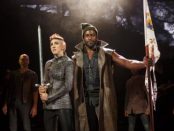
Co-presented by The Theater at the 14th Street Y, '…it’s time…" explored the dynamics of a small group of five—excellent—performers whose existence appeared to be controlled by a large digital countdown clock that frowned down upon them from the back wall. They were all dressed in tight outfits in shades of yellow, uniforms designed by Mondo Morales.To a stark, ingenious percussive score by Dani Markham, co-arranged and played brilliantly by drummer Price McGuffey situated high above the stage in his own cubbyhole, the dancers meandered onto a stage occupied only by five red folding chairs in a neat row. The score ranged from clicks to drum rolls to bossa nova rhythms.
[more]
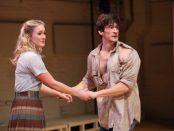
Quite simply, Rubberband, the Montreal-based dance troupe’s season at The Joyce Theater was a spectacular success. Directed by Victor Quijada, Rubberband performed his "Ever So Slightly," a 75-minute investigation of contemporary angst staged to original music by Jasper Gahunia and William Lamoureux, played live. "Ever So Slightly" came at the audience in waves, starting with calm, gentle waves and ending in a tsunami of roughness and near anarchy.
[more]
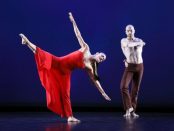
Halfway through the abstract hijinks there are fleeting references to terrorists, getting in trouble for bringing a little knife on an airplane and vague political debates as the tone grows more serious. Devotees of Mr. Wellman’s idiosyncratic style may be enchanted while anyone else could be baffled. Brevity, playfulness and presentational polish are its virtues.
[more]
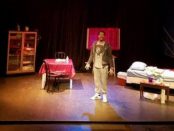
Both Moran and his script are disarming, captivating, touching, and thought-provoking. The audience cranes to hear his every truth-packed word, feeling his moments of joy and triumph as well as those of disappointment, resignation and, yes, even anger.
[more]

«
1
…
42
43
44
45
46
…
114
»
Copyright Jack Quinn, 2001-2023