
Archive
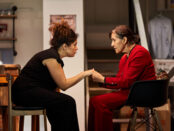
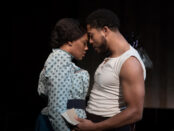
Dominique Morisseau’s "Confederates," her second play of her Signature Theatre Residency 5, is a clever, but overly talky dissertation on race, power and family. She offers the audience parallel stories alternating between the Civil War era and modern day academia. The contemporary plot involves Sandra (Michelle Wilson, solid), a Black political science professor who is the victim of a racist insult. A period photograph of a slave wet nurse, white infant attached to her breast, was altered to superimpose her head on the slave’s. Finding the culprit spurs Sandra to think about the precariousness of being a Black woman in academia. [more]

The Patsy
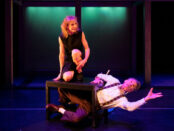
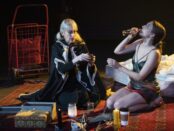
Greenspan, a six-time Obie Award winner, whirls at breakneck speed through this three-act play in just over an hour, transforming from one character to the next with expert fluidity. He transitions between the highly dramatic and entitled Grace, the histrionic and prideful Mrs. Harrington, the simple but lovable Mr. Harrington, the gentle and sweet Patricia, and the gangly, dopey gentleman callers Tom Anderson and Billy Caldwell, drawing on every gender-bending limb, muscle, hand, voice, look or facial gesture he can muster. Even the brusque Tip Busty and party girl Sadie Buchanan get their own unique treatment. [more]
Take Me Out
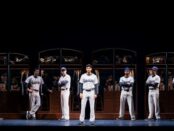
As the most respected player in baseball, Williams has a quiet dignity and charm as a man of few words and few outward motions. While his wry remarks do not often come through as humor, he is very endearing as a man who has always had everything go his way but for the first time in his life must deal with events he cannot control. Ferguson in the role of Mason Marzac which won creator Denis O’Hare a Tony Award for Best Featured Actor in a Play in 2003 makes the role his own. His social awkwardness as well as his delight at being close to the superstar is patently palpable. He also has a handle on the volubility and articulateness of this clearly deep thinking man. As the narrator Kippy who is also a member of the team, Adams holds our interest as a compassionate man who uses big words and is known as an intellectual among his teammates. He has the task of doing a great deal of explaining both to his teammates and us and he does an excellent job without making it seem like exposition. [more]
Queens Girl in the World
Whether frenetically dancing, rhapsodizing over Nancy Drew, fretting about when she’ll wear a bra or reacting horrified upon learning about sex, Ms. Curry performs with the verve of Lily Tomlin in her prime. Curry’s rich portrayal of Jaqueline Marie Butler captures the wonderment of childhood amidst harsh realities and the physical and emotional upheavals of adolescence. A matter-of-fact confession that Jaqueline has been molested is a chilling highlight. With her wide-eyes, expressive facial features, limber physicality and vocal prowess, Curry often rapidly achieves distinctive characterizations of the dozen other figures in the play. The wizardry of Mika Eubanks’ costume, hair and makeup design all visually enhance Curry’s performance. [more]
Penelope, Or How the Odyssey Was Really Written
The musical gets a great deal of mileage out of its humor particular in its parody of recognizable tropes. "Penelope, Or How The Odyssey Was Really Written" is an entertaining musical comedy which turns into a feminist statement in the final scenes between husband and wife at the end of the show which gives this ancient Greek tale a modern sensibility. From the way the audience greeted the new musical comedy "Penelope" at the preview performance under review, The York Theatre Company may have a big hit on their hands. [more]
On the Town with Chip Deffaa: “Rent” at the Frank Sinatra School of the Arts: An Appreciation
This production was an ensemble success—which is what Jonathan Larson was hoping to achieve—so I’d like to mention every member of the company. Not just the leads, whom I very much enjoyed (Logan Spaleta, Brendan Dugan, Lily Resto-Solano as an appealingly amiable “Mimi Marquez,” Justin Nicot as the insouciant “Angel Dumont Schunard,” Monica Malas making the most of the role of “Maureen Johnson,” Tsehai Marson as her frustrated girlfriend “Joanne Jefferson,” Luke Studley Roberts as “Tom Collins” (who falls for “Angel”), and Matthew Macneal as landlord “Benjamin Coffin III”), but every member of the ensemble: Olivia Summer, Nicholas Martell, Miekayla Pierre, Ben Gluck, Sophia Longmuir, Gabriel Paredes, Isaac Wilson, Isabella Soleil Smith, Daniel Stowe, Jaiden Torres, Monica Malas, Ellistair Perry, Zune Misrra-Stone. [more]
Irving Berlin and Me (And a Brush with Death Along the Way)
In the past 20 years, I’ve produced a total of 34 different albums; 16 of them have dealt with Irving Berlin (1888-1989). The newest album in this ongoing Berlin series, "Chip Deffaa’s Irving Berlin: Love Songs and Such"--featuring such gifted artists as Betty Buckley, Karen Mason, Steve Ross, Anita Gillette, Jon Peterson, Natalie Douglas, Jeff Harnar, Sarah Rice, Bobby Belfry, Keith Anderson, Molly Ryan, and Seth Sikes--was the hardest of all the albums to produce. And, for reasons I’ll address in a bit, it took by far the longest time to produce; life is not always easy. But for me, this is the most satisfying album of the bunch. (And as I type these words, I’m happy to note it’s just been nominated for a MAC Award, which is extra gratifying!) I know I’ve made a worthwhile contribution to Berlin’s recorded legacy. [more]
Take Shape
An astronaut in a space station, a YouTube cooking show, evicted apartment residents and a romance on the rocks are a few of the dramatic and antic incidents depicted in "Take Shape," an entertaining full-length program of mime. It’s presented by the Broken Box Mime Theater (BKBX), which was founded in 2011, and whose mission is “to activate the imagination of our audiences, to contemporize the art of mime, and to remind us all of the simple power of storytelling.” "Take Shape" is a collaboration by the company’s members, many of whom appear in rotation at various performances. This creative troupe is comprised of Nick Abeel, Becky Baumwoll, Ismael Castillo, Julia Cavagna, Géraldine Dulex, Blake Habermann, David Jenkins, Marissa Molnar, Kristin McCarthy Parker, Tasha Milkman, Regan Sims, Jae Woo and Josh Wynter. [more]
Gong Lum’s Legacy
On one level, "Gong Lum’s Legacy" is revealing in that it demonstrates Southern racism against not only African Americans but also Chinese immigrants who were given the same treatment. On another hand, the script which moves rather slowly with its 18 scenes over a period of two years would be more effective if it was less like a screenplay and more stageworthy. The play would also be more powerful if the historic Gong Lum made appearances in the play to tell his own story rather than reporting it as radio news. Playwright Charles L. White has a fine ear for dialogue but is weak in dramaturgy. [more]
7 Minutes
Given one hour to decide and vote, the union committee must come to a decision in real time. On one level the play is very much like Reginald Rose’s "12 Angry Men" in which a group of disparate people must also make a life or death decision. However, unlike that play, the characters in "7 Minutes" are not clearly delineated so that we do not know where many of them stand or who they are. While the production directed by Mei Ann Teo is absorbing for most of its running time placing us in the room where it happens, her staging having the actors move about a great deal makes it difficult to keep most of the 11 women separate from each other. Unlike "12 Angry Men," "7 Minutes" does not offer a great many arguments for and against to warrant its running time, mainly getting into personalities. [more]
The Chinese Lady
Presentational flourishes abound in director Ralph B. Peña’s gorgeous physical staging which combines small-scale spectacle with humanity. Scenic designer Junghyun Georgia Lee provides a large gold frame through which we observe Afong’s act and an assortment of stylized pieces which evokes the past through clever artifice. That’s complemented by the shimmering artistry of lighting designers Jiyoun Chang and Elizabeth Mak and projection designer Shawn Duan. Sound designer and composer Fabian Obispo’s original music and composition, ranges from delightfully jaunty to purposefully moody. [more]
Help
Poet and Yale professor Rankine’s play makes use of a narrator/interviewer as her stand-in played by April Matthis. According to program notes by Rankine herself, “The text spoken by white people in the piece was primarily culled from responses to the Times article, public statements by men and women in the government and public life; and interviews conducted with white men by civil rights activists and theologian Ruby Sales; or documentary filmmaker Whitney Dow, or myself.” It also includes updates to the original script from “the January 6 insurrection and the global pandemic.” However, as the quotes are out of context they occasionally refer to entirely different issues as in former President Donald Trump’s saying “Such a nasty woman,” that was addressed to then candidate Hillary Clinton during one of the 2016 presidential debates. [more]
Heartland
While Gabriel Jason Dean’s "Heartland" is an enlightening play about Afghan culture mentioning the classic poet Rumi and the contemporary novelist Atiq Rahimi, some of it will still be opaque to American audiences. On the other hand, it also reveals how American involvement in other countries may have the opposite effect of that which is intended. The fine production, however, makes this a compelling though subtle story of an extended family in its understated way. The play was first produced as part of the National Play Network Rolling World Premiere with four simultaneous productions including the one at The Geva Theatre Center in Rochester, New York. [more]
Alex Edelman: Just for Us
Despite the familiar visual trappings--mic stand, performer-blinding stage lights, and a dull curtain backdrop--Edelman's deceptively free-flowing talents hew more towards the monologist Spalding Gray than those of Williams. Like Gray, Edelman is an entrancing storyteller capable of stitching together personal anecdotes into a rich thematic tapestry. In Just for Us his canvas includes mental pictures of growing up Orthodox Jewish in a Boston where white privilege is starkly stratified; his brother's 2018 Winter Olympics participation as a member of the Israeli team in possibly the least athletic competition; witnessing the actions of a predictably conceited Jared Kushner at synagogue; and the touching time his family celebrated Christmas in order to console a bereaved non-Jewish friend. [more]
The Medium
Who knew that Marshall McLuhan was such a nut? "The Medium," a dance-theater work conceived and directed by Anne Bogart puts McLuhan through her particular way of combining dance and words and the outcome was silly and brilliant at the same time. First performed in 1993, "The Medium" was revived at the Brooklyn Academy of Music's BAM Fisher where five members of the experimental SITI Company were put through their manic paces attempting to explicate the McLuhan’s “medium is the message” philosophy in a series of pointed, surreal skits. Bogart updated the media references to include all the electronic/internet variations. [more]
what you are now
As a play about neuroscience, Sam Chanse’s "what you are now" needs a great deal more data and information. As a play about the plight of Cambodian refugees, what are you now needs to be clearer and less convoluted, although ultimately it is quite powerful and moving. Informative about the startling situation of these refugees, the play needs to be seen and heard, but in this form it defeats its own purposes by being confusing in chronology and not offering the drama behind the science of trauma and memory. [more]
Anyone Can Whistle
Although when MasterVoices chose the third of the four Stephen Sondheim/Arthur Laurents collaborations, "Anyone Can Whistle," as part of their 80th season at Carnegie Hall, they had no way of knowing that it would prove to be a memorial to the late Mr. Sondheim rather than a tribute. This rarely revived show, now considered a “cult classic,” a euphemism for a quick flop in 1964 running only nine performances, was ahead of its time, attempting a new form, one that Sondheim has called “the first absurdist musical.” Performed by stars Vanessa Williams, Santino Fontana, Elizabeth Stanley, Douglas Sills, Eddie Cooper, Michael Mulheren, and Joanna Gleason as the narrator, it was beautifully sung under the direction of maestro Ted Sperling, but can’t hide the fact that Laurents’ libretto is extremely scattershot taking on far too many targets for one show. Subtitled “A Musical Fable” in its first publication, the musical is really a cartoon satirizing everything imaginable. The theme is one of individualism versus conformity, a big trope for shows and movies in the turbulent 1960’s, now symbolized by the more famous "King of Hearts" (1966), "Your Own Thing" (1968), "HAIR" (1968) and "Easy Rider" (1969). [more]
Garbageman
Unfortunately, Huff the author of the psychological puzzler "A Steady Rain" in which Daniel Craig and Hugh Jackman starred in on Broadway in 2009, and who has written episodes of the television shows "Mad Men," "House of Cards," "American Crime," here exhibits a lack of dramatic construction. After a slack 35 minutes of wayward exposition there is finally some semblance of an actual plot. The lumpy first act lasts an hour and 20 minutes; the tauter second act runs 45 minutes. Together "Garbageman"’s two acts are a semi-satisfying experience. This is its world premiere so perhaps future incarnations will be more refined. Thankfully, its cast has stamina and delivers terrific performances. [more]
Coal Country
Songwriter Steve Earle, a three-time Grammy Award winner, returns providing homey, twangy music and acting as an understanding host/narrator. With charm that belies the depth of Coal Country’s horror, he pulls the audience into the sad story, sometimes musically underlining the confessions of those involved, most particularly the tale of the sole survivor of the disaster, Tommy, played with passion and an undertone of survivor’s guilt by Michael Laurence. [more]
Tiananmen Requiem
The play itself is suitably dramatic and thought-provoking; as a piece of theater it should continue to be presented to enlighten future audiences. This particular production isn’t quite up to the task of delivering the play to maximum impact. [more]
Bruise & Thorn
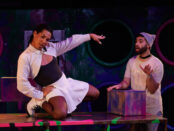
C. Julian Jiménez’s "Bruise & Thorn" is not for everyone. Older theatergoers may be put off by both the raw language and street slang that they will not know. However, if you want to know what the younger playwrights and audience members are thinking you cannot afford to miss this over-the-top Queer Ball event. Pipeline Theatre Company’s production has to be seen to be believed. [more]
Man Cave
Page 73’s world premiere of John J. Caswell, Jr.’s "Man Cave" is an exciting, riveting supernatural horror story. While at times it seems overwrought and overstuffed with too many issues, Taylor Reynolds’ production works beautifully holding our attention until the final moment. Its satisfying ending seems totally in keeping with the events that precede it and its ensemble of four is completely believable as they attempt to deal with seemingly overwhelming contemporary issues. [more]
Little Girl Blue
Nina Simone’s vocal talents, physical presence and spirit are all dazzlingly channeled by Laiona Michelle in her engaging self-written biographical concert-style musical, "Little Girl Blue." Ms. Michelle employs just enough of Simone’s cadences, facial expressions and physical gestures to create an authentic characterization while supremely singing over a dozen songs associated with the charismatic vocalist. The show’s well-researched spoken word portions deliver historical facts, life details and cultural commentary in the manner of Simone. [more]
Hart Island
Whether or not Tracy Weller’s "Hart Island" directly harkens back to Masters, it certainly has similarities, most particularly in its poetically rendered revelations of the underbelly of life and death. Weller turns Hart Island, impeccably rendered in Christopher & Justin Swader’s set occupying most of the Gym at Judson, into a dark metaphor revealing more than any statistics or headlines could ever do about existence during the Covid pandemic. Hart Island is where the bodies of indigent and anonymous people wind up, usually buried by prisoner work details from nearby Riker’s Island. Of course, during the last two years Hart Island’s necropolis has burgeoned both in reality and in Weller’s imagination as fertile in this time as Masters’ was in his. [more]
This Space Between Us
The world premiere of Peter Gil-Sheridan’s "This Space Between Us" gives itself away in its title: it is about a dysfunctional family that does nothing but argue when they get together. Jonathan Silverstein’s production for Keen Company bills itself as a comedy but unfortunately there are few if any laughs. While the author has an ear for realistic dialogue, he demonstrates little talent for plot, with the play as linear and predictable as could be. The only wrinkle in this timeworn theme is that the protagonist’s father is Cuban-born while his mother is American, and his Aunt Pat is a nun. One gets the feeling (possibly misplaced) that there is a semi-autobiographical element and the author is too close to his material. [more]
On Sugarland
Aleshea Harris’ third New York stage play following her form-bending "Is God Is" and "What to Send Up When It Goes Down" is epic in all senses of the word: it includes poetry, dance, incantation, comedy and drama. The new play "On Sugarland," an anti-war drama, also harks back to the Greeks, borrowing characters from Sophocles’ "Philoctetes" and Euripides’ "The Trojan Women," as well as the concept of the Chorus. It tells three interwoven stories as well as one communal one and ends with a shocking finale that is the hallmark of Greek tragedy. Director Whitney White’s production with its cast of 14 is quite versatile and lives up to its lofty task. [more]
A Touch of the Poet
Director Ciarán O'Reilly confidently lets the clever cast explore their characters' profound complexities, which means forcing the audience to simply accept a few psychological contradictions. At its best, watching the play feels like eavesdropping on a real family whose lives are unfolding before us naturally. Dramatically, it's a little messy but also much more human. Where the play falters somewhat is at the very beginning, with a long, exposition-laden exchange between a gossipy bartender (James Russell) and Con's old war buddy (Andy Murray) that is less a scene than an information-delivery system. Fortunately, the put-upon Russell and Murray enjoy later opportunities to put their estimable skills to better use. [more]
Jane Anger
Puns, witty repartee, double entendres, verbal wordplay out of Abbott and Costello, sight gags and slapstick all abound in playwright Talene Monahon's zany, edgy and accomplished historical comedy, "JANE ANGER or The Lamentable Comedie of JANE ANGER, that Cunning Woman, and also of Willy Shakefpeare and his Peasant Companion, Francis, Yes and Also of Anne Hathaway (also a Woman) Who Tried Very Hard." During a breezy 90 minutes, four offbeat characters cavort in a room; laughter is plentiful. [more]
Artists at the Center: Tiler Peck
By far, the audience favorite was the world premiere “Time Spell,” an entertaining attempt at a hybrid of tap dancing (choreographed by Michelle Dorrance and Jillian Meyers) and ballet (choreographed by Peck) with the assistance of Byron Tittle. The musicians Aaron Marcellus and Penelope Wendtlandt provided witty a cappella close harmony vocal accompaniment, even occasionally joining in the dancing. The alternating of tap dancing and ballet began slowly with the two dance forms not combining easily, but as the speed picked up so did the similarities until the ballet dancers were tapping in their toe shoes and the tappers were bourrée-ing in their tap shoes. The large cast included Dorrance, Meyers, Peck, Lovette and Mejia. [more]
Out of Time
Conceived and directed by Les Waters, his staging of Out of Time is of purposeful simplicity. The actors are seated, standing or in motion fulfilling the intentions of each author. The stage is set with scenic designer dots’ atmospheric assemblage of gauzy curtains and minimal furnishings which abstractly suggest different locales and tones. Reza Behjat’s clinical lighting design and Fabian Obispo’s modulated sound design successfully accentuate and realize each of the diverse works. Black, white and red are the colors of Mariko Ohigashi’s smart costume design. "Out of Time" is a fine opportunity to experience some stimulating new dramatic writing and uniformly superior acting. [more]

Goodbye, Mr. Chips
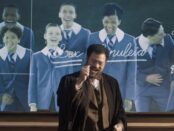
The production is a combination of film and theater techniques which keep reminding us that we are watching a dramatization: realistic sets (designed by Jacquelyn Scott) give way to scenes in which we are on a stage. Sets also revolve for no specific reason except possibly to show the passage of time. As seen up-close on camera, they all look too clean and tidy which suggest theater sets. The 20 members of the Young People’s Chorus of New York City, augmented by an additional 20 voices (all conducted by Francisco J. Núñez), are only seen in video that appears on Chips’ blackboard or behind the windows of various rooms. We never get a sense of Chips’ running a class or his interaction with a roomful of boys. [more]

The Unamerican
So rages legendary Right Wing Hollywood gossip columnist Hedda Hopper in playwright Claude Solnik’s well-observed historical fantasia about the 1950’s anti-Communist Blacklist, "The Unamerican." Besides a comically accurate Hopper, Mr. Solnick offers rich portraits of Marilyn Monroe, Arthur Miller and Elia Kazan. The romance of Miller and Monroe and the clash between those male friends and colleagues over their disagreements of how to deal with testifying before the House Un-American Activities Committee (HUAC) are perceptively rendered by Solnick’s erudite research and keen writing. A highlight is the background of "The Crucible," with Monroe reciting a speech from it. When "The Unamerican" focuses on the interplay between its four main characters it soars. [more]
English
You may have never thought about it before but you are defined by your language. Your identity is shaped by the words you have and the words you don’t. You can say certain things in one language but not in another. Being bilingual you have one identity, two, or have a split personality. Learning a new language may be like finding a new identity as an adult after you have learned to live with the old one for a long time. These ideas are all beautifully handled in Sanaz Toossi’s lovely, poignant new play, "English," under the astute direction of Knud Adams, now being given its world premiere in a co-production between Atlantic Theater Company and Roundabout Theatre Company at the Linda Gross Theater. We grow to care about the characters as we watch them struggle with learning English as though their lives depended on it. [more]
Space Dogs
Heyman and the rest of the production team quickly turn "Space Dogs" into an exercise of quantity over quality. More lights. More noise. More projections. More props. It's theater as sensory overload, with success measured by distraction. The major problem is that it also leads to a lot of other annoyances, with Nathan Leigh's sound design doing nothing for the intelligibility of Hughes and Blaemire's lyrics, Mary Ellen Stebbins' concert lighting occasionally blinding the audience in MCC's small off-Broadway space, and Stefania Bulbarella's numerous projections just stoking the meaningless hurly-burly. [more]

sandblasted
A woman’s arm falls off soon into playwright Charly Evon Simpson’s engrossing allegory, "sandblasted." Ms. Simpson’s tone beautifully mixes the comic with the wistful, her dialogue is glorious, and her characters are appealing. Structured as 18 punchy short time-shifting scenes, with duologues, trialogues and monologues, the play builds to a stirring conclusion. Simpson quotes Audre Lorde, Toni Morrison and Samuel Beckett in stage notes, their aesthetic influence is evident. The setting is a sandy landscape, the time is “now. after. future.” [more]
First Down
A plea for understanding the pain of being Muslin-American, Sevan’s First Down at the 59E59 Theaters focuses on the plight of an adored football player who decides to kneel and pray during the national anthem rather than stand at polite attention, hand over heart. Quarterback George Berri (a handsome, well-built, sensitive Peter Romano) is a mid-westerner with pale skin and a name that doesn’t necessarily connote his Muslim upbringing. After the Star-Spangled Banner is played, Berri, a young Lebanese/American, is first seen. He is on his knees praying in the locker room well after the game is over. Soon Coach Bill Fitzgerald (Larry Bull, finding every nuance in what could have been a clichéd macho role) enters and the structure of First Down begins to manifest itself: three conversations of increasing emotional power beginning with Coach Bill, then Berri’s agent and finally his impassioned mother. [more]
The Daughter-in-Law
The Mint Theater Company which gave the first New York production of "The Widowing of Mrs. Holroyd," Lawrence’s best play and one of the great British tragedies of modern drama, has revived "The Daughter-in-Law" which it first staged in 2003 in an excellent new production again directed by Martin Platt. While the authentic and thick Midlands dialect (developed with specialist Amy Stoller) may be a problem for some theatergoers, not only does it get easier as the play develops but the local slang is easy enough to figure out. Unlike the other two plays in the trilogy, the engrossing Daughter-in-Law is not usually considered autobiographical (Lawrence had not married Baroness Frieda von Richthofen Weekley at the time he wrote it), but it was written at the time of his very autobiographical Sons and Lovers which has similar themes: mothers and sons, and wives and husbands. [more]

The Music Man
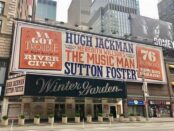
Because of changing social mores, some Broadway musicals are assumed to make audiences uncomfortable today. Take for example Rodgers and Hammerstein’s "Carousel" whose protagonist is a wife-beater. The recent revival did everything in its power to mitigate this problem but did not succeed. Now we have the long awaited revival of Meredith Willson’s "The Music Man" starring film megastar Hugh Jackman as Professor Harold Hill and two-time Tony Award-winner Sutton Foster as Marian Paroo, the librarian and music teacher. The problem the director and producers had with this classic piece of Americana, set in 1912, is that the hero Professor Hill is a con-artist and a serial seducer with whom we are supposed to be sympathetic. However, in 2022 this is an obstacle in an era when lovable rogues are not acceptable as heroes. As a solution, Jackman has been directed by Jerry Zaks to play Harold Hill as low-key and muted as he possibly can. What this does is straitjackets Jackman’s personal charm and charisma which he normally has in spades. The result is an undercooked Music Man even though it has been given a big, expensive production – six Tony Award winners on stage and six in the production team - maybe the starriest cast in New York right now. [more]
A Few Thoughts on Those Needless Changes to “The Music Man”
I want to be clear. "The Music Man" is such a masterfully written musical that making some changes here and there can’t really ruin it; but changes are not needed in this show and they certainly don’t help. I believe in the old saying: “If it ain’t broke, don’t fix it!” I also believe, as Tommy Tune once told me years ago in discussing a different show, many producers and directors feel a need to tinker with shows, making changes for the sake of making changes, even when the wiser choice would be to simply leave things alone. There’s just that desire to “improve” things, whether or not the changes actually improve anything. [more]
The Same
Lisa and The Other Lisa are the two characters in acclaimed Irish playwright Enda Walsh’s haunting short play, "The Same." The conceit that The Other Lisa is Lisa 10 years ago is soon discerned. That’s achieved through Mr. Walsh’s alluring dialogue and stirring reveries which combine the poetic, the mundane and the cryptic. By the end of 47 entrancing minutes, one has experienced Lisa’s life in Ireland with its high points and disappointments. [more]
Black No More
"Black No More," the new musical inspired by George S. Schuyler’s 1931 Afrofuturist novel, is the most exciting and inventive new show to be seen so far this season in New York though it is still in need of work. With a book by Academy Award-winning screenwriter John Ridley (12 Years a Slave), the stage version drops Schuyler’s scathing satire of Harlem Renaissance and Depression figures as well as its political election hijinks for a more direct story about race and racism in the United States. As brilliantly staged by Scott Elliott for The New Group, Black No More is also a play of ideas and will keep you thinking and debating long after the final curtain in this story of the sacrifices people have to make to change the world. [more]
Made by God
It's just that, as the fictional Eva supplants the non-fictional Ann onstage, the play reverses course and sacrifices its human scale back to the rhetorical, with pro-life Eva and pro-choice Michael's gentle discord eventually turning toward the upcoming 2018 Irish referendum to repeal the Eighth Amendment. Actually, the far more spirited debate is being held in Eva's own head as her religious upbringing wrestles with a sense of culpability for a recent tragedy that has cast doubt on her previously rock-solid convictions. Unfortunately, the much too-on-the-nose parallels between Ann's fate and what is tormenting Eva's conscience amount to a bundle of contrivances that touch off a cascade of underwhelming revelations not nearly as thought-provoking as the play's beginning scenes involving Ann and Mikey. [more]
The Merchant of Venice (Theater for a New Audience)
Arin Arbus, resident director at Theatre for a New Audience, staging her tenth classic for them took a great risk with her new production of Shakespeare’s The Merchant of Venice: not only putting this 1597 play in modern dress, she has made Venice diversely multicultural as well as having the Jewish Shylock played by an African American. All of these things might have backfired and looked out of place. Surprisingly it all works, due to her spare, stripped-down direction, her fine cast, the nearly bare stone setting by Riccardo Hernandez which suggests an elegant Greek amphitheater, and her star, John Douglas Thompson with whom she has worked four times before in an assortment of classics. Along with the work of voice director Andrew Wade, the diction is crystal clear and Shakespeare’s verse sounds conversational and newly minted. [more]
Why Robert De Niro’s New Film Studio Matters
De Niro’s goal is to lure more film and television production from Hollywood to New York, and that can only be a plus for New York-based actors. A brand new studio, created for the needs of the industry today, with state-of-the-art digital-production capability, will make New York more competitive in the world of film and television. De Niro hopes that this new studio, along with the nearby Kaufman Astoria Studios and Silvercup Studios (which are also based in Queens), will mean more work for actors, writers, directors, and all sorts of support personnel. And producers will find it easier to complete films in NYC. [more]
Wolf Play
Hansol Jung’s "Wolf Play" is a fantasy on several levels but it is also rather confusing in its details. Inspired by the true case of an Asian adoptee who was “re-homed” on the Internet when his new American parents no longer wanted him, the play also conflates this with the idea of the lone wolf who does not assimilate into a society of like animals. In addition, the Korean adoptee is played by a puppet that is manipulated by a character called “Wolf.” The author who is particularly interested in the families we choose makes the new parents a queer entity, adding another level of complication to the storyline. [more]
Barococo
Mandell’s costume and wig design are exquisite, perfectly defining each character in their own distinct look and style with numerous fabrics and colors and without overlap. Each of the actors’ performances are as unique as their costumes. Grastorf gets many laughs from her wide-eyed, innocently naivety (or just plain dimwittedness), and Mark Jaster’s puffy bravura and expressive face are delightfully campy. Mandell’s cantankerous bawdiness is perfectly chosen for her character, and Thomas plays the narcissistic Dauphine with laughable presumptuousness. Vernon’s pretentious, foppish roguery is spot on for his role, and Caleb Jaster as the simple musician interacts perfectly when called upon. Each actor’s facial expressions, gestures and gaits are very distinct and in line with their characters. [more]
Four Quartets
In her selection of the movements and structure of "Four Quartets," Tamowitz chose to ignore the depth and imagery of the poems, producing a cool Merce Cunningham-like ballet that glided along beautifully on the surface of Eliot’s heavy, sometimes distasteful, imagery. Movements were balletic, full of arabesques, skittery connecting steps, soft leaps and jumps. She built the work upon a series of steps and phrases that are repeated in various ways: jumped, turned, performed alone, performed in unison and performed in reverse. One salient image was that of a dancer jumping into the arms of another. Other than that there was very little touching. The barefoot dancers often mimicked each other or performed side by side. Only two duets occurred, one quite long near the end, watched by the other cast members gathered at the corners of the set. [more]
Intimate Apparel
The new opera, "Intimate Apparel" is a very impressive, accessible work. If it has a fault, it is completely humorless but then the original play did not include comic relief either. Unlike Ricky Ian Gordon’s last opera, the recent Garden of the Finzi-Continis, the music here is not only beautiful but suitable and appropriate as the singers and the music are one. Lynn Nottage’s libretto is a masterpiece of economy, though her play was too. Will the opera supersede the play? Probably not, but it should certainly do well in other intimate opera houses where its charms can be fully appreciated. [more]
MJ
Wheeldon and Pulitzer Award-winning playwright Lynn Nottage make every effort to hide the fact that MJ is a jukebox musical, despite the fact that the first notes of every song elicited loud shouts and applause (part of the reason the show runs two and a half hours). Nottage has invented a plodding framework for the show. It is 1992 in Los Angeles. TV reporter, Rachel (a down-to-earth Whitney Bashor who acts as the play’s Greek chorus) and her hyperactive assistant, Alejandro (a charming Gabriel Ruiz) corral a reluctant Jackson to have his rehearsals for his huge upcoming 'Dangerous" tour documented. [more]
Specially Processed American Me
Who knew that SPAM has figured so importantly in Korean and Korean-American cuisines? Jaime Sunwoo’s "Specially Processed American Me" tells that story and much more. "Specially Processed American Me"—check out those first letters!—uses SPAM as a metaphor to explore the huge subject of the Korean War, SPAM and her own intimate, moving autobiography as a Korean-American. [more]
Tambo & Bones
The dynamic W. Tré Davis and Tyler Fauntleroy deliver rousing performances as Tambo and Bones. Each is possessed of a limber physicality, superior comic timing and dramatic depth. Their immense chemistry is such that they appear to be long-time show business partners instead of just actors in a play. With their imposing physiques, close-cropped hair and vocal talents, Brendan Dalton and Dean Linnard are hilarious as the robots. Taylor Reynolds' fizzy staging realizes Harris’ vision with theatrical flair, each scene is perfectly presented. Lighting designers Amith Chandrashaker and Mextly Couzin and sound designer Mikhail Fiksel respond to three diverse settings with resourceful artistry. Composer Justin Ellington’s delightful original music ranges from jaunty melodies to rap tunes. [more]
Prayer for the French Republic
Joshua Harmon’s latest play, the dense, untidy, brilliant and timely Prayer for the French Republic, is his most ambitious, epical play covering five generations of one French Jewish family with relatives in America as they negotiate the troubled landscape in a time when Marine Le Pen, president of the National Front, an anti-Semitic, xenophobic and Islamophobic organization, may win the election for president of France. Marcelle and Charles have to consider if France is still safe for their family which includes 28-year-old daughter Elodie and if not where they should go. If you think none of this has anything to do with you, Marine Le Pen is currently running for President of France once again and the Manhattan Theatre Club at New York City Center Stage I has a husky guard on watch throughout the performance in Manhattan – that is the world we live in. The play also contains the most dramatic scenes to be played on a New York stage in many years. David Cromer’s production is riveting in its intensity and as a play of ideas it is very accessible even to those who have not been following recent current events. [more]
Long Day’s Journey into Night
But, again, O'Hara does these actors no favors, forcing them to contend with incongruous historical information while also depriving them of the greatest acting benefit O'Neill's four-act play affords: time. The characters' drawn-out, if not periodically downright tedious, interactions are fundamental to establishing the family dynamic and, more importantly, necessary for giving the work it's much-needed oppressive weight. It's nice that O'Hara wants to spare us from that suffering, but it doesn't help the play. [more]
Shhhh
Warning: "Shhhh," a world premiere commissioned by Atlantic Theater Company from Clare Barron, Susan Smith Blackburn Prize-winner for "Dance Nation," may just be the most visceral play you will ever see, describing all bodily fluids graphically from saliva to urine to feces and blood. It is not for the faint-hearted. "Shhhh" is meant for those who like adventurous, cutting- edge theater, performance that pushes the envelope. You may not like it but you will not easily forget it. [more]
The Tap Dance Kid
Let’s start with the best: The great Joshua Henry’s 11 o’clock number, “William’s Song,” a gut-wrenching revelatory song sung by the title character’s emotionally distant father. Henry endows the number with the emotional punch of “And I Am Telling You” from "Dreamgirls." Since Henry Krieger wrote the music to both songs the striking similarity is understandable. Of course, Tom Eyen wrote the "Dreamgirls"’ vivid lyrics and librettro; Robert Lorick wrote the words for the pleasant, plot-moving score of "The Tap Dance Kid." "The Tap Dance Kid"—book by Charles Blackwell, based on the novel "Nobody’s Family Is Going to Change" by Louise Fitzhugh—is a simple domestic tale now reset in the 1950’s, gussied up with the brilliant tap choreography of Jared Grimes and the keen, vivifying direction of Kenny Leon. But, even under Leon’s artful hand and Grimes’ beautifully performed numbers, "The Tap Dance Kid" remains a defiantly unimaginative story. [more]
The Garden of the Finzi-Continis
While Gordon has said in interviews that his model for the music was Puccini, in fact, the atonal orchestral score sounds more like operas by Gian Carlo Menotti, Carlisle Floyd and Dominick Argento. The singers are usually so loud that they tend to drown out the orchestra which is playing something different than the vocal score. Placed on the far right of the stage, the orchestra plays to the side wall muffling the sound. The orchestral score suggests background music for a film rather than music for the opera house. On paper, Korie’s text reads fairly well; however, in performance the singers are punching his rhymed couplets so hard that they seem a mistaken intrusion. At almost three hours, "The Garden of the Finzi-Continis" feels overwritten though episodes have been left out of the original novel. In the libretto provided to the press in advance, Alberto’s story deviates from that of the novel, but on opening night this was changed back to the book’s ending. [more]
The Collision / The Martyrdom
Throughout these plays there resonates an overarching message of female empowerment, a message that provides depth to the otherwise light comedy being served up. Nuns are habit forming, that’s what people say, and this viewer wanted nothing more than to run back and see this show again. [more]
Skeleton Crew
Set in the breakroom of a stamping plant in 2008, Ms. Morisseau achieves a high level of dramatic writing with this well observed exploration of Black working-class life. Each of the short scenes is perfectly crafted, imparting exposition, plot points and narrative momentum. Morisseau also has created four vivid, appealing and humane characters who speak her authentically rich dialogue and who are majestically performed. [more]
The Hang
After a grand Pippin-style introductory opening, one exhilarating number follows another in acclaimed theater maker Taylor Mac’s "The Hang." Derived from jazz and opera, this vibrant musical fantasia is inspired by the Greek philosopher Socrates’ last hours in 399 BC Athens. He’d been sentenced to death by drinking the poison hemlock for “corrupting the youth” and “impiety.” The show is based on his student Plato’s account of these events. As there’s a homoerotic strain to the Greek philosophical milieu, "The Hang" has a raucous queer vibe. [more]
Di Froyen (The Women)
The New Yiddish Rep’s (David Mandelbaum, artistic director) production of the Yiddish language "Di Froyen (The Women)" is a bittersweet, anger-inducing portrait of modern day Chasid women caught between orthodox Jewish ideology and the rush of modern society’s laws and attitudes into their lives. Adapted by Malky Goldman and Melissa Weisz from Naomi Regan’s "Women’s Minyan," "Di Froyen," in one compact, tense hour, opens up a previously secret world to the public. Here are six women, all wearing sheitels (wigs that orthodox Jewish women must wear because showing their own hair is proscribed by religious law) and all under immense pressure from within and without their enclave. [more]