
Hold on to Your Butts
Recent Cutbacks’ modest production proves that imagination, ingenuity, and craft can conjure boundless worlds, even on a delightfully low-budget scale.
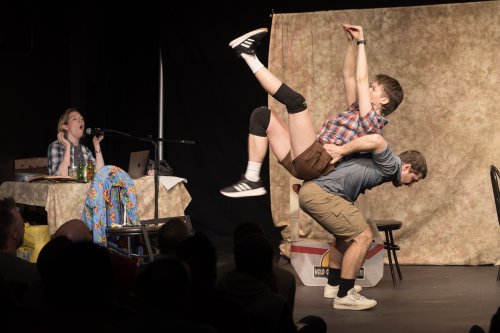
Kelly Robinson, Natalie Rich and Nick Abeel in a scene from “Hold on to Your Butts” at the SoHo Playhouse (Photo credit: JT Anderson)
Hold on to Your Butts is the brainchild of the theater company Recent Cutbacks, conceived in the very year of the company’s founding—2014—by Nick Abeel, Kyle Schaefer, and Kristin McCarthy Parker. The production is helmed by Parker herself, whose directorial hand shapes the inventive, joyous, and meticulously orchestrated chaos that defines the show. For those who missed its earlier New York City runs, Hold on to Your Butts makes a triumphant return as part of the SoHo Playhouse’s International Fringe Encore Series—and what a welcome, joyous revisit it proves to be, reaffirming the show’s enduring charm and inventive verve.
Few entertainment ventures have so efficiently conflated spectacle with cultural inevitability as Jurassic Park, whose 1993 debut announced not merely a blockbuster but a governing industrial thesis: that technological prowess, gargantuan budgets, and ever-expanding scale are the proper instruments for summoning collective awe. Its afterlife—a handful of sequels and theme-park aftershocks—has only hardened that logic. This, we are told—implicitly by marketing departments and explicitly by box-office returns—is how the modern cinema is consecrated: through amplitude, through utter sensation, through the carefully calibrated overwhelm of image and sound. This is the prevailing catechism of the industry, the doctrine that insists enormity equals necessity. If the masses are to be gathered, dazzled, and briefly unified in the dark, it will be by scale alone—by thunderous soundtracks, vertiginous visuals, and budgets large enough to seem like destiny.
Hold On to Your Butts approaches that thesis with a straight face and a mischievous glint. Rather than parodying blockbuster bloat from a position of smug diminishment, it accepts the premise of spectacle and then turns it inside out, rebuilding grandeur from the humblest of materials. What materializes is not a sneer at Hollywood excess but a warm, slyly philosophical argument—that awe, so often presumed to be the exclusive property of digital wizardry and nine-figure capitalization, can in fact be reconstituted from far more fugitive materials: from the tensile eloquence of actors’ bodies in motion and from the deep well of collective memory that an audience carries with it into the dark—and, when inspiration and desperation converge, from the unimpeachable dramaturgy of a strategically worn traffic cone.
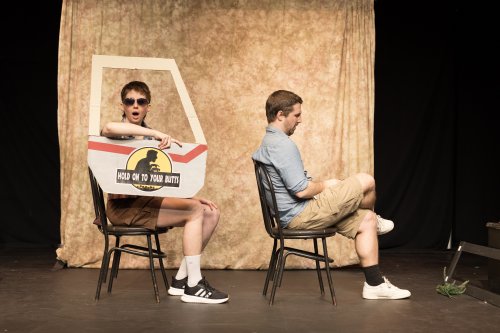
Nick Abeel and Natalie Rich in a scene from “Hold on to Your Butts” at the SoHo Playhouse (Photo credit: JT Anderson)
Actors Kerry Ipema and Natalie Rich, joined by the live Foley artist Kelly Robinson, proceed to conjure Spielberg’s dinosaur epic. They marshal an arsenal of materials so defiantly homespun it borders on subversive: cardboard cutouts standing in for apex predators, skeletal wooden frames sketching out jeeps and laboratories, pocket flashlights pressed into service as cinematic chiaroscuro, and a scattering of objects manipulated with priestly concentration, shot for shot—all deployed with an almost ascetic economy of means that make the absence of machinery feel not like deprivation but like principle.
The theater doors open and the swelling, unmistakable score of John Williams, its symphonic amplitude flood a room more suited to cabaret and standup comedy intimacy than Cretaceous majesty. The disjunction is immediate and delicious. The glorious soundtrack rattles the modest walls; patrons clutch plastic cups as if bracing for a T. rex. The joke lands—yet the joke is not merely decorative; it undertakes, with disarming lightness, a smuggling of theory inside farce asking the audience to reconsider the very mechanics of astonishment. The production advances a quiet but pointed thesis: spectacle is not a birthright of magnitude, nor the exclusive property of scale and capital, but a mutable condition—one that can be conjured as persuasively in miniature as in monument.
The comedy is fueled as much by anticipation as by execution. An umbrella snaps open to become a venom-spitting Dilophosaurus; a Hawaiian shirt conjures Wayne Knight’s classic Dennis Nedry; a pair of spectacles summons Jeff Goldblum’s career-defining Ian Malcolm. Rich captures not merely Goldblum’s languid cadence but the syncopated swagger beneath it. When Malcolm’s “Life, uh, finds a way” arrives—at one point delivered by Ipema after a swift exchange of those talismanic glasses—the audience joins in on cue. The house becomes briefly unified in quotation as we are all Ian Malcolm for that split second. That participatory glee is carefully engineered. The audience’s affection for the source material is tempered by a brisk intelligence. A throwaway welcome to BD Wong’s Dr. Henry Wu—“just in time for exposition”—lands with precision, both skewering the film’s narrative shortcuts and delighting in their brazen efficiency.
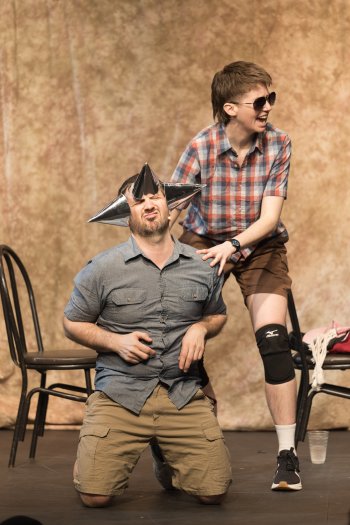
Natalie Rich and Nick Abeel in a scene from “Hold on to Your Butts” at the SoHo Playhouse (Photo credit: JT Anderson)
The “attack” stands as one of the evening’s most deliriously inventive moments: an actor crowns herself with a green traffic cone, secures a bike helmet, and contorts her limbs with feral precision to embody the T. rex—only to punctuate the transformation with the absurdly perfect gag of chomping down on character Gennaro’s tie. The effect is simultaneously hilarious, inventive, and physically astonishing, a miniature masterclass in the alchemy of imagination and bodily dexterity. Her diminutive arms flail with desperate earnestness at the unattainable Jeep—first a humble cardboard door, now an overturned red chair—a tableau so gloriously absurd that it lodges in the mind, refusing to be unimagined. Later, a painstakingly staged doll-sized reenactment of the Jeep’s precipitous tumble down the cliff—every tilt, topple, and minor collision rendered with miniature precision, transforms a moment of cinematic peril into a delightfully intimate exercise in theatrical imagination.
Robinson’s Foley work is, in its way, the evening’s stealth dramaturg. Silverware clatters with percussive insistence, keyboards rattle in anxious staccato, and breath—human, insistently present—mingles with vocalization until the air itself impersonates meteorology. Robinson layered the soundscape with an astonishing breadth of invention: dinosaur roars, helicopter rotors, the tremor of impacts, the mundane gurgle of drinking—each effect meticulously conjured, each a small miracle of auditory imagination that transforms the stage into a fully inhabited, fantastical world. Sound gathers, layer upon layer, like a storm front assembling over open water. These effects do not merely embellish the action with clever accompaniment; they assume the burden of narration, thrusting into the foreground the artisanal exertion that cinema’s frictionless digital sheen is designed, almost pathologically, to erase.
A conspiratorial murmur of “Barbasol” swells, with mock-operatic grandeur, into an extravagantly overwrought acoustic fantasia for the purloined DNA canister—each slosh and metallic click inflated to symphonic consequence. The gag gently indicts the plot’s blithe absurdities even as it salutes their stubborn immortality in the cultural imagination. In place of cinema’s frictionless digital lacquer, we are offered the gratifying spectacle of labor made manifest; polish yields to perspiration, and our fascination, in turn, is expanded, almost chastened, to make room for the conspicuous evidence of its own manufacture, inviting us not merely to consume astonishment but to regard, with something like gratitude, the human exertion that brings it into being.
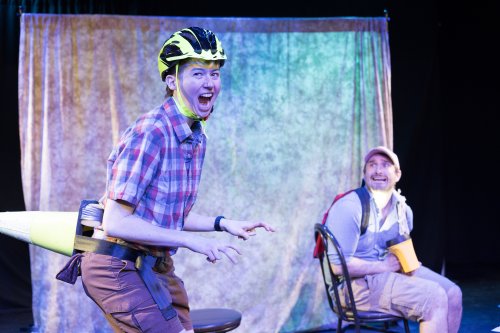
Natalie Rich and Nick Abeel in a scene from “Hold on to Your Butts” at the SoHo Playhouse (Photo credit: JT Anderson)
Yet the production’s nuance resides in the rapport between Ipema and Rich, which is no mean feat as both alternate with fellow company actor Nick Abeel at other performances, just as Foley Robinson has her alternate in Blair Busbee on other dates. Their buoyancy is anchored in the unmistakable evidence of discipline and deep mutual trust. At one memorable moment, they physically interlock to conjure a dinosaur—an image simultaneously absurd and unexpectedly tender, leaning on one another with precise mutual confidence. The metaphor is unapologetically overt, yes, even acrobatic yet it gains power precisely from its clarity: here, spectacle is forged through collaboration and care, and very little else.
The aisles and front row are subtly enlisted, extending the stage into the audience without ever fracturing concentration, while the evening opens with a series of parody trailers…for instance, in one delightfully minimalistic scene, Ipema and Rich approach, exchange a perfunctory “hi,” and immediately part ways—only to be framed from the outset by a disembodied voice intoning, “Brief Encounter,” a single, knowing gesture that transforms the simplest motion into a playful theatrical wink. These vignettes hilariously meet the audience in the familiar atmosphere of moviegoing before deftly taking them, almost imperceptibly, toward that “otherness” of theatre itself.
In rapturously copying one of late-twentieth-century cinema’s most technologically audacious spectacles through cardboard, homemade artifacts, and sweat, the production does more than armchair-travelogue Isla Nublar (the fictional setting for Jurassic Park) and its ill-fated ambitions. It proposes an alternative model of making art, standing as a testament both to the unbridled inventiveness of its creators and to the limitless potential inherent in low-budget theatre, where imagination, ingenuity, and meticulous craft can conjure worlds far grander than any ledger might predict.
Hold on to Your Butts (through March 15, 2026)
Recent Cutbacks
SoHo Playhouse, 15 Vandam Street, in Manhattan
For tickets, visit www.sohoplayhouse.com
Running time: 65 minutes without an intermission


Leave a comment