
Hate Radio
Milo Rau’s play offers a cautionary tale of how progressive ideals, stripped of complexity and weaponized by opportunists, can be made to sanctify atrocity.
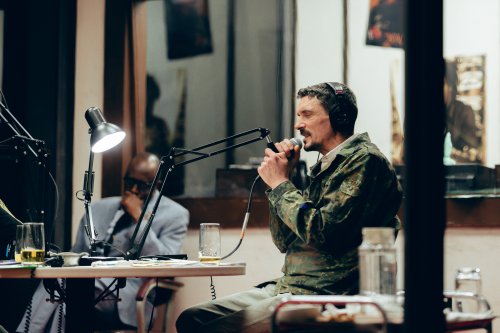
Diogène Ntarindawa and Sébastian Foucault in a scene from Milo Rau’s “Hate Radio” at St. Ann’s Warehouse (Photo credit: Amir Hamja)
In 1994, over the course of roughly one hundred days, Hutu extremists oversaw the slaughter of some eight hundred thousand to one million Tutsi, along with thousands of moderate Hutus, in Rwanda—a cataclysm executed not only with machetes and militias but with microphones. Two decades later, International Institute of Political Murder turned its forensic gaze to the airwaves with Hate Radio, a production that dares to incarnate the disembodied voices of Radio-Télévision Libre des Mille Collines, better known as RTLM. The program notes describe the station as “the most powerful instrument of the genocide,” and the play proceeds as if to test that assertion in real time. After touring to over 25 countries over the last 12 years, the play by the Swiss theatre director, journalist and playwright Milo Rau makes its U.S. debut at St. Ann’s Warehouse, where its clinical scrutiny and unnerving formal restraint feel especially at home amid the company’s history of politically exacting imports.
The evening opens not with live performance but with a 20-minute filmed prologue, a gesture that immediately establishes the production’s documentary rigor. Video designer Marcel Bächtiger projects the video onto a wall of Venetian blinds that obscure the central playing area. The slats fracture the faces onscreen, striping them with light and shadow, an apt visual metaphor for memory filtered through mediation. The evening is shrewdly bookended by these video testimonies from a journalist (Estelle Marion) and two survivors (Afazali Dewaele and Nancy Nkusi)—brief, unadorned, and almost unbearably calm, offering sober contextualization: the civil war that convulsed Rwanda in the early 1990s; the assassination of President Juvénal Habyarimana; the ethnic tensions that metastasized into genocide; and the subsequent prosecutions of the génocidaires and their media collaborators.
The tone is measured and forensic. Yet the act of being addressed so squarely—of meeting the gaze of those who recount catastrophe without melodrama—creates a disquiet that no reenactment could rival. By the time the blinds rise to begin the “play proper,” the audience has been primed not for spectacle but for indictment. These recorded fragments, projected before and after the live action, operate as moral ballast. They counterweigh the central conceit: set designer Anton Lukas’ ingenious and meticulous reconstruction of the RTLM studio, encased in a transparent glass box that sits onstage like a museum vitrine or a laboratory specimen. The effect is doubly distancing and claustrophobic. We observe the broadcasters as if they were insects under glass—yet it was precisely their casual speech, transmitted beyond such confines, that metastasized into mass murder.
There are three hosts at the center of Hate Radio, and they are not composites but historical figures—broadcasters who were later tried for their roles in the genocide. Valérie Bemeriki and Kantano Habimana, played by Bwanga Pilipili and Diogène Ntarindwa, respectively, the station’s most prominent voices, together accounted for roughly half of RTLM’s airtime, their banter and invective forming the rhythmic backbone of the broadcast. Alongside them sits Georges Ruggiu, played by Sébastien Foucault, Belgian by birth and often described as the station’s “token white,” whose presence lent the enterprise a perverse cosmopolitan sheen, particularly for educated, French-speaking listeners.
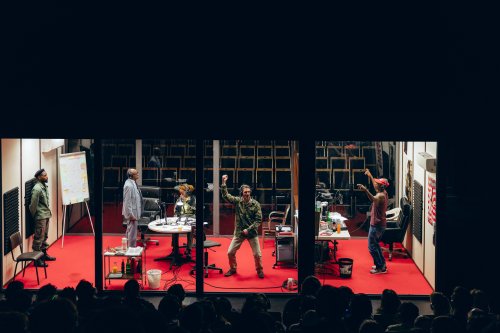
Sylvain Souklaye, Diogène Ntarindwa, Sébastien Foucault, Bwanga Philipili and Eric Ngangare in a scene from Milo Rau’s “Hate Radio” at St. Ann’s Warehouse (Photo credit: Amir Hamja)
As Valérie Bemeriki, Pilipili locates a trembling core beneath the broadcaster’s brittle bravado. She conjures something like recognizably human emotion—rage, certainly, but also sorrow and, most potently, a sheen of dread mixed with panic. The knowledge of what defeat would mean hangs over her like a storm cloud. The hatred she spews feels, at times, like an incantation against her own annihilation. At the broadcast’s close, her deadened gaze, fixed somewhere beyond the studio walls, tells the story of the years to come more eloquently than any projected epilogue. In that stare is calculation and the dawning comprehension of consequence.
Habimana, by contrast, is rendered without visible fissure. As embodied by Ntarindwa, he is all velocity and appetite—dancing to Afrobeat with manic abandon, as if chemically propelled. When he theatrically reveals a pair of holstered guns and proceeds to read a list of murdered Tutsi as though announcing new players on his favorite soccer teams, the grotesque fusion of entertainment and extermination reaches its apex. This is a man intoxicated not merely by ideology but by spectacle. The performance suggests a broadcaster who experiences carnage as a kind of ecstatic feedback loop: the more he incites, the more alive he feels.
Georges, the Belgian interloper, is the evening’s most enigmatic and, in some ways, most chilling presence. An ethnic Italian raised in Belgium, he occupies a perverse position: a white European serving as a polished mouthpiece for Hutu supremacism. In Foucault’s restrained, unnervingly placid portrayal, Georges appears less driven by grievance than by thrill. His proximity to history’s violence seems to offer stimulation, even glamour. One is reminded how often ethnic conflicts attract the self-reinvented zealot, the outsider who discovers in borrowed hatred a sense of purpose. The production pointedly suggests that such figures, lacking personal stake yet embracing ferocity, may be among the most dangerous of all: tourists of atrocity, intoxicated by death’s theater.
In performance, the linguistic layering becomes part of the dramaturgy. Bemeriki and Habimana oscillate between French and Kinyarwanda—an easy code-switching that mirrors the station’s reach across class and region—while Ruggiu broadcasts exclusively in French, his diction crisp, authoritative, and chillingly matter-of-fact. (The production supplies supertitles, but the tonal shifts register even before they are translated.) What emerges is not a portrait of fringe demagogues but of polished media professionals, fluent in the idioms of popular culture and adept at calibrating their message to different constituencies. The horror lies less in their volume than in their fluency.
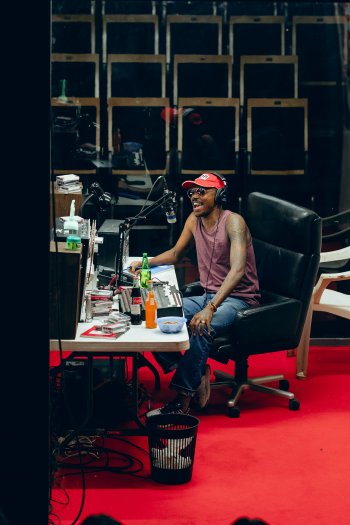
Eric Ngangare in a scene from Milo Rau’s “Hate Radio” at St. Ann’s Warehouse (Photo credit: Amir Hamja)
Inside this box, the hosts banter with a buoyancy that would be unremarkable on any morning drive-time program. They toggle between international headlines, soccer scores, buoyant pop tracks played by a chill Eric Ngangare as DJ Joseph, and chatty dedications. The geniality is the horror. Threaded through the music and chatter is a steady current of dehumanization: the Tutsi reduced to inyenzi—“cockroaches”—and described as an infestation requiring extermination. The announcers do not rant so much as smirk. Their disgust is conversational, their incitement wrapped in the syntax of entertainment. Guns lie conspicuously about the studio, but no violence is staged. None is needed. Language itself is the weapon on display.
The premise—a radio broadcast—might seem theatrically inert, yet Rau ingeniously implicates the audience by issuing each spectator a set of headphones. We are not merely watching propaganda; we are tuning in. If we need to gauge our own humanity while we watch the hideous display, all we need to do is look straight ahead – on the other side of where the actors play sits the other half of the St. Ann’s Warehouse audience. The isolation produced by the earphones intensifies the intimacy of the rhetoric. One hears the laughter, the rhythm, the coded exhortations as if they were meant for one’s own ear. The imaginative leap—who would listen to this? who would believe it?—collapses. The seduction of format, the familiarity of tone, do much of the ideological work.
Jens Baudisch’s sound design is the production’s most insidious coup. RTLM is not merely simulated; it is funneled directly into our ears through individual headphones placed at every seat, transforming the auditorium into a constellation of private listening booths. The effect is unnervingly intimate. The hosts’ laughter, their casual slurs, their buoyant segues into pop songs arrive with the seductive clarity of a personal whisper. Remove the headphones, however, and the illusion collapses. What remains in the shared air is little more than ambient rain—an acoustic void that underscores how thoroughly the experience has been individualized.
This mode of reception mirrors the way many of us, in the 21st century, consume media: atomized, curated, delivered through earbuds and algorithms, sealed off from communal scrutiny. Yet it is also a subtle historical distortion. Most Rwandans in the early 1990s would have encountered Radio-Télévision Libre des Mille Collines not in isolation but collectively—gathered around shared radios in bars, markets, and homes, the rhetoric reverberating through public space. By filtering the broadcast into solitary channels, the production both contemporizes the experience and implicates us in it. We are alone with the propaganda, as we so often are with our own media streams, left to decide—without the friction of a visible crowd—how much we are willing to absorb.
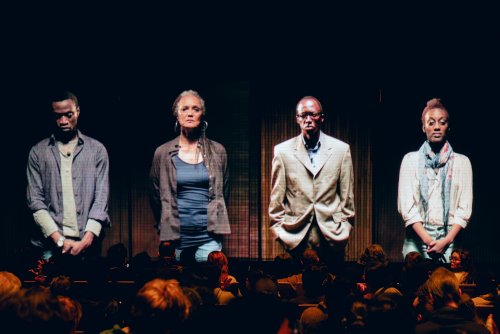
Afazali Dewaele, Estelle Marion, Diogène Ntarinwa and Nancy Kkusi in a scene from Milo Rau’s Hate Radio at St. Ann’s Warehouse (Photo credit: Amir Hamja)
Hate Radio operates as both a scrupulous act of historical excavation and a theatrical indictment. By anatomizing the role of Radio-Télévision Libre des Mille Collines in the 1994 genocide in Rwanda, Rau does more than reconstruct a catastrophe; he dissects the machinery that made it possible. The production insists that mass violence does not erupt spontaneously but is rehearsed—daily, casually—through jokes, headlines, playlists, and the steady drip of insinuation.
What emerges is a bracing inquiry into the culpability of media institutions in normalizing racism, amplifying conspiracy theories, and laundering hatred through the reassuring cadences of broadcast professionalism. The play asks, without rhetorical flourish, what responsibility accrues to journalists, editors, and producers when language ceases merely to describe and begins to dehumanize. If a population can be reduced to vermin over the airwaves, if extermination can be couched as civic hygiene, then the distance between commentary and complicity narrows to nothing.
The chill of the evening lies in its contemporaneity. One need not strain to detect uneasy parallels in the present media ecosystems of the United States where outrage is monetized, disinformation travels frictionlessly, and the rhetoric of exclusion increasingly passes for common sense. Rau’s production does not indulge in facile equivalence; it does something more unsettling. It suggests that the conditions which enabled genocide were not uniquely Rwandan aberrations but manifestations of a human susceptibility—one that modern democracies, with their fractured information spheres, would be reckless to dismiss.
What lingers is less a portrait of monstrosity than of normalcy. The broadcasters are not staged as demonic aberrations but as glib professionals performing a job with unnerving cheer. The final message—voiced not as prophecy but as sober observation—is that this genocide was neither singular nor final. Others have occurred; others will. The suggestion, at times bald yet theatrically intricate in its execution, is that genocide does not erupt from some alien pathology but from recognizably human capacities: resentment, tribalism, the pleasure of belonging, the narcotic ease of listening to one’s worst impulses affirmed over a catchy pop refrain.
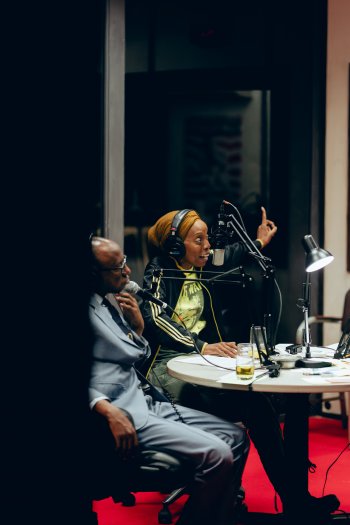
Diogène Ntarindwa and Bwanga Philipili in a scene from Milo Rau’s Hate Radio at St. Ann’s Warehouse (Photo credit: Amir Hamja)
Hate Radio thus leaves us with a disquieting proposition. If the airwaves can be weaponized so effortlessly, if the boundary between entertainment and extermination can be traversed with such ghastly fluency, then responsibility cannot be cordoned off to history’s villains alone. The glass box may contain the actors, but the frequencies travel outward.
Hate Radio (through February 28, 2026)
St. Ann’s Warehouse, 45 Water Street, in Brooklyn
For tickets, visit www.stannswarehouse.org
Running time: one hour and 50 minutes without an intermission


Leave a comment