
Watch Me Walk
Whitney Houston may have sung, “Step by step, Bit by bit, Stone by stone” but Anne Gridley teaches us the education comes in the faltering.
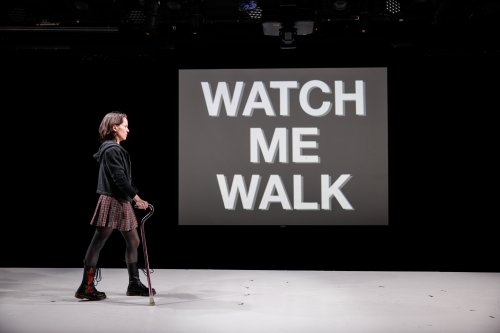
Anne Gridley in a scene from the Soho Rep production of her show “Watch Me Walk” at Playwrights Horizons (Photo credit: Maria Baranova)
Anne Gridley begins Watch Me Walk by taking its title at punishingly literal face value. She introduces herself, grips her walking stick—never a cane, a semantic correction that quickly reveals its philosophical weight—and proceeds to walk the length of the stage again and again, in near silence, for so long that the initial charge of provocation slowly discharges. What remains is not suspense but facticity. In another theatrical ecosystem, this might register as endurance art or a sly conceptual prank; here, in a Soho Rep production presented in association with the recently concluded 2026 Under the Radar Festival, it operates as a recalibration of spectatorship itself. We arrive alert, waiting for the performance to “start,” only to discover that it already has—and that the only thing lagging behind is our attention.
Gridley, a founding member of the Nature Theater of Oklahoma and a longtime architect of experimental performance, refuses both concealment and consolation. She lives with hereditary spastic paraplegia, a rare degenerative condition affecting mobility that traces a maternal lineage, announcing itself in her own body only in her thirties. She rejects the tradition of disabled discretion she jokingly calls “pulling an FDR,” but she also declines the more contemporary impulse to soothe an audience’s unease. Instead, she leaves that unease intact, allowing our nervousness, curiosity, and self-consciousness to circulate freely alongside her body in motion. As the minutes accrue, the walk sheds its aura of exceptionality and becomes almost aggressively ordinary. The radical gesture is not that Gridley walks, but that she obliges us to sit with how quickly fascination with difference collapses into indifference.
That ordinariness, however, stands in sharp and uneasy contrast to the extraordinary conditions shaping Gridley’s life with disability. Watch Me Walk detours repeatedly into the systemic neglect of so-called “orphan diseases,” those too rare to merit sustained research funding or pharmaceutical interest. Gridley literalizes the term by donning a Little Orphan Annie costume and singing a plaintive, wryly buoyant song—written with Noah Lethbridge—that frames her condition as both genetic inheritance and bureaucratic afterthought. The irony floats, but the resentment beneath it never quite submerges. This is a life sculpted not only by neurological degeneration but by institutional disregard.
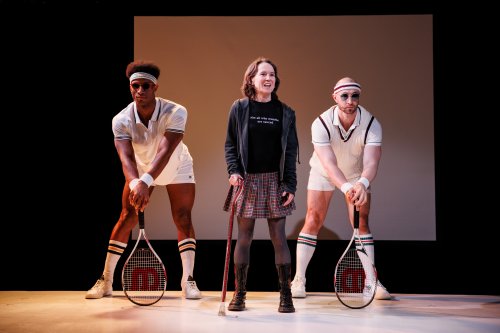
Keith Johnson, Anne Gridley and Alex Gibson in a scene from the Soho Rep production of her show “Watch Me Walk” at Playwrights Horizons (Photo credit: Maria Baranova)
Ableism, particularly when dispensed by those cloaked in professional authority, becomes one of Gridley’s richest comic targets. With surgical timing, she recounts a physical therapist’s advice that she smile more while walking—“It was a woman,” she notes dryly, “so I didn’t punch her in the face.” Elsewhere, she turns the critique inward, belting “I’m the biggest ableist of them all” in dramatic evening wear courtesy of Lux Haac, alongside two apparently able-bodied backup singers, Alex Gibson and Keith Johnson, early on in form-fitting tennis outfits and later in silver lamé tuxedo jackets with black tuxedo short-shorts and cummerbunds. Her joke works because it refuses moral hygiene: Gridley does not position herself outside the culture she indicts, but squarely within it, implicated and alert.
Under Eric Ting’s unobtrusive direction, the piece unfolds as a series of loosely braided vignettes, layering autobiography, instruction, and theatrical play. Gridley conducts a Q&A with an unseen voice about the logistics of disabled life, ranging from health insurance (“Viva Luigi!,” which gets cheers from anyone in the audience who has had a necessary procedure or medication denied by their insurance) to her extensive and flamboyant collection of walking sticks—twenty in all, each lovingly named. “I’m the Imelda Marcos of mobility aids,” she boasts, and the line lands not merely as a quip but as a declaration of aesthetic agency. Jian Jung’s seemingly spare set accommodates these tonal pivots with quiet ingenuity, revealing its small surprises without insisting upon them. Supporting Gridley’s self-effacing performance, Kate McGee’s balanced lighting and Tei Blow’s steadied sound and video design are firm complements.
The evening’s most extravagantly theatrical episode arrives when Gridley appears in a tentacled costume as “Dumn-Dumn, Anne Gridley’s Degenerating Upper Motor Neuron,” delivering a PowerPoint-assisted inquiry into her family history under the heading “Whose Fault Is It Anyway?” The question is posed as both a genetic puzzle and psychic wound. Gridley recounts, with devastating calm, learning that her mother—who shared the same condition—once said she regretted giving birth. The disclosure lands with chilling force, even as it is framed by absurdist trappings. A later pedagogical monologue delivered by a childhood duck named Ping, which attempts to explain neurological processes at the cellular level, proves less potent, flattening complexity into instruction without the compensatory sting that animates the rest of the piece.
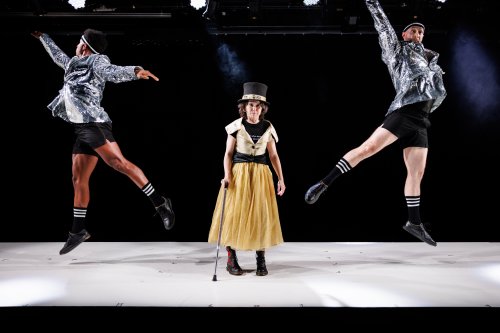
Keith Johnson, Anne Gridley and Alex Gibson in a scene from the Soho Rep production of her show “Watch Me Walk” at Playwrights Horizons (Photo credit: Maria Baranova)
Trust becomes one of the work’s quieter, more consequential themes. Early on, Gridley falls deliberately and instructs the audience to ask whether she needs help—and to accept “no” as a complete response. Later, during a dance sequence choreographed by Asli Bulbul and intertwined with the story of her mother’s death, she falls again. By then, the gesture has shifted its meaning entirely. What once functioned as a lesson now reads as a declaration of autonomy. Gridley has taught us not only how to watch her, but how to restrain our reflex to intervene.
Gridley notes that her neurologist has told her human beings can only consciously attend to walking for about eight seconds; evolution, after all, designed the act to recede into muscle memory. Watch Me Walk asks us to do the opposite: to spend nearly two hours thinking about walking—her walking, her falling, her climbing a ladder while singing, with cheerful menace, “I’m on a ladder and it’s making you feel nervous, and yes, that is the point.” What emerges is not a comprehensive portrait of Gridley’s artistic life—those contours remain surprisingly underdrawn—but a sustained act of looking that exposes the habits, blind spots, and limits of the gaze itself.
Gridley gives us a reckoning with a life that has learned, stubbornly and brilliantly, how to keep moving. She is in complete command—of her balance, of the moment, of the uneasy tenderness she has coaxed from the room—and, more to the point, of us. What once felt like peril now reads as authorship: the fall, the recovery, the forward motion all unfolding on terms she has rigorously set. In that instant, the audience’s anxiety resolves into trust, and that trust into a recognition of her dramaturgical grip. Gridley does not merely steady herself; she steadies the gaze trained upon her, guiding it exactly where she intends it to land.
Watch Me Walk (extended through February 15, 2026)
Soho Rep in association with the 2026 Under the Radar Festival
Peter Jay Sharp Theater at Playwrights Horizons, 416 West 42nd Street, in Manhattan
For tickets, visit www.sohorep.org
Running time: 100 minutes without an intermission


Leave a comment