
Falling Out
A restrained, ensemble-driven rock musical at UNDER St. Marks that sustains mood over plot, letting meaning accumulate through music and performance.
Review by Jack Quinn, publisher

Amelia Grace Beckham and Gavin Cole in a scene from Josée Klein’s “Falling Out” at UNDER St. Marks (Photo credit: Seana E. Rogovin)
Falling Out is a rock musical built around mood rather than plot. It does not rush to orient the audience or resolve itself into a clean narrative arc. The piece situates us inside a familiar but unstable social ritual—an open-mic night that suggests informality while quietly enforcing exposure. Meaning accumulates through rhythm, memory, and proximity. The experience feels less like a story unfolding than a state being sustained.
What gives the piece its shape is the way its elements think together. Nothing operates in isolation, and nothing feels decorative. Text, music, performance, and design remain in constant conversation, responding to one another in real time. Authority is shared rather than assigned. The show advances as an ensemble, and that collective intelligence becomes its defining strength.
Josée Klein’s book, music and lyrics establish the work’s restraint. The writing avoids overstatement, favoring conversational phrasing and implication. The score draws on rock idioms without leaning on volume or emotional push. Songs emerge as extensions of thought rather than punctuation marks, often stopping short of resolution. Klein trusts the material to carry weight without insisting on interpretation.
That musical language is shaped further by Klein and Calvin Hitchcock’s arrangements, which provide propulsion without crowding the performers or the room. The arrangements understand when to thin out and when to press forward. Gideon Klein’s additional arrangements add texture and flexibility, keeping the sound world responsive. Together, the music team creates a structure that can hold vulnerability without rushing past it.

Alex Crossland, Gavin Cole and Patrick Dinnsen in a scene from Josée Klein’s “Falling Out” at UNDER St. Marks (Photo credit: Seana E. Rogovin)
At the emotional center of the evening are Alex and Rock—not as traditional protagonists, but as points of gravity. Their shared history is not dramatized through confrontation or catharsis; it surfaces through avoidance, proximity, and the residue of unfinished feeling. The show resists turning their relationship into a lesson, allowing what remains unresolved to stay active.
The performances meet the score’s discipline with clarity and focus.
Matthew Liu, serving as Narrator and in multiple roles, anchors the evening with steady attentiveness. His presence guides without instructing. Liu frames observation as an active stance, keeping the audience oriented while preserving ambiguity.
Ashley Margaret Morton, appearing as the Therapist and in other roles, works with precision and control. Her performance balances empathy with boundary, avoiding caricature or excess. Morton is particularly attuned to rhythm—knowing when to let silence register and when to move forward—giving scenes shape without strain.

Gavin Cole and Ashley Margaret Morton in a scene from Josée Klein’s “Falling Out” at UNDER St. Marks (Photo credit: Seana E. Rogovin)
Patrick Dinnsen, as the Ex and in additional roles, brings grounded physicality and a sense of lived history. His work allows discomfort and humor to coexist, often in the same moment. Dinnsen does not push for effect; tension surfaces naturally, lending the performance credibility.
Alex Crossland, as Bandleader and in other roles, bridges the musical and theatrical worlds. His presence reinforces the idea that the music is not accompaniment but participant. Instruments circulate through the space as tools rather than symbols, helping transitions remain fluid without imposing momentum.
The design elements operate with similar restraint. Mikaila Baca-Dorion’s scenic and projection design favors suggestion over literalism, shaping atmosphere without crowding the performers. Zach Pizza’s lighting design guides focus subtly, using tone and contrast rather than overt cues. Emerson Wachnik’s sound design preserves vocal clarity while retaining the score’s rawness, supporting intimacy without flattening texture.
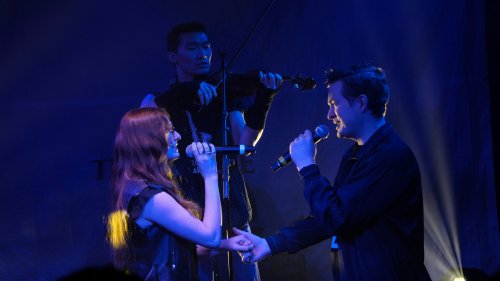
Amelia Grace Beckham, Matthew Liu and Patrick Dinnsen in a scene from Josée Klein’s “Falling Out” at UNDER St. Marks (Photo credit: Seana E. Rogovin)
Pacing benefits from director Anthony Logan Cole’s work on the show. Transitions feel deliberate rather than rushed, respecting the emotional residue of each section. The show knows when to pause and when to move.
Support from Frigid New York is evident in the production’s clarity. The scale and infrastructure allow the work to remain productively incomplete—prioritizing process over polish, listening over emphasis. Risk is supported without pressure to over-explain.
Ultimately, Falling Out distinguishes itself through trust—trust in collaborators, trust in audience attention, and trust in restraint. It sustains focus through consistency of tone and integrity of craft. The piece leaves room for unresolved feeling, inviting the audience to sit with it rather than watch it conclude. In a theatrical landscape often crowded with urgency, Falling Out stands out for its confidence in quieter power.
Falling Out (through February 3, 2026)
UNDER St. Marks, 94 St. Marks Place, in Manhattan
For tickets, visit https://www.frigid.nyc
Running time: 100 minutes without an intermission


Leave a comment