
Marjorie Prime
A fleetingly futuristic play about artificial intelligence and mortality finally gets a well-deserved life on Broadway.
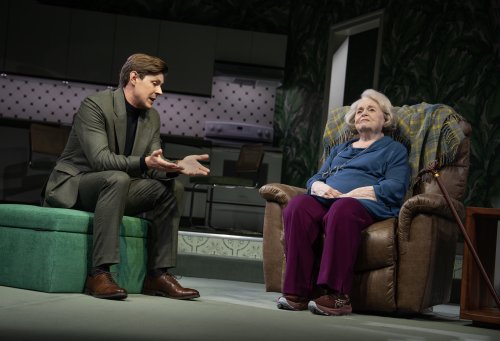
Christopher Lowell and June Squibb in a scene from The Second Stage production of Jordan Harrison’s “Marjorie Prime” at the Helen Hayes Theater (Photo credit: Joan Marcus)
It’s often held that the vast majority of humans are forgotten within, at most, a few generations. They are lost in dying memories either created personally or through the recollections of others. On the surface, Jordan Harrison’s 2015 Pulitzer Prize finalist, Marjorie Prime, foretells a different collective fate, where it’s possible for everyone to have an eternal digital life in eerily precise physical form, but not necessarily an equally rendered psychological one. Yet like many of the strongest science-fiction writers, Harrison is much less interested in the technological than the philosophical. For that reason, Marjorie Prime has its own well-deserved chance at immortality, as a melancholic meditation on how there wasn’t really a time when humans could be forgotten, because nobody is ever truly known.
Director Anne Kauffman, who impressively guided the play’s Off Broadway premiere a decade ago, returns to do the same for its Broadway debut. With Michael Almereyda’s cinematic adaptation having been released between these productions, the new challenge for Kauffman is navigating a wave of narrative familiarities she first fostered. Not only has Harrison’s once intentionally disorienting plot become straightforward on a second or third pass, his formerly fanciful depiction of artificial intelligence now carries an impending sense of mundanity, too.
As the play opens–in the disquietingly near and recognizable future of 2062–a young man, Walter (Christopher Lowell), talks to the octogenarian Marjorie (June Squibb) about their marriage. For those in the storytelling loop, there isn’t any initial mystery or scandal to their supposed union. Essentially an anthropomorphized chatbot–or, in its maker’s marketing parlance, a Prime–Walter is a holographic projection of Marjorie’s dead husband (yes, the play’s title is a spoiler) at his physical peak, adaptively programmed to become progressively believable through informative exchanges about the genuine Walter’s life. Marjorie’s daughter Tess (Cynthia Nixon) and son-in-law Jon (Danny Burstein) acquired this sophisticated simulacrum to provide comfort to the cognitively deteriorating Marjorie, but that, of course, isn’t what the past usually does.
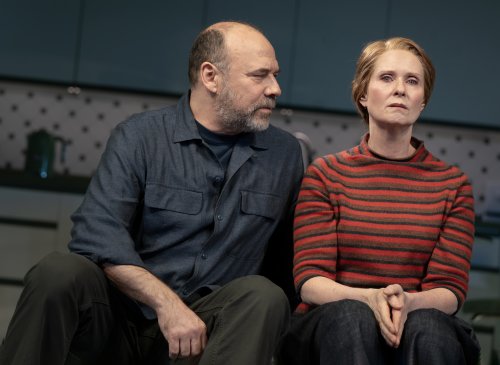
Danny Burstein and Cynthia Nixon in a scene from The Second Stage production of Jordan Harrison’s “Marjorie Prime” at the Helen Hayes Theater (Photo credit: Joan Marcus)
Aware of fake Walter’s photonic identity and purpose, Marjorie consciously reshapes history to her liking, swapping the movie that inspired real Walter’s marriage proposal from My Best Friend’s Wedding to Casablanca while also adding other “fairy tale” embellishments. All of these tweaks are essentially harmless and not dissimilar from the standard shared white lies present in any long-term, flesh-and-blood marriage. But trauma cannot be so easily amended, and there is an immense one splintered within Marjorie’s head. She never does put it together, though Walter Prime eventually learns the entirety of what happened from Jon, a decent guy whose kindness doesn’t go hand-in-hand with top-notch judgment. Despite a performance emotionally circumscribed by his character’s coding, Lowell is nonetheless uncannily touching as he conveys fake Walter’s artificial surprise and sadness.
To be sure, those feelings, and many others, flow more naturally from the play’s human characters, all subsumed under a cloud of grief that drifts from Marjorie to Tess to Jon. If the plot is no longer revelatory, that’s actually a huge plus, allowing Squibb, Nixon, and Burstein’s gut-wrenching efforts to take center stage from the showy skillfulness of Harrison’s writing. Although often very clever, its patiently developed manipulations can obscure the poignant themes of Marjorie Prime for the uninitiated.
Upon a repeat viewing, the most salient idea vivifying the play is that, when it comes to alienation, technology gets a bum rap. Artificial intelligence isn’t pulling us apart; it’s a symptom of our desperation to fill the gaps that have been there from the beginning. And, as Harrison persuasively argues, they will be there long after the end, because we are just as desperate to maintain them. With reddened eyes, Nixon’s Tess is the fulcrum for each impulse, fretting about a lack of connectedness to her mother while shielding Jon from the self-destructive pain gnawing at her own beleaguered soul. Or, maybe after almost three decades of marriage, the outwardly sensitive Jon should have seen what Tess could not endure. Culpability is also a theme of Marjorie Prime.
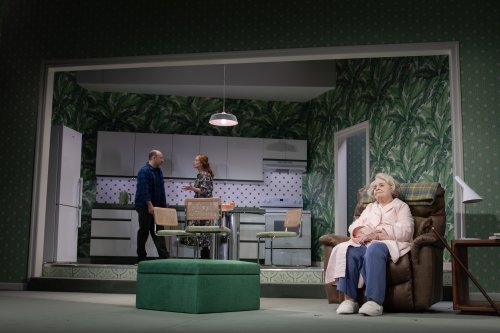
Danny Burstein, Cynthia Nixon and June Squibb in a scene from The Second Stage production of Jordan Harrison’s “Marjorie Prime” at the Helen Hayes Theater (Photo credit: Joan Marcus)
Whereas technology is supposed to become outmoded, there is a paradoxically evergreen quality to the ephemeral challenges of being human. Lee Jellinek’s verdant set, festooned in tropical wallpaper, waggishly acknowledges that ongoing struggle, along with the canonical status it might grant the achingly perceptive Marjorie Prime. That potential legacy won’t primarily come from the play’s genre trappings. Still, Kauffman does give them their due, marshalling the combination of Ben Stanton’s lighting and Daniel Kluger’s sound and original music to engender some futuristic vibes.
It’s well done, though pales in comparison to what the 96-year-old Squibb accomplishes from a putty-colored recliner. As Marjorie, her frail exterior just barely contains the long and complicated life roiling underneath. When the strain of remembering the good parts, forgetting the bad ones, and rounding off a few edges becomes overwhelming, a weary Marjorie turns suddenly beatific as she asks fake Walter to sit close by in silence. It’s a graceful note through which Squibb perfectly defines Marjorie’s deepest and most heartbreaking desire, one that many in the audience will understand immediately, and probably want to replicate themselves someday.
Marjorie Prime (through February 15, 2026)
Second Stage Theater
Helen Hayes Theater, 240 West 44th Street, in Manhattan
For tickets, call 212-541-4516 or visit http://www.2st.com
Running time: one hour and 30 minutes without an intermission


Leave a comment