
BUM BUM (or, this farce has Autism)
Osmundsen’s riotous farce skewers the media’s soft-focus packaging of autism, with EPIC’s neurodivergent cast delivering a wickedly funny jolt of truth.
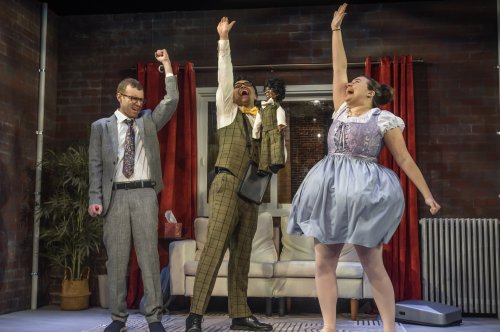
Max Tunney, Meconan Ashe and Jordan Patricia Boyatt in a scene from the EPIC Players’ production of the world premiere of Dave Osmundsen’s “BUM BUM (or, this farce has Autism)” at HERE Arts Center (Photo credit: Alejandro Aguirre @Drif7)
In BUM BUM (or, this farce has Autism), EPIC Players—New York’s indefatigable standard-bearer for neuroinclusive performance—unfurls a world premiere that feels less like a conventional new play and more like a controlled theatrical detonation. Written by autistic playwright Dave Osmundsen, the play arrives disguised as farce, yet beneath its slapstick velocity lies an exacting critique of how neurodivergent lives are shaped, softened, and rendered consumable for mainstream audiences. It is a work that understands comedy not as an escape from politics but as one of its most effective instruments. Under the brisk, clear-sighted direction of Meggan Dodd, EPIC Players has assembled a company of actors on the spectrum to bring to life the buoyantly subversive text of award-winning Osmundsen—a writer whose instinct for farce is matched only by his ear for the humiliations, large and small, that so often attend the rhetoric of “inclusivity.”
The structural joke at the center of the play is a live telethon for an autism nonprofit burdened with the acronym SHAG, later bureaucratically deodorized into SAHAG. This is not merely a sight gag but a thesis: language itself must be managed to avoid discomfort, even when meaning is thinned in the process. The telethon’s glossy artificiality becomes the perfect container for examining how institutional good intentions so often smother the very people they claim to uplift.
Within this televisual apparatus stand three autistic performers—Lisa (a luminous Jordan Patricia Boyatt readies “Bum Bum”—a number so cheeky and self-possessed that one imagines Louise from Gypsy giving an approving wink from the wings, Sean (a marvelously deadpan Max Tunney vetoes his Hallmark family program while aspiring to be the lovechild of George Carlin and Richard Pryor), and Jason (Meconan Ashe handling his foulmouthed ventriloquist dummy with aplomb)—each carefully guided toward a version of themselves deemed “appropriate.” Lisa is steered into ballet emptied of erotic charge, Sean into stand-up comedy stripped of danger, and Jason into ventriloquism rendered charming rather than destabilizing.
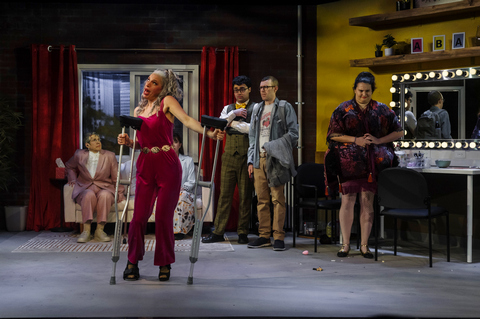
Nancy Redman, Amy Hope Miller, Cameron Walker, Max Tunney and Jordan Patricia Boyatt in a scene from the EPIC Players’ production of the world premiere of Dave Osmundsen’s “BUM BUM (or, this farce has Autism)” at HERE Arts Center (Photo credit: Alejandro Aguirre @Drif7)
The event’s title, “All Stars for Autism,” encapsulates the aesthetic Osmundsen skewers: philanthropic spectacle engineered—thanks to press handlers, donors, a celebrity host—to flatter both giver and receiver. Its promise of “Sharing and Hearing Autistic Greatness” sounds generous until it reveals itself as a euphemism for curating difference into digestible form. Lisa, Sean, and Jason enter this space with guarded hope, aware that broadcast visibility can be as flattening as it is empowering.
What makes Osmundsen’s script so piercing is its recognition that the greatest obstacles these performers face are not their own anxieties or limitations, but the misguided “helpers” who hover around them like anxious helicopters. There is Susan, the overprotective mother (Nancy Redman) terrified her daughter Lisa will mortify herself; Jeff, the browbeating publicist (Cameron Walker) whose belittling of his cousin Jason leaves the young man nearly voiceless; and Caty, the well-meaning sister (Carly Hayes) who attempts to sanitize her brother Sean’s material into something—anything—less sexual, less authentic, less him.
The first rupture arrives through inadvertent honesty. Lisa’s casual reference to a scandal involving the pop-star host, Rhina (an aptly played broadly and over-the-top Amy Hope Miller), punctures the telethon’s immaculate surface. Rhina’s response—public, patronizing, and faintly cruel—exposes the fragility of celebrity culture when confronted with unscripted truth. In this moment, the play suggests that authenticity is welcome only insofar as it preserves the illusion.
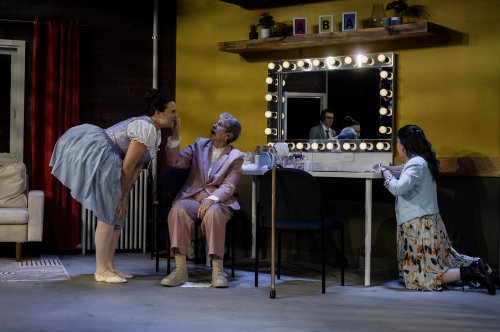
Jordan Patricia Boyatt, Nancy Redman and Carly Hayes in a scene from the EPIC Players’ production of the world premiere of Dave Osmundsen’s “BUM BUM (or, this farce has Autism)” at HERE Arts Center (Photo credit: Alejandro Aguirre @Drif7)
But the true rupture occurs backstage, when the trio accidentally overhears Rhina dismissing both the autistic performers and the benefit itself with the sort of airy contempt reserved for those trapped by contractual obligation. This is the catalytic injury, the moment in which indignation hardens into resolve. What begins as a hurt feeling becomes a clandestine uprising. With a degree of strategic mischief one might more readily expect from a Restoration comedy, the trio ensnares Rhina’s perspiring publicist Jeff—blackmailing him, imprisoning him in the bathroom, and wielding the incriminating recording of Rhina’s mockery like a theatrical doomsday device.
From here, the play careens into orchestrated mayhem. A twisted ankle, a bottle of “Evian” heavy with vodka, and a host suddenly stripped of authority collapse the hierarchy in full view. The comedy is physical, but its implications are moral. The boundary between performance and coercion dissolves, revealing how often inclusion depends on compliance rather than consent. Dodd’s direction keeps the gears of the farce turning with admirable velocity. Doors slam, bodies hurtle, props misbehave, and yet the proceedings never devolve into mere chaos. Osmundsen’s script, rich with tight comic dialogue and buoyed by a sense of righteous mischief, provides the performers ample room to shine.
The ensuing takeover of the broadcast functions as a miniature coup d’état. Lisa, Sean, and Jason finally present their work without filtration; each performer finally unveils the material deemed too unruly, too specific, too autistic for mainstream consumption. This is farce sharpened into a scalpel and the moment is less celebratory than revelatory. In reclaiming the narrative, Lisa, Sean, and Jason deliver a riotous repudiation of the infantilizing gloss demanded of them, insisting instead on a visibility as messy, fabulous, and unapologetically inappropriate as real autonomy requires. Max Tunney’s coolly calibrated deadpan, Maconan Ashe’s agile ventriloquism, and Jordan Patricia Boyatt’s radiant theatrical authority ground the anarchy in disciplined craft.
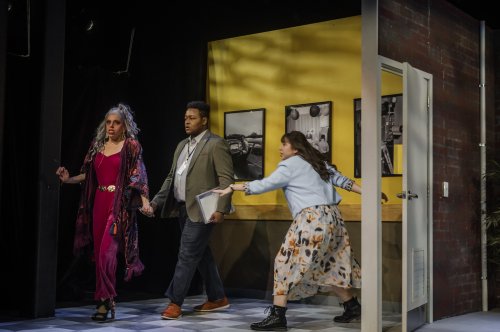
Amy Hope Miller, Cameron Walker and Carly Hayes in a scene from the EPIC Players’ production of the world premiere of Dave Osmundsen’s “BUM BUM (or, this farce has Autism)” at HERE Arts Center (Photo credit: Alejandro Aguirre @Dif7)
Crucially, Osmundsen refuses to render these figures as villains. They are not malicious but symptomatic, embodiments of a culture that equates support with supervision. The humor cuts deep because it targets systems rather than individuals, revealing how even well-meaning frameworks can erase agency. What lingers, however, is not simply the laughter—though there is plenty of that—but the unanticipated swell of emotion that catches the audience off guard. Many comedies provoke tears through laughter; this one delivers laughter through tears. It reminds us, with a gentle ferocity, that people will surprise us—gloriously—if only we allow them to show us what they can do. They do not simply overturn our prejudgments; they leave them in the dust. BUM BUM skewers the media-industrial complex that insists on packaging neurodivergent lives into digestible narratives—preferably uplifting, always simplified. In lesser hands, this might read as polemic; here, it is a jubilant theatrical argument, buoyed by structure, character, and a profound comic intelligence.
When the laughter fades, what remains is the play’s quiet insistence that visibility without authorship is another form of disappearance. BUM BUM dismantles the media’s appetite for sanitized narratives of disabled inspiration and replaces it with something unruly, specific, and self-determined. EPIC Players has not merely mounted a farce; it has staged a provocation—one that invites audiences to sit with the discomfort of seeing autonomy claimed, rather than granted.
EPIC’s neurodivergent ensemble, long committed to the subversion of representational clichés, brings unmistakable authenticity and an exhilarating sense of ownership to the material. Their performances, supported by scenic designer Christian Flemming’s exacting backstage, costume designer Nicole Zausmer’s thoroughly lived-in clothes, and lighting designer Will Morris’ sensitive-to-mood choices, radiate a lived clarity—an insistence that visibility without autonomy is merely another form of erasure. In a beautifully meta twist, the company disassembles the very tropes they have spent years painstakingly replacing, turning the stage (and that hapless telethon) into a battlefield where narrative control is the ultimate prize. BUM BUM is a theatrical middle finger wrapped in glitter, a farce that refuses to apologize for its nerve, its specificity, or its unruly joy.
BUM BUM (or, this farce has Autism) (through December 14, 2025)
EPIC Players
HERE Arts Center, 145 6th Avenue, in Manhattan
For tickets, visit http://www.here.org
Running time: 90 minutes without an intermission


Leave a comment