
Kathy Kaefer — Kiss Me Once: Stories from the Homefront
A poignant cabaret tribute where Kathy Kaefer brings WWII stories and classic 1940s songs vividly to life with warmth, history, and heartfelt storytelling.
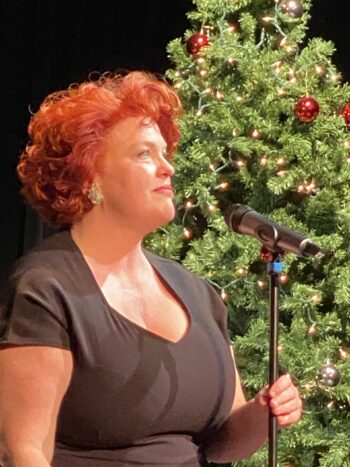
Kathy Kaefer at Winter Rhythms. Photo by Sue Matsuki
Kathy Kaefer’s Kiss Me Once: Stories from the Homefront is one of those rare cabaret evenings that feels less like a performance and more like a beautifully guided remembrance. Through stories gathered from veterans, families, and her own grandmothers, Kaefer restores the wartime songbook to the people who once held it close, letting each number glow with lived experience rather than nostalgia. Presented as a part of Winter Rhythms at Urban Stages.
The evening begins with the jaunty wartime spirit of “Kiss the Boys Goodbye / Something for the Boys,” songs launched into popularity by Alice Faye and Ethel Merman. But beneath the cheerful swing lies the story of Joe Columbo—born in Detroit to immigrant parents, arriving in America without English, determined to belong. When Kaefer sings “Don’t cry until they’re out of sight,” the lyric lands with fresh poignancy, a reminder of the countless families who hid their fear behind patriotic bravado.
Hollywood drifts in next with “Long Ago and Far Away / Let’s Face the Music and Dance,” associated with Jo Stafford and Fred Astaire. Here Kaefer conjures her sixteen-year-old grandmother Teresa in California, dazzled by sunshine and movie glamour. The dreamy line “I dreamed a dream one day” becomes both a memory and a warning—the world was shifting, and sweet illusions were already threaded with shadows.

Kathy Kaefer at Winter Rhythms. Photo by Sue Matsuki
A spark of romance enters with “I Left My Heart at the Stage Door Canteen,” the Kenny Baker wartime standard that accompanied thousands of real-life meet-cutes. Teresa met Paul Geare there, and Kaefer lets the lyric “I left my heart at the Stage Door Canteen” float like a snapshot of two young people falling in love on the edge of uncertainty. The flirtation continues through “Shoo Shoo Baby”—the Andrews Sisters hit—as she tells us about Teresa and Paul racing home from San Francisco, breathless with youth and possibility.
The mood deepens with the wartime anthem “I’ll Be Seeing You,” long associated with Jo Stafford and Bing Crosby. Teresa, the eleventh of thirteen children, knew intimately what it meant to say goodbye. When Kaefer leans into “I’ll be seeing you in all the old familiar places,” she sings it with the quiet authority of someone who has heard those words spoken at kitchen tables for decades.
Kaefer then widens the focus to the women who anchored the home front. “Milkman, Keep Those Bottles Quiet / No Nuthin’,” enlivened by Ella Mae Morse and Judy Garland, becomes a portrait of her great-grandmother Alice, a Red Cross commander, and her grandmother Arlene in Buffalo trying to keep family life intact. The comedic bounce of “Milkman, keep those bottles quiet!” masks the strain these women carried daily while the world sat on edge.
Arlene returns in “I Don’t Want to Walk Without You / I’ll Walk Alone,” introduced by Helen Forrest and Dinah Shore. With two young sons and a husband overseas, she clung to the lyric “I don’t want to walk without you” in a way audiences today can still feel. Kaefer’s understated delivery gives the song its full emotional weight.
One of the most touching moments comes with “I’ll Be Home for Christmas,” Bing Crosby’s wartime benediction. Kaefer holds the line “If only in my dreams” with aching simplicity—then quietly tells us that Gary, one of the young men in her research, did make it home. For a moment, the room breathes relief.
Correspondence becomes its own love story in “You’ll Never Know,” first sung by Alice Faye, as Kaefer recalls Annie Alexander and Marvin of Pittsburgh, two people held together by letters. “You’ll never know just how much I miss you” becomes a whispered truth passed across oceans.
Finally, she closes with the Vera Lynn pillars “White Cliffs of Dover / We’ll Meet Again.” In Kaefer’s hands, “There’ll be bluebirds over the white cliffs of Dover” is not nostalgic—it is a promise forged from resilience, hope, and the belief that the people we love return to us, one way or another.
Poignant, evocative, and carefully shaped, Kiss Me Once honors the Greatest Generation not as icons but as real people—young, frightened, brave, and in love. Kathy Kaefer doesn’t simply sing their songs; she gives them back their voices. Winter Rhythms continues with community, craft, and a reminder of why these songs still matter.


I was at the show and it was beyond magical. It’s a pity the reviewer failed to credit the pianist, David Shenton, a world class performer who deserved a mention at the very least. This show was a true collaboration, where both performers were equally important in their roles.
Thank you for adding this context. The pianist was not identified in the materials provided at the time of review, but his contribution was clearly felt in the room and appreciated. It’s helpful to have his name noted here for readers.