
Eddie Bruce — The Magic & Music of Tony Bennett
Eddie Bruce’s Urban Stages debut shines with soulful swing, rich storytelling, and a heartfelt tribute that defines Winter Rhythms.
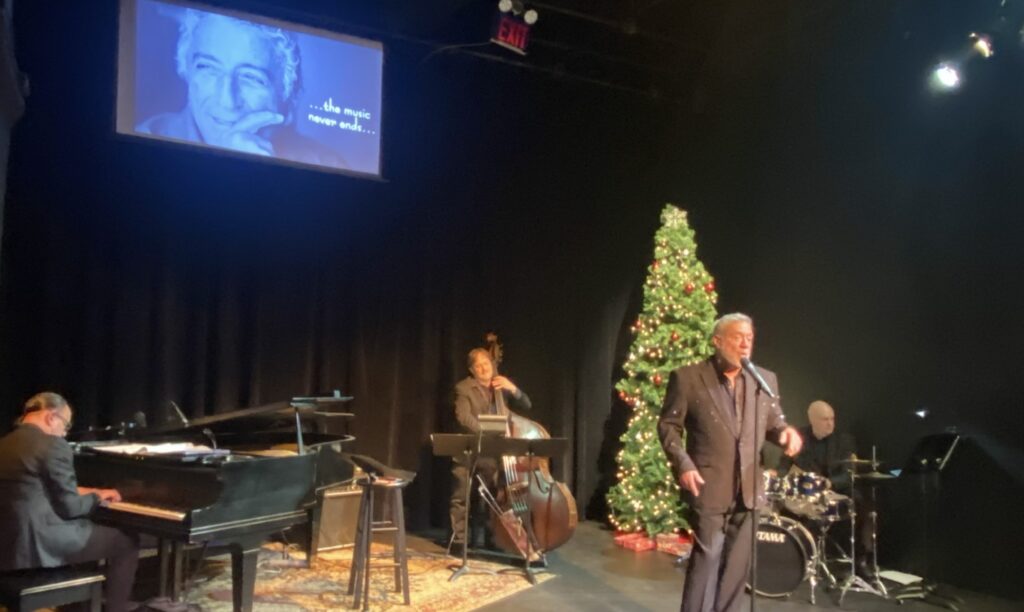
Eddie Bruce with Dean Schneider on piano, Brian Glassman on bass, and Lew Leabman on percussion. Photo by Sue Matsuki
Review by Jack Quinn, Publisher
Urban Stages — Winter Rhythms 2025
Winter Rhythms opened this year with a sense of ease and welcome that only Urban Stages can create. Festival producer Sue Matsuki greeted the audience with her familiar mix of calm leadership and genuine affection for the performers she curates. And before the music began, Frances Hill, Urban Stages’ founder and artistic director, set the tone with a brief, warm introduction. She reminded the room that although she is “a theatre person,” Winter Rhythms honors musicians—and that in her experience, “music people lift each other up.” In a space built on access, diversity, and artistic generosity, the line felt true and perfectly placed.
Into that atmosphere stepped Eddie Bruce, making his first-ever appearance at Urban Stages, joined by an excellent trio: Dean Schneider on piano, Brian Glassman on bass, and Lew Leabman on percussion. Bruce’s tribute to Tony Bennett ran about 75 minutes and moved with the ease of someone who understands the material deeply without needing to imitate it.
He opened with “Watch What Happens,” settling into a light swing that immediately established the trio’s sensitivity. Schneider’s touch was clean and spacious; Glassman provided a steady pulse; Leabman shaped the groove with brushes. Bruce delivered the lyric as if in conversation, and that straightforward approach carried naturally into “Changes” and “Because of You,” Bennett’s 1951 breakthrough. Bruce kept the sweetness intact without leaning sentimental.
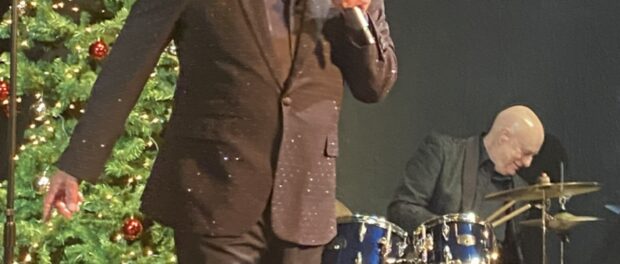
Lew Leabman on percussion With Eddie Bruce on vocals. Photo by Sue Matsuki
“If I Ruled the World” built steadily to a controlled, dramatic finish, followed by a breezy “Steppin’ Out” that nodded to Bennett’s MTV Unplugged era. “The Good Life” gave the trio their first real feature, with Schneider opening the tune in a warm, jazz-club mood. Bruce sang it with an unforced clarity that matched the spirit of the lyric: nothing rushed, nothing over-shaped.
A reflective “Maybe This Time” brought the room closer. Schneider’s piano framed the song with simplicity, and Bruce let the lyric carry the emotion instead of manufacturing it. “Just in Time” brought a lift, and “Days of Wine and Roses” settled into a slow, thoughtful swing that played to the trio’s quiet strength.
“The Shadow of Your Smile” was one of the evening’s most tender moments. Schneider’s bossa voicings were subtle and full of air, and Bruce kept his phrasing understated. The shift into a bright Latin-swing “Old Devil Moon” energized the room; Glassman and Leabman played with rhythmic accents that gave the number a buoyant lift.
The most striking moment came with “Fly Me to the Moon.” The trio played softly, but Bruce stepped away from the microphone entirely. Without amplification, the sound of the room changed. His voice carried on its own weight—natural, unfiltered, slightly vulnerable. Bennett’s 1965 version with Count Basie is bold and stylish; Bruce chose directness and connection. It was the clearest expression of what a small room and a trusted trio can do.
“For Once in My Life” returned the set to a fuller sound, followed by a bright, generous “I Got Rhythm,” where the trio took extended solos. Glassman‘s bass line was agile and musical, and Leabman delivered a crisp, compact drum break that fit the room perfectly. Bruce closed with “How Do You Keep the Music Playing?,” letting the lyric carry its own reflection on continuity: how songs survive, and why.
The encore was “I Left My Heart in San Francisco,” sung cleanly and without affectation. It felt like an offering rather than a finale.
By the end of the night, the throughline was unmistakable. Matsuki’s thoughtful curation, the trio’s quiet excellence, and Bruce’s steady, generous musicianship came together in a way that matched Urban Stages’ mission: to create access, nurture artists, and give audiences something honest. Frances Hill’s welcome—her belief that music people lift one another up—proved true. Eddie Bruce didn’t just honor Tony Bennett; he honored the house he was singing in. Winter Rhythms began exactly where it should: with community, craft, and a reminder of why these songs still matter.


Eddie Bruce was Divine..Brilliant..And…he doesn’t need a Microphone!!