
The Unfinished Conversation: Shaw in 2025
George Bernard Shaw — A salon-style evening at the American Irish Historical Society brought artists and educators together as David Staller led a candid, contemporary look at Shaw’s ideas in 2025.
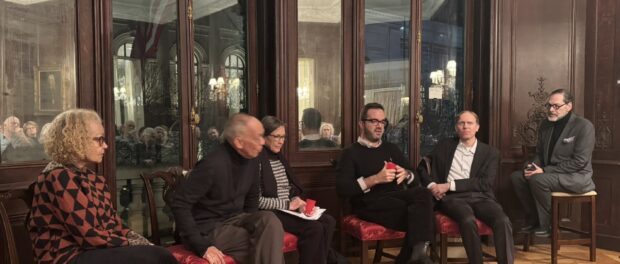
Lizan Mitchell (actress), Thom Sesma (actor), Patricia Denison (professor), Stephen Brown-Fried (director), James Armstrong (professor), and David Staller (artistic director of the Gingold Theatrical Group) (Photo by Jack Quinn).
By Jack Quinn, Publisher
The American Irish Historical Society’s wood-paneled parlor — glowing with warm light and Fifth Avenue reflections — proved an ideal setting for a salon-style evening dedicated to the ideas of George Bernard Shaw. Hosted by Gingold Theatrical Group and guided by founding Artistic Director David Staller, the night brought together actors, professors, board members, and students for a conversation that felt part seminar, part rehearsal room, part living history.
Staller began with a deceptively simple question: why does Shaw remain so challenging — intellectually, morally, and theatrically — in 2025? The responses moved easily around the room, beginning with actor Thom Sesma, long associated with GTG’s Shaw work, who described rehearsing Shaw as an “intellectual crucible.” For him, the text asks performers to balance argument, logic, and emotional pull at once, creating what he called a “third space” where thought itself becomes action and audiences must meet the actors halfway.
Lizan Mitchell, the actress currently appearing in Pygmalion, added that Shaw provides little explicit history for Mrs. Higgins, which means the performer must build a private emotional foundation strong enough to explain her clarity about Eliza’s vulnerabilities. Professor Patricia Denison, who brought a class of young women studying Pygmalion, noted that her students connected most strongly to Eliza’s shifting language — not as mythic transformation, but as an act of self-definition that felt close to their own experience of transitional identity.
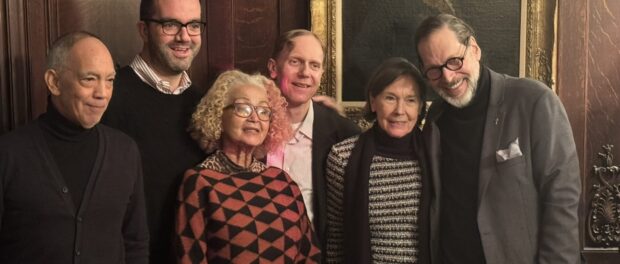
Thom Sesma (actor), Stephen Brown-Fried (director), Lizan Mitchell (actress), James Armstrong (professor), Patricia Denison (professor), and David Staller (artistic director) (Photo by Jack Quinn).
Stephen Brown-Fried, director and professor at The New School’s College of Performing Arts, expanded the point: Shaw’s meticulous phonetics reflect a belief that accent encodes class, geography, and aspiration. In a cultural moment reassessing the privilege embedded in “neutral American speech,” his approach feels surprisingly current. James Armstrong, professor of script analysis at Marymount Manhattan College, observed that students often judge Henry Higgins instantly, but when invited to consider him through frameworks such as neurodiversity or internal logic rather than morality, they begin to see a more complex consistency emerging beneath the character’s contradictions.
Armstrong later emphasized how different it is to read Shaw versus watch him. The plays are filled with philosophical asides, design notes, and detailed descriptions meant for artists, not audiences — hidden architecture that shapes the performance. Brown-Fried agreed, calling these passages “the blueprint beneath the world of the play.”
At one point, Sesma returned with one of the evening’s clearest provocations. Before asking who “inherits” Shaw’s mantle today, he suggested asking for whom new plays are actually being written. Many of the boldest contemporary playwrights — often writers of color — create work for communities that major institutions don’t consistently cultivate. The issue, he argued, is not a lack of Shavian voices but a structural gap between who writes the plays and who gets welcomed into the audience. The room absorbed this without contradiction.
Staller anchored the night with Shaw’s biography: a childhood of poverty in Dublin, a father battling alcoholism, a mother who doubted him, self-education in libraries, and a refusal to abandon his Irish accent. Shaw’s advocacy for women, labor, queer dignity, children’s welfare, and animal protection grows directly from that lived experience. Staller also revisited Shaw’s parent-child structures, particularly in Major Barbara and Mrs. Warren’s Profession. In early American productions, the real scandal of Mrs. Warren’s Profession wasn’t her past — theatre was full of “fallen women” — but her refusal to repent. Her daughter’s rejection is the play’s true emotional wound.
The evening included GTG’s managing producer, Isaiah Josiah, along with board chair Pamela Singleton and board member Mary Henninger, underscoring how deeply the organization’s leadership invests in the kind of idea-driven conversation Shaw himself prized.
As the gathering wound down, Staller spoke about the “unique weirdness” each person carries — the small rhythms and choices that reveal individuality. Shaw believed these quirks were not affectations but moral truths about a person’s character. Laughter followed, but recognition did too.
The night ended with Prosecco, slices of cake, and a quiet toast for Staller’s 70th birthday. A group photo closed the event, capturing a room still mid-thought — an ending entirely in the spirit of Shaw, who rarely tied his arguments neatly and never intended them to stop at curtain call.


Leave a comment