
The Yellow Wallpaper
As all great adaptations do, the play stays true to its source material while finding new ground all its own.
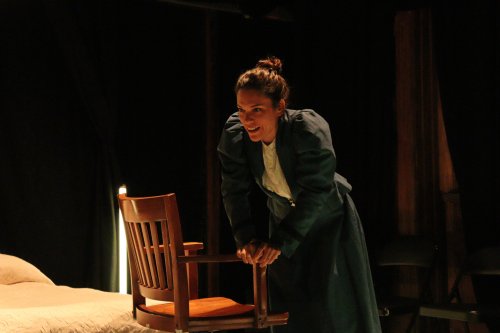
Susannah Millonzi in the Millonzi and Morley adaptation of Charlotte Perkins Gilman’s “The Yellow Wallpaper” at Bedlam’s West End Theatre (Photo credit: Rose Gonzales0
The Yellow Wallpaper is an enthralling new stage adaptation of Charlotte Perkins Gilman’s 1892 short story of the same name. Gilman’s original narrative is written as a series of diary entries by a woman who’s been confined to the upstairs room of a rented mansion by her husband, who is also her doctor. He prescribes her bed rest and little else, leading her to slowly losing her mind due to the stifling restrictions she is forced to exist under. Actress/choreographer Susannah Millonzi (Beldam’s Fall River Fishing, Hedda Gabler, The Crucible) and director Caitlin Morley (Macbeth, Twelfth Night) adapted the story together, taking a very direct approach. The diary entries become a series of monologues to be read by the nameless protagonist, the play’s only character. At the same time, the creative production and clever blocking adds significant depth to the narrative, introducing new ideas and exploring them wonderfully.
The show’s production perfectly establishes the claustrophobia of its narrative. The stage itself (designed by set designer John McDermott) is organized in such a way as to make the room feel small and stifling. A large bed and a small nightstand are the only furnishings in the protagonist’s room, where the entire story takes place. Hunter Lustberg’s lighting design plays a major role as well – a series of LED lights on the floor and back wall box in the protagonist, and the occasional spats of darkness or flashing different colors drive home her disorientation. John, the protagonist’s husband, never appears directly, he is instead represented in Joe Sinkovits’ sound design by a low and vaguely upsetting rumbling noise. The audience is placed as close as possible to the stage, further constricting the space, creating an uncanny intimacy of which the show makes excellent use.
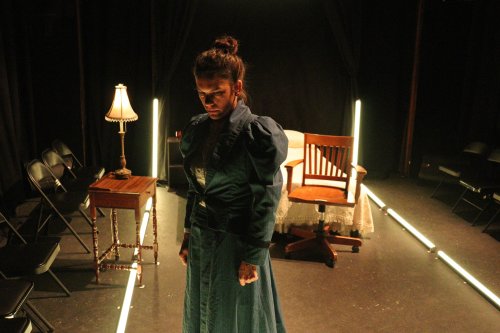
Susannah Millonzi in the Millonzi and Morley adaptation of Charlotte Perkins Gilman’s “The Yellow Wallpaper” at Bedlam’s West End Theatre (Photo credit: Rose Gonzales)
Over the course of the dramatization, the narrator’s clothes, the standard stifling late-19th-century women’s attire (set up by costume designer Sam DeBell), are slowly removed until she’s in just her nightdress at the end. This serves as a rather literal marker of the character’s progression, but also neatly marks the passage of time.
Millonzi, who portrays the nameless protagonist (credited simply as Woman), is the show’s lone actress. Her performance is masterful. She is on stage the entire show and excels throughout. Millonzi’s mannerisms slowly shift as the character progresses, never feeling too sudden. She perfectly captures the protagonist’s gradual loss of sanity. At the start, her performance embodies a jitteriness, as if the character is stifling her feelings in the name of decorum. That jitteriness, interestingly, fades the more stir-crazy she gets. There’s almost a joyousness to her performance towards the end, when the protagonist has begun stripping the wallpaper off and seeing shapes around the room. The movement is kept remarkably controlled, which is a unique choice that works quite well. Even when the protagonist is crawling on all fours or picking at the walls, it’s a madness without mania. It can be difficult to tell whether she’s finding solace in the wallpaper or if it’s simply a representation of her boredom-induced decline, and that uncertainty is something the acting and directing take in fascinating directions.
Millonzi’s physicality is deliberate, skillfully exploring these ambiguities. Even without speaking, she effortlessly commands the room. At one point she gets up on the bed and slowly falls into a Christ pose, seeming to go limp yet remaining upright in a moment of silent contemplation. It’s a striking moment, allowing Millonzi and Morley to introduce a new understanding of the nameless Woman: as a martyr, of sorts, in the Christian sense – her extraordinary suffering has become a source of solace for future generations.
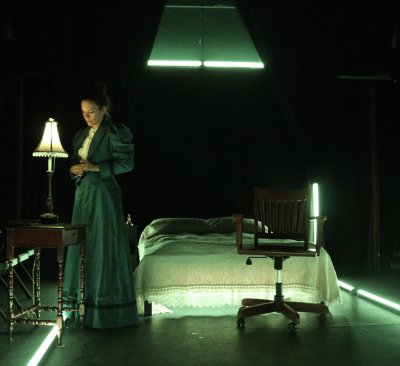
Susannah Millonzi in the Millonzi and Morley adaptation of Charlotte Perkins Gilman’s “The Yellow Wallpaper” at Bedlam’s West End Theatre (Photo credit: Rose Gonzales)
A brilliant little moment is when the character cries for the first time. It’s a sudden emotional shift that manages to be quietly devastating entirely through Millonzi’s skill as an actress. Informing her performance is an interesting idea: in the original story, journaling is a form of relief for the protagonist. Her husband doesn’t want her writing, believing it detrimental to her health, yet she does so anyways, hiding her notebook from her husband. In the stage adaptation, then, acting plays a similar role for the narrator. The performance, then, draws new meanings out of the same story, while being a considerable artistic feat in its own right.
The show is, simply put: incredible. A brilliant and moving experience, with a spectacular performance from the solo actress. The directing and acting are fine-tuned, with every detail of the character’s emotional progression fitting together. Millonzi and Morley’s adaptation furthers the themes of the original short story, often creating new meanings without needing any words at all.
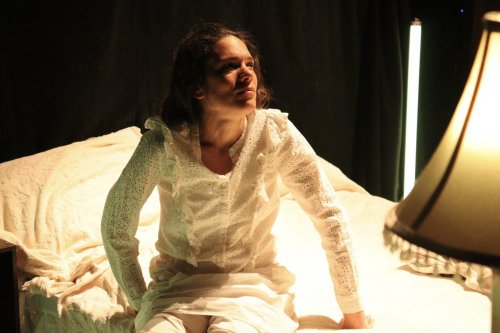
Susannah Millonzi in the Millonzi and Morley adaptation of Charlotte Perkins Gilman’s The Yellow Wallpaper” at Bedlam’s West End Theatre (Photo credit: Rose Gonzales)
The Yellow Wallpaper is sometimes called a story that women read. Over a century later, its words still resonate deeply. This adaptation, just as the original, tackles the themes of women’s infantilization, denial of agency, and pathologization. Without changing the text, Millonzi and Morley put their stamp on the narrative, introducing a new layer of complexity. As all great adaptations do, the show stays true to its source material while finding new ground all its own.
The Yellow Wallpaper (extended through December 21, 2025)
Bedlam & Wayward Son
West End Theatre, 263 West 86th Street, in Manhattan
For tickets, visit http://www.bedlam.org
Running time: 70 minutes without an intermission


Leave a comment