
Slaughter City
Naomi Wallace’s play makes palpably clear just how brutal a so-called “hard day's work” can be when dignity is a luxury and survival the only wage.
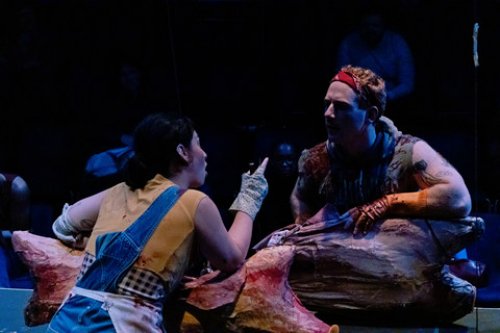
Lucy Buchanan and Ben Natan in a scene from Naomi Wallace’s “Slaughter City” at The Jeffrey & Paula Gural Theatre at A.R.T./New York Theatres (Photo credit: Matt Cubillos)
It has taken nearly three decades, but Naomi Wallace’s feverish proletarian dreamscape Slaughter City has finally carved its way onto a New York stage—and in doing so, has made a queasily persuasive case for its own urgency. First mounted by the Royal Shakespeare Company (January 1996) and the American Repertory Theatre (March 1996), this bruising, bloodstained fable—set in a slaughterhouse where class war, labor unrest, and the surreal intermingle like steam off a fresh carcass—feels, depressingly, like prophecy fulfilled.
In the years since its debut, the power of organized labor has withered in many corners of American life. But Wallace’s dramaturgy doesn’t so much wither as wound: the play’s beating heart remains the same—pulsing with the traumas of exploitation, the rot of institutional racism, and the inextinguishable ache of the working class for dignity, love, and survival. That Slaughter City now arrives in New York under the direction of Reuven Glezer, via Alex Winter and Small Boat Productions, feels not belated but inevitable. And its resonance today, in our era of “essential” workers and renewed labor militancy, is uncanny.
But if all this sounds grim, don’t be misled. Wallace is no polemicist. She is a poet of the blood-soaked floor, and her language, even at its most furious, is rich with humor, imagination, and a deep theatricality that resists the dry rigidity of didacticism. This is a playwright who embraces magic realism not as stylistic garnish but as spiritual necessity—and this production, to its great credit, doesn’t shy away from her flights of fancy. It soars with them.
Visually and viscerally, Glezer’s staging commits fully to Wallace’s aesthetic of the grotesque sublime. The action largely unfolds on and around a long central table, a symbolic altar for both the butchery of animals and the sacrifice of human bodies under capitalism. The design, to its credit, is striking: a runway stage displaying hanging carcasses swaying gently like pendulums of doom, and a wall with a throne-like chair that represents the management office if greed and authority emanate from some subterranean hellmouth. It is a production rich in sensory invention. Glezer and team (scenic designer Forest Entsminger, lighting designer Celia Krefter, costume designer Hannah Bird, props designer Jonathan Schatzberg, and sound designer Emma Hasselbach) deploy colors and sound with stormy abandon, and live music weaves through the production like a ghostly radio signal from somewhere deep inside the building’s pipes.
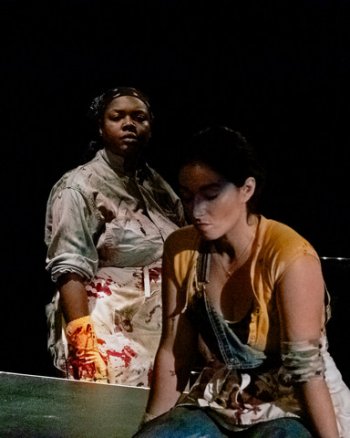
Le’Asha Julius and Lucy Buchanan in a scene from Naomi Wallace’s “Slaughter City” at The Jeffrey & Paula Gural Theatre at A.R.T./New York Theatres (Photo credit: Matt Cubillos)
Here, meatpacking workers in bloodied aprons flirt, bicker, sing, and slice—while somewhere just outside the periphery of the naturalistic lurk phantoms, time warps, and a meat-grinding specter from another century. The ostensible setting is Slaughter City, U.S.A., a nowhere-everywhere meatpacking plant suspended in a sort of Brechtian limbo, where the past bleeds into the present and the workers speak in epigrams and extended metaphors. These aren’t conversations so much as incantations, and what is left unsaid — about unionization, exploitation, or actual political stakes — looms larger than what is spoken.
Le’Asha Julius anchors the production with a galvanizing, soul-rich performance as Roach, a line worker whose toughness is matched only by her moral clarity. Julius moves through the play like a live wire, finding both the grit and lyricism in Wallace’s language. As Brandon, the buff co-worker whose swagger masks deeper vulnerabilities, Ben Natan delivers a finely shaded portrayal—at once swaggering and self-defeating, predatory and pitiable.
Lucy Buchanan is a standout as Maggot—Roach’s best friend and a character whose name hints at decay even as her spirit suggests defiance. Buchanan’s performance has a steeliness that never tips into cliché. Her quiet longing for Cod, the enigmatic newcomer played with eerie precision by KP Sgarro, lends the play an aching tenderness. Cod, a scab and something more, exudes the strange magnetism of a figure who has slipped through a crack in time—and possibly through a few dimensions of reality as well.
In the managerial echelons of this industrial underworld, Gil Charleston is moving as Tuck, a supervisor caught between loyalty and survival, trying to navigate the racialized power structure enforced by Baquin—the play’s most grotesque villain, and perhaps not entirely human. Nicholas Eric Sanchez embraces the part with reptilian relish, his Baquin a capitalist phantasm in an anachronistic suit who seems as likely to sprout wings as to downsize the workforce. Baquin keeps, of all things, a pet snail. Not just any snail, but the very last surviving specimen of its species: a slow-moving, mucus-trailing monument to fragility, preservation, and, perhaps, hubris.

Alan Simon in a scene from Naomi Wallace’s “Slaughter City” at The Jeffrey & Paula Gural Theatre at A.R.T./New York Theatres (Photo credit: Matt Cubillos)
It is the sort of absurd, symbolic flourish playwright Wallace delights in—a creature so singular and delicate, nestled perversely within a world of mechanized violence and dehumanization. One need not be a seasoned tragedian to anticipate the creature’s fate. Suffice it to say: the inevitable arrives not with quiet dignity, but with a squelch. Let us just observe that when tyrants cradle rare, defenseless things, the outcome is rarely poetic—unless one counts poetic justice. In this case, the comeuppance is as sticky and symbolic as one could hope for. Call it moral ecology, or simply karma with a machete.
And then there’s the wandering, wailing Sausage Man, played with melancholic whimsy by Alan Simon. With his hand-cranked meat grinder and mournful reflections on labor’s lost glories, he appears less like a character than a cautionary tale given flesh, a mournful wraith of industrialism past. Toward the tail end of Slaughter City, a singular moment of lucidity — or at least theatrical cheek — rises like a gasp from the abattoir fog. Out slinks the Sausage Man, a meat grinder slung across his neck like some grotesque St. Bernard keg, confronting a sneering, cartoonishly tyrannical meatpacking manager. The ghost offers not vengeance nor wisdom, but grass — actual grass — which the manager, in a fit of metaphorical over-identification, chews atop his desk before spinning toward the audience and releasing an anguished, ruminant “moo.” The manager has throughout the play taken a perverse pleasure in querying his workers for the “mood” on the “killing floor,” a site of blood, butchery, and bruised dignity. Thus, his bovine transmogrification becomes a symbolic collapse: capitalist becomes cattle, butcher becomes beef. It’s a neat conceit and in this moment, Wallace’s dense allegorical web briefly finds a thread of comprehensibility.
Similarly, the mute seamstress (Gabrielle Kogut) who appears at the start, toiling at the edge of the action, becomes a figure of haunting significance—part Greek chorus, part silent indictment in a recounting of a legendary workplace tragedy.
As in much of Wallace’s work, time is porous. The present melts into the past. The dead speak. Costumes defy chronology. Events shimmer with ambiguity. Is this a dream? A memory? A prophecy? In this world, there is no sharp line between meat and metaphor. Their rebellion is swallowed in symbolism, their plight smothered by abstraction. They speak as though their thoughts had been filtered through a dozen dialecticians, then rearranged by a Dadaist refrigerator magnet poetry set. The result? A play that seeks to evoke the visceral toll of industrial labor, but succeeds only in evoking the characters’ endless miasma.
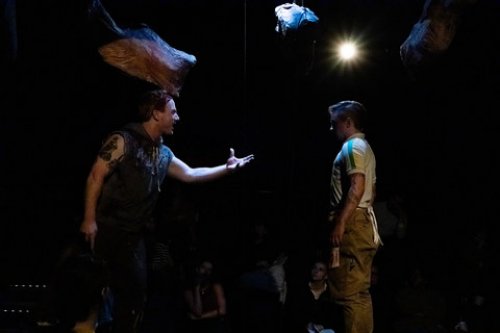
Ban Natan and KP Sgarro in a scene from Naomi Wallace’s “Slaughter City” at The Jeffrey & Paula Gural Theatre at A.R.T./New York Theatres (Photo credit: Matt Cubillos)
But the production’s real meat — to borrow the metaphor Wallace so loves — lies in its moments of unintentional comedy and theatrical surrealism. Brandon seducing a cut of meat. Roach biting a knife while whispering sweet threats. The textile worker (whose purpose remains enigmatic) spending most of the evening perched in darkness like a forgotten gargoyle, only to emerge with a monologue about the Triangle Shirtwaist Factory fire — a reference so tonally and thematically jarring it feels like it wandered in from another play entirely.
Ultimately, this Slaughter City is less a revival than a resurrection. Wallace’s play, with its grotesque beauty and moral fire, speaks as clearly to our present as it did to the Clinton-era world in which it was born. It is a work of rare ambition—maximalist in spirit, lyrical in construction, and unafraid to descend into the muck to show us what gets buried beneath “progress.” It leaves you shaken, stirred, and maybe even a little haunted by the ghosts of labor, and by the ones still hacking away on the line.
A prescient and unflinching meditation on the relentless machinery of industrial exploitation—regardless of the century or the continent—Slaughter City exposes the human toll exacted by systems that treat labor as expendable and bodies as interchangeable cogs. Whether conjuring the suffocating inferno of the Triangle Shirtwaist Factory in 1911 or the collapsing walls of the Rana Plaza in Dhaka over a century later, Wallace’s play insists that these tragedies are not aberrations but echoes—chilling refrains in a long, bloody chorus of capitalist indifference. Through the lived experience of its characters, bent-backed, blood-spattered, and desperate, Slaughter City is not merely historical allegory—it’s a cry from the factory floor that reverberates across time.
Alex Winter and Small Boat Productions
Slaughter City (through October 18, 2025)
The Jeffrey & Paula Gural Theatre at A.R.T./New York Theatres, 502 West 53rd Street, in Manhattan
For tickets, visit http://www.art-newyork.org
Running time: two hours and 30 minutes including one intermission


Leave a comment