
Punch
A new British play turns a deadly fight into one for redemption.

Will Harrison as Jacob (center) with Lucy Taylor, Piter Marek, Jacob Orr, Cody Kostro, Kim Fischer and Camila Canó-Flaviá in a scene from the Manhattan Theatre Club production of James Graham’s “Punch” at the Samuel J. Friedman Theatre (Photo credit: Matthew Murphy)
As an interminable cricket match enthralled a roaring crowd, Jacob Dunne, a troubled young man from a council estate in Nottingham, England, bar hopped nearby with his mates. Fueled by alcohol, drugs, and toxic masculinity, it was a reckless night that changed Jacob’s life forever after he ended someone else’s. Now, that real tragedy has become a staged one through British playwright James Graham’s Punch, which is currently in the dramatic throes of simultaneous Broadway and West End premieres.
Based on Dunne’s 2022 memoir Right from Wrong: My Story of Guilt and Redemption, Graham’s adaptation relies heavily on first-person subjectivity. Under Adam Penford’s feverish direction, that choice yields manic theatrical results as Jacob is seemingly caught in a whirlwind of past experiences that preceded and followed the only moment he remembers in slow motion: when he delivered a single, fatal blow to James Hodgkinson’s head. A sweet-natured paramedic, James had done nothing to provoke Jacob’s attack. He was simply in the wrong place at the wrong time. Aside from the fact he had loving parents, too, that’s roughly all the audience learns about the never-seen James who in death gets to be both a victim and a plot device.
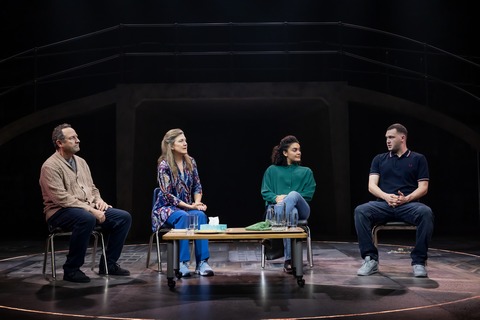
Sam Robards, Victoria Clark, Camila Canó-Flaviá and Will Harrison in a scene from the Manhattan Theatre Club production of James Graham’s “Punch” at the Samuel J. Friedman Theatre (Photo credit: Matthew Murphy)
Despite its noble-hearted objective to discourage random acts of violence (well, at least among the working class), Punch suffers from A Clockwork Orange problem. Jacob (Will Harrison) is a thoroughly charismatic miscreant but, as his “story of guilt and redemption” unfolds, he becomes an equally bland penitent. That’s not the fault of Harrison, an actor with presence to spare who merely plays the script he was dealt. In a snatch of Jacob’s propulsive monologuing, there is a key to why Punch goes sideways: “no one likes to admit…doing bad things…creates good feelings. It just does.” As with Alex and his droogs (or Tony Montana, Dexter, the Joker), Jacob’s personal high at deviating from social norms becomes a visceral one for the audience.
There’s brutal excitement in Jacob’s downtrodden world, which Penford and movement director Leanne Pinder choreograph to within an inch of hyperventilation, putting most of the cast through the mill as a costume-swapping chorus line of indiscriminate characters on Anna Fleischle’s bridge-to-nowhere set. Robbie Butler’s frenetic lighting and Alexandra Faye Braithwaite’s pounding original music and sound contributions add to the heady mix, along with an illusion that a lot is happening when, yeah, not much is happening. After James is taken off life support by his parents, Joan and David (the wasted talents of Victoria Clark and Sam Robards), and Jacob is handed a 30-month sentence for manslaughter–serving about half of it–Punch does shift into a lower gear, as if to say now let’s take it slow for the big lesson. But the play’s didacticism is incredibly lazy, as Graham goes through the motions of sketching Jacob’s transformation from Midlands hooligan to exemplar of restorative justice.
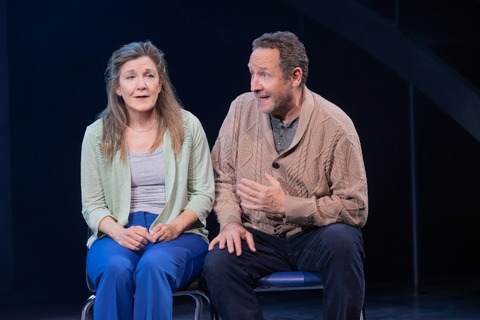
Victoria Clark and Sam Robards as Joan and David Hodgkinson in a scene from the Manhattan Theatre Club production of James Graham’s “Punch” at the Samuel J. Friedman Theatre (Photo credit: Matthew Murphy)
Graham rattles off a list of poorly explored reasons for Jacob’s spiraling behavior–absent dad; alcoholic mum (Lucy Taylor); autism; the dreary, panoptic nature of British public housing–before hitting a playwriting wall when it comes time to explain Jacob’s miraculous upswing. There is the hint of a religious conversion that apparently begins when a prison chaplain catches Jacob secretly reading a foreshadowing Bible psalm out loud: “let the redeemed…tell their story” (or, to put it another way, write a memoir and get the guy who wrote the book for the musical Tammy Faye to adapt it). In another blink-and-you’ll-miss-it sign of spiritual rebirth, Jacob then acquiesces to lighting a candle for James. Despite these steps toward the straight and narrow, however, a freed and still bloodthirsty Jacob soon is balefully chasing his ex-pal Raf (Cody Kostro) around the old neighborhood for ratting him out to the coppers about killing James. Then, after catching Raf, Jacob’s vengeful desire confusingly morphs into a primal scream followed by small talk about Raf’s dad (Robards, again). Maybe it was a delayed Biblical reaction. I’ll have to buy the memoir to check.
Most frustratingly, Punch mystifies in its primary aim: depicting the restorative justice process. At the encouragement of a charity worker (Camila Canó-Flaviá) and a probation officer (Taylor, again), Jacob participates in a tentative correspondence with James’s parents that eventually leads to an in-person meeting deep into the play’s second-cum-final act. That leaves just enough time for a declaration of forgiveness from mum but not dad, though they both wish Jacob well with the rest of his not prematurely ended life. It doesn’t seem particularly cynical to believe that, in this case, a 50 percent forgiveness rate is astonishing; it would be nice to know how that happened. One also wonders about Jacob’s meet-cute girlfriend Clare (Canó-Flaviá, again) whose major character development includes not having an “i” in her name, as well as a capability for romantic devotion unconnected to curiosity about the past. If nothing else, Punch has a playwright reluctant to muddy a happy ending with actual playwriting.
Punch (through November 2, 2025)
Manhattan Theatre Club in association with Nottingham Playhouse
Samuel J. Friedman Theatre, 261 West 47th Street, in Manhattan
For tickets, call 212-239-6200 or visit http://www.manhattantheatreclub.com
Running time: two hours and 30 minutes including one intermission


Leave a comment