
The Cherry Orchard
A multimedia approach to telling the story of Anton Chekhov's Russian classic.
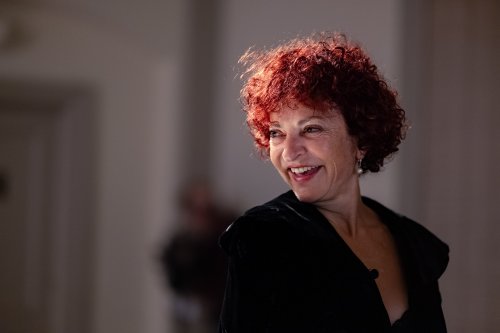
Megan Metrikin as Lubov in a scene from Anton Chekhov’s “The Cherry Orchard” at Rutgers Presbyterian Church (Photo credit: Joey Damore)
Anton Chekhov was a playwright and prolific short story writer who lived in Czarist Russia. He is considered one of the finest short story writers of modern times, and four of his plays have been continuously produced since the late 19th and early 20th centuries. His plays were commentaries on the contrasting differences and similarities between the Czarist Russian aristocracy and the developing middle class. His plays were uncomplicated from a plotting standpoint but were replete with nuanced expressions of how people truly act and speak. It was a realistic manifestation of the human condition that resonated with audiences then and now.
One of his seminal plays was The Cherry Orchard, a story about an aristocratic family who have fallen on hard times and must sell their estate and its famous cherry orchard. The play has been produced hundreds of times since its first performance in 1904, the year of Chekhov’s death, with numerous translations and interpretations of the story. It is essentially an exploration of the transition from the old aristocratic world to a new, more egalitarian one. It is a portrait of the shifting social structure through the lenses of loss, socio-political change, and the strong emotional influence of memory.
The story is relatively simple, following the actions of Lubov Ranevskaya (Megan Metrikin), a Czarist Russian noblewoman who returns to her estate after five years in Paris, where she was swindled out of her fortune. She returns to an estate that is in financial ruin and soon to be auctioned to pay the family’s debts. A significant part of the estate is a large, renowned cherry orchard.
The production by Adult Film, in association with BKE Productions, incorporates a multimedia approach to telling the story, based on a translation and adaptation by John Christopher Jones, who appears as the character Firs in filmed sequences. The show is dedicated to him, as he passed away before the show was scheduled to open. Ryan Czerwonko, the artistic director of Adult Film, is both the director of this production and plays Ermolai Alexeyevitch Lophakin, the son and grandson of serfs once owned by the estate, who has now become a very successful merchant. Lophakin is the principal protagonist of the tale who will resolve the fate of the cherry orchard and the estate. The ensemble of actors beautifully embodies the characters, exploring some of the subtler elements of their personalities.
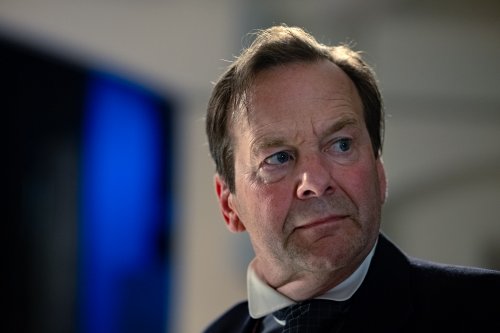
Simón Fortin as Gaev in a scene from Anton Chekhov’s “The Cherry Orchard” at Rutgers Presbyterian Church (Photo credit: Joey Damore)
The setting is sparse with minimal sets and props, and a large projection screen forming the back wall of the staging area. What makes this production interesting is not only its use of projections and film but also how it defines the characters into distinct groupings of aristocrats, servants, and a developing middle class. The production gives clarity to some of the socio-political issues presented by Chekhov.
The show opens with a prologue that is not directly connected to the play but serves as a device to define the performers and establish the production’s format. The entire ensemble is present, with film projections appearing on the back wall; one of these includes the late John Christopher Jones.
Lubov Ranevskaya is the core of the aristocratic group centered on her estate. Her brother, Gaev (Simón Fortin), is a gregarious man who talks too much, and although appearing to be in denial of what is happening, gives indications that he has a concern, if only fleeting, for his future. He discusses various methods of raising money to prevent the sale of the estate.
Anya (Raina Soman) is Lubov’s 17-year-old biological daughter, who is a typical teenager of that period. She is naïve about the world at large, having led a sheltered life and been raised in an aristocratic family. She did see how her mother was being exploited in Paris, but wasn’t able to help her. Gaev thinks that if she marries a rich man, the estate will be saved.
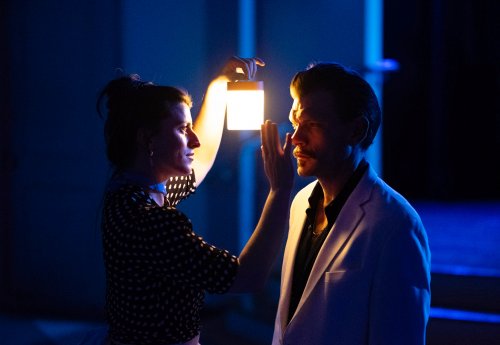
Madeline Bernhard as Dunyasha and Ryan Czerwonko as Lophakin in a scene from Anton Chekhov’s “The Cherry Orchard” at Rutgers Presbyterian Church (Photo credit: Joey Damore)
Varya (Lauren Guglielmello) is the adopted daughter of Lubov and is the underappreciated caretaker of the estate. She is treated more as a piece of furniture than as a loving daughter. She is the one who must deal with the fallout of Lubov’s behavior when it comes to spending the scarce resources of the estate. She is also romantically linked to Lophakin, with the expectation of everyone who knows them that he will marry her. A romantic tension is made clear in this production.
Joshua Matteo fully embodies Carlotta as an eccentric gypsy type woman who hides her loneliness through her eccentricities, such as using a Tarot deck or magic tricks to interact with others on the estate. She worked as a governess for the family, and although she is seen as a part of the estate by others, she feels apart from any group.
There are several romantic or proto-romantic developments. One involves Dunyasha (Madeline Bernhard), a vain and self-absorbed maid who fantasizes about romance and becoming a noblewoman. Her first romantic interest is Epikhodov (Matthew Zimmerman), the estate’s accountant, but she becomes attracted to Yasha (Taylor Petracek), who is an opportunistic parasite, full of pretension and putting on airs of aristocracy. He is a predator, and Dunyasha becomes his prey. He rejects anything that reminds him of his peasant past, including his mother.
Epikhodov, on the other hand, introduces a comedic element from his first entrance, with his boots squeaking with each step. His existence also serves as a comedic element, given that the estate is bankrupt. He is in love with Dunyasha, but her desire for a higher status has led her to be seduced by Yasha.

Lauren Guglielmello as Varya and Raina Soman as Anya in a scene from Anton Chekhov’s “The Cherry Orchard” at Rutgers Presbyterian Church (Photo credit: Joey Damore)
Another character, entirely in the throes of denial, is Pischik (Jay Geist). He is a neighbor of Lubov’s and represents all the landowners in the region who are struggling financially. He is constantly searching for money, including approaching Lubov on the first night she returns to the estate. He is also a comedic element in the story, as evidenced by some of the ridiculous things he does.
The character Trofimov (Ethan Navarro) presents a critical element to the play. He is the perennial student who was the tutor to Lubov’s son, who died in a tragic accident. He is the voice of the revolution, intelligent and impassioned, but lacking in real-world experience, a factor that contributes to his judgmental and unforgiving nature.
The character of Firs, as presented in the film, is a departure from the importance of the character and his physical interactions with the various groups. He is deaf and senile and is Chekhov’s representation of old Czarist Russia. While presenting Firs in a film is a departure from the original text, it is handled effectively by director Czerwonko. It imparts a ghost-like presence to the character, which would be in line with the nature of the character as conceived by Chekhov.
The staging area lends itself to an immersive quality, another element that helps focus on particular aspects of the performances. The structure of the show allows for a clearer understanding of who these characters are and how they fit into the whole collapsing world of the estate and ultimately, the cherry orchard. There are choreographed elements that add a surreal touch to the events being depicted, as when a group of actors slowly moves a piano from one side of the performance space to another. It is less of a distraction than a focus element to the action taking place in the foreground.
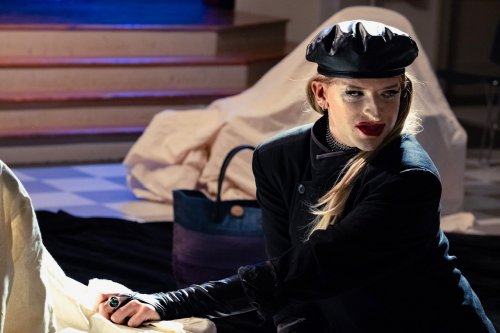
Joshua Matteo as Carlotta in a scene from Anton Chekhov’s “The Cherry Orchard” at Rutgers Presbyterian Church (Photo credit: Joey Damore)
The tech and video design by Case and Porter solidly adds structure to the production. It can be a challenging task to blend projection elements, film, and video into any production, and in this case, the team achieved a seamless integration of all these crucial elements. Madeline Rostmeyer’s costume design evokes the period by blending contemporary design elements with traditional period styles. Sound design is a critical element in the staging, given that it is spread throughout the entire performance space. Justin Ma has created a sound environment that is true to Jones and Czerwonko’s vision, keeping the audience engaged even when actors are not in the center of the performance space.
The Cherry Orchard (through October 12, 2025)
Adult Film in association with BKE Productions
Rutgers Presbyterian Church, 236 West 73rd St., in Manhattan.
For tickets, visit http://www.eventbrite.com/e/the-cherry-orchard-tickets-1579204094959?aff=ebdsoporgprofile
Running time: two hours and 10 minutes including one intermission


Leave a comment