
Last Call, A Play with Cocktails
En Garde Arts has been producing thrilling site-specific performances in New York City since 1986, and here they strike 24k theater gold once again.
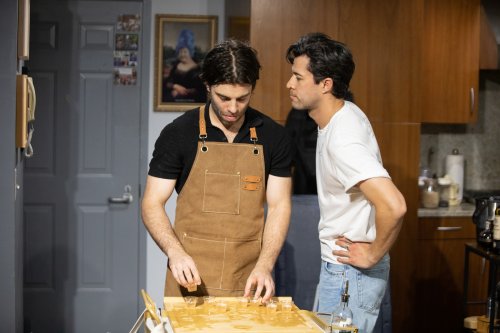
Chris Bannow and Mitchell Winter in a scene from Hansol Jung’s “Last Call, A Play with Cocktails” at various locations (Photo credit: Fred Charles)
The theatrical landscape, always a shape-shifter, now finds itself pouring back into living rooms, kitchens, backyards—spaces both domestic and uncanny. Last Call, A Play with Cocktails, a site-specific collaboration from Hansol Jung and co-director Dustin Wills, is less a conventional drama than a moody, high-proof séance. It’s being served (and staged) not in theaters but in private homes around the city, and while the storytelling occasionally loses its balance, what it gains in atmosphere, intimacy, and alchemical unpredictability is intoxicating in its own right.
Let us begin, as one must, with the world itself—or what shimmers into view in place of one. The world-building here is fragmentary, suggestive rather than declarative. There is a lockdown. There are curfews. There’s an unnatural frequency of funerals. One must don protective gear to go outside, but whether the threat is viral, ecological, authoritarian, or all three in catastrophic concert, we are never told. The uncertainty is less a flaw than a feature. In 2025, the whiff of apocalypse clings to everything anyway, and the production leans into that free-floating dread with the confidence of artists who know we no longer require specifics to feel doomed.
The conceit is clever: each performance takes place in a real home, the precise address dispatched only the day before, like a speakeasy or secret society. A password grants entry. There’s a frisson to ringing an unfamiliar doorbell in a neighborhood you’ve selected but don’t know, expecting to be welcomed inside. And welcomed you are—by a host (a literal homeowner, not an actor), who hands you a letter (“Congratulations on leaving the comfort and safety of your homes during this crisis…”) and offers wine and chatter before ushering you toward a makeshift audience configuration: a scatter of couches, dining chairs, bar stools, forty-some options in all, arranged with deliberate casualness.
Just as you begin to wonder how, exactly, this will become a play, your (bar)Tender arrives. He’s late. He’s distraught. He’s encased—hilariously, ominously—in the hard shell of a full-sized USPS mailbox, which he declares is “protective gear.” (A detail as absurd as it is revealing—after all, in a crumbling state, even the mail must wear armor.) The actor, on the evening attended, was Christopher Bannow, half of a rotating duo; his other half, Mitchell Winter, arrives later—and not altogether alive.
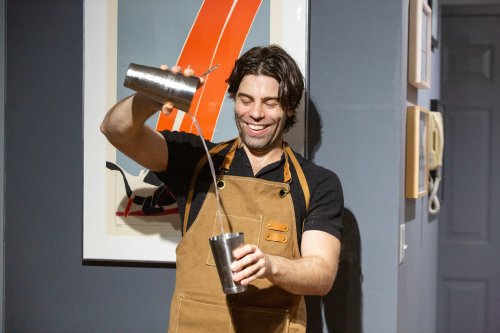
Chris Bannow in a scene from Hansol Jung’s “Last Call, A Play with Cocktails” at various locations (Photo credit: Fred Charles)
Bannow is magnetic from the first pour. As he begins constructing cocktails with the easy flair of someone who knows this is not just performance but ritual, he spins stories, trivia, and personal laments in equal measure. A funeral, he reveals, made him late. The funeral was his husband’s. It’s fine, he insists—grief, after all, is just part of the air we breathe now. He deftly draws in the audience with the intuitive charm of a seasoned bartender: knowing precisely when to press a personal question, and when to pull back into the comfort of a shaker and a tale of Prohibition-era imbibing.
The evening builds like a slow-boil infusion. The house becomes both bar and confessional, the audience both patrons and potential witnesses. That duality is by design. The performance flexes around its audience, bending to participation, to silence, to the unique social chemistry of any given night. There are, apparently, two entirely distinct versions of the script – this one featured a Hanky Panky and a daiquiri, while the play seen on other nights features a Vieux Carré and an Aviation—with different stories, histories, and textures leading, ultimately, to the same destination. This variation, far from a gimmick, is emblematic of Jung and Wills’ ambitions: to create a theatrical experience that is truly porous, unstable, alive. And then, like a twist of lemon dropped into gin, the dead man arrives.
A voice on a walkie-talkie calls our Tender away. When he exits, someone slips in past him at the door: It is Winter, his dead husband, his former co-conspirator in these illicit gatherings. Winter plays him not as a ghost in the traditional sense, but as a specter of memory, contradiction, theatrical necessity. He can see Christopher; but Christopher cannot see him. Only we can. And thus begins the production’s most ingenious conceit: the audience as medium. Our reactions—gasps, shifts, laughter, discomfort—become the bridge. Upon returning from the empty vestibule, Christopher begins to sense something. Something is in the room. We know, because we’ve seen “it.” “It” has already engaged us in delightful banter as well. And now Christopher begins to know because we do.
It’s a device that could feel forced, but doesn’t. Instead, it creates a kind of shared haunting—where the boundaries between performer and participant blur. This conceit demands that at least one audience member rise to the occasion, becoming, briefly, part of the narrative scaffolding. It’s a risk—but one the performers navigate with generosity and grace.
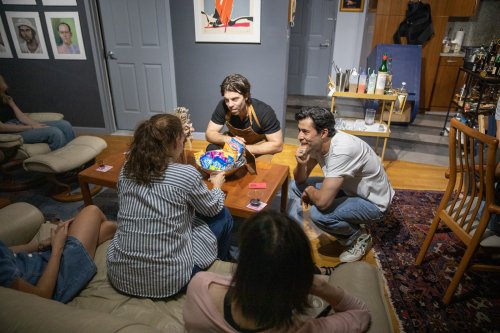
Chris Bannow and Mitchell Winter in a scene from Hansol Jung’s “Last Call, A Play with Cocktails” at various locations (Photo credit: Fred Charles)
Bannow and Winter offer sharply contrasting energies, each calibrated to draw out a different tension. Bannow’s bartender is poised, intellectual, gently manipulative—there’s sincerity in his grief, but also calculation. This, after all, is his stage, and he wants a good tip. Winter’s ghost, by contrast, is pure mischief—until he isn’t. He flirts, teases, flirts, dazzles, and flirts. But as their incompatible versions of Winter’s death unfurl, Bannow’s charm curdles into accusation, regret, perhaps even guilt. One of them is lying—or at least distorting. And the audience, now deeply implicated, is asked to judge.
We do judge, eventually. But the choice, like any good twist, leaves an aftertaste. No resolution is entirely satisfying. No version is entirely true. The ending—a final turn that won’t be divulged here—lands with unexpected weight, a bitter note in an otherwise bittersweet cocktail. You leave the home (someone else’s home!) feeling unsettled, moved, and slightly complicit.
It must be said that the world of Last Call, A Play with Cocktails never entirely coheres, but that matters little. The specifics of this dystopia remain blurry, and at times, one longs for a firmer grasp of what’s at stake beyond the metaphorical, but the main focus is the shattering of a relationship. The two attractive men could be the advertising campaign for a gay Match.com (but to the nth power), so what happened, and if there is blame, who of these two engaging men could be at fault? There are stretches of exposition that flit, then distract, particularly when we dip into the backstory of the couple’s business and its dissolution. It may occasionally strain credulity that Christopher would place so much trust in a roomful of strangers—even given the circumstances, but it’s entirely probable that he may not have anyone in his life to interact with…that certainly seeps through. Audience members may be compelled to get up just to give him a much needed hug.
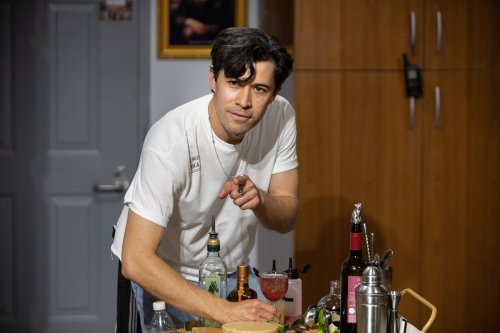
Mitchell Winter in a scene from Hansol Jung’s “Last Call, A Play with Cocktails” at various locations (Photo credit: Fred Charles)
But none of that vagueness fatally undermines the production’s core strengths: its mood, its magnetism, its formal daring. Like the cocktails at its heart, Last Call is built on balancing acts—bittersweetness and booze, artifice and intimacy, presence and absence. It asks you to come close, to sip deeply, and to sit with the discomfort of not knowing exactly what you’ve consumed.
Every performance is different, and that is not mere marketing copy: different houses, different actors, different drinks, different ghosts. The show you see will not be the one your pickleball buddy sees. But if Jung, Wills, and their cast continue to conjure that same aura of haunted conviviality, then Last Call: A Play with Cocktails remains a toast worth raising.
Last Call, A Play with Cocktails (rotating cast through October 13, 2025)
En Garde Arts & The Pack
(Located in private homes and apartments across New York City)
For tickets, visit http://www.engardearts.org
Running time: 80 minutes without an intermission


Leave a comment