
Mystic Conversations
An exploration of paranormal experiences of a ten-year-old boy who sees and senses spirit forms.
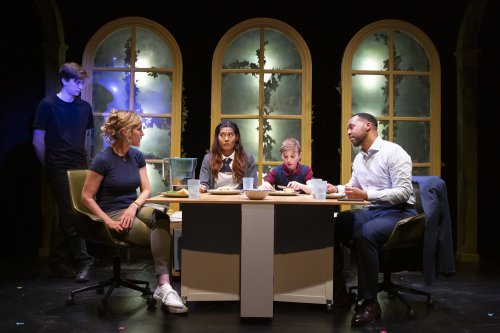
Nicky Torchia, Jenny Strassburg, Frenie Acoba, Lincoln Cohen and Brandon Jones in a scene from Julia Barry Bell’s “Mystic Conversations” at Theatre Row (Photo credit: Hunter Canning)
There are times in everyone’s life when something is sensed or seen without being recognizable. It could be a feeling of being watched or a view of something out of one’s peripheral vision, leading to questions of whether it was real or my imagination. Children frequently experience these events of seeing things no one else can see or hearing sounds that are beyond the perception of adults who are asked to listen. Sometimes, what is being perceived is not based on a misperception or imagination but on an actual encounter in what some would call liminal space, a place at the boundary of real and unreal.
Mystic Conversations is a story brushing the edges of liminality as told by Julia Barry Bell. The play, directed by Joey Brenneman, explores the paranormal experiences of a woman’s ten-year-old son who sees or senses spirit forms, including one persistently present in his room. The exploration attempts to deal with the personal dynamics surrounding the boy’s experiences and the challenges they present to the family’s religious beliefs and their understanding of a reality based on science.
The play opens with The Mom, effectively embodied by Jenny Strassburg, presenting a prologue to the story. She is an artist in her early 40s with two children: The Boy (Lincoln Cohen), a ten-year-old with psychic abilities, and The Sister (Frenie Acoba), a 15-year-old with a typical teenager’s attitude. The father, The Dad (Brandon Jones), is a mid-40s businessman who appears to be emotionally detached from the other family members. The Sister and The Dad are not fully developed characters and serve superficially to fill out some of the scenes, occasionally supplying lines of dialogue that add to the definition of The Mom and The Boy.
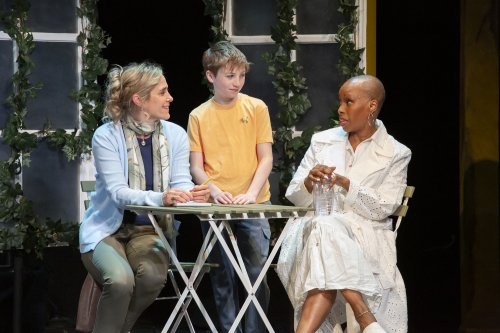
Jenny Strassberg, Lincoln Cohen and Brenda Braxton in in a scene from Julia Barry Bell’s “Mystic Conversations” at Theatre Row (Photo credit: Hunter Canning)
The story is centered on The Mom, The Boy, and two other characters, The Mystic, fully embodied by Brenda Braxton, and the Spirit Child, a representation of a 16-year-old boy. Nicky Torchia gives a solid and touching performance of this non-verbal character who appears in a number of the scenes throughout the play, including, most importantly, near the end.
The first encounter with The Mystic and The Mom occurs at a hair salon which The Mom patronizes. Their interaction establishes the direction the story will take and introduces two key elements: the boy seeing things and The Mom having had three pregnancies. As she leaves the shop, The Mystic mysteriously tells her that they will meet again.
The Mom is dismissive of the idea that it is possible to see spirits or that dead relatives are often nearby. Her view begins to change when, over dinner, she talks about the woman she met at the salon. In the course of the conversation, she tells of the woman thinking The Mom had three children, which revealed the three pregnancies. This piece of history was unknown to the kids, and it triggers a conversation with the children that The Dad shuts down. After the children leave the dining room, the Dad suggests that the conversation should not take place with the children. Later that evening, The Mom is with The Boy in his room and they begin to talk about the idea of seeing spirits. In the course of the conversation, The Boy reveals that he sees orbs of light and a boy who sometimes sits on his bed.
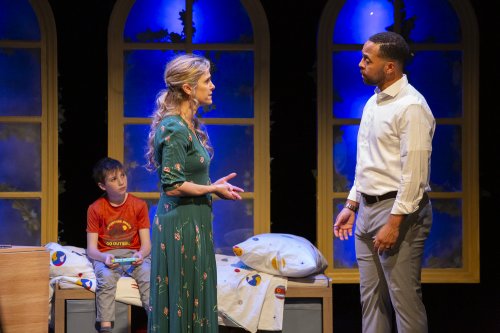
Lincoln Cohen, Jenny Strassburg and Brandon Jones in a scene from Julia Barry Bell’s “Mystic Conversations” at Theatre Row (Photo credit: Hunter Canning)
What follows is The Mom and The Mystic getting more involved with the paranormal nature of The Boy. As the play progresses, more details about the spirits and their interactions with the boy are revealed. It reaches a point where The Mom helps The Boy make the spirits in and around his room go away, except for one, the teenage boy who sits on his bed and appears in other areas of the house.
The play is a nicely developing mystery fantasy story about the paranormal, but when the teenage boy is revealed as the Spirit Child, the show goes off track. The idea presented is that the Spirit Child is the child who would have been born except for the miscarriage. This idea is a stretch in believability for the dramatic structure of the show.
It introduces the idea that a consciousness once attached to a developing embryo continues to be attached to the woman who was carrying that embryo even after the tissue has been expelled through a miscarriage. It turns on its head the whole idea of developmental psychology. How is it possible for the miscarried tissue that was not even old enough to definitively determine sex to become a spirit that ages as if it had been born?
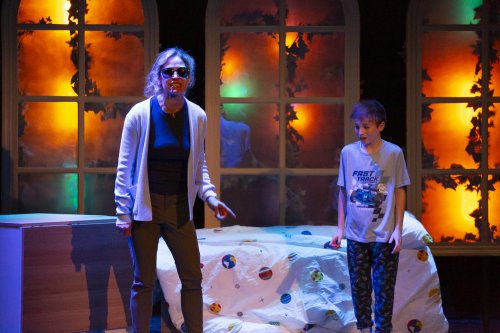
Jenny Strassburg and Lincoln Cohen in a scene from Julia Barry Bell’s “Mystic Conversations” at Theatre Row (Photo credit: Hunter Canning)
I am not averse to the idea of a consciousness becoming attached to a developing embryo. Still, the attachment ends when the embryo ends, and the energy that was that particular consciousness will find a different embryo with which to attach.
Unfortunately, this is not what plays out in this show. As The Mom and The Boy become more involved with The Mystic and discover more aspects of his abilities, he begins to refer to the Spirit Child as his brother. All of the focus on the paranormal exacerbates the personal issues between The Dad and The Mom which are treated superficially. The first indication of a problem occurs in the opening scene when The Mom says, in response to a question about her marriage from The Mystic: “Always the same. Very little talking. Life as we know it could come crumbling down around us, and he wouldn’t even notice, or at least he would refuse to.” It is a serious emotional issue treated as a side element in the couple’s discussions about The Boy.
The show ends without a clear resolution to several issues introduced throughout the play. The audience is left with holes in the dramatic arc that need to be filled.
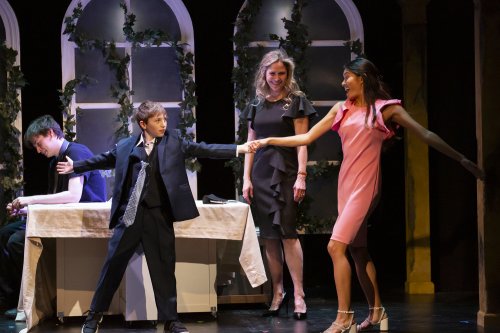
Nicky Torchia, Lincoln Cohen, Jenny Strassburg and Frenie Acoba in a scene from Julia Barry Bell’s “Mystic Conversations” at Theatre Row (Photo credit: Hunter Canning)
Scenic designer Dana Weintraub’s sets work well on the small stage, allowing simple changes to be made, effectively shifting the focus from one location to another. Their use of window frames was clever in simply shifting the action from an interior location to an exterior one. The sound design by The Roly Polys (Janet Bentley and Andy Evan Cohen) works seamlessly with Bobbi Reneé Fullerton’s lighting design. Fullerton’s lighting design is solid in highlighting the presence of the Spirit Child without distracting from the integrity of the action.
Mystic Conversations (through May 17, 2025)
New Light Theater Project Spotlight Series
Theatre One at Theatre Row, 410 West 42nd Street, in Manhattan
For tickets, visit http://www.bfany.org/theatre-row/shows/mystic-conversations/
Running time: one hour and 40 minutes without an intermission


Leave a comment