
Grief Camp
A new play from the Atlantic Theater Company takes an Annie Baker-style approach to youthful bereavement.
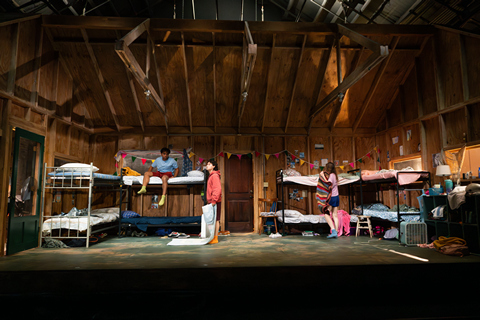
Arjun Athalye as Bard, Dominic Gross as Gideon and Maaike Laanstra-Corn as Blue in a scene from Eliya Smith’s “Grief Camp” at Atlantic Theater Company’s Linda Gross Theater (Photo credit: Ahron R. Foster; set design: Louisa Thompson)
Time passes slowly during Grief Camp as a bunch of adolescent characters and the audience watching them struggle collectively to figure out the point of being there. Playwright Eliya Smith fails to provide that enlightenment, though director Les Waters does his best to pretend it might be forthcoming, stretching the emptiness of Smith’s script until it simply has to be acknowledged. Set in the actual town of Hurt, Virginia, the play’s narrative development is mostly in its title and that correspondingly unsubtle location choice, where Smith hazily depicts a sleepaway camp for young people coping with death at an age when life is painful enough.
Substantially draining this decades-old, group-healing concept of its heartrending reality, Smith makes the curious choice to largely disengage from her characters’ trauma by never showing them in their therapeutic sessions. Admittedly, in the intervening moments, Smith allows some suffering to emerge, but not enough to suggest it’s her prevailing concern. Instead, Smith seems primarily intent on navigating the far reaches of the mundane. Unfortunately, that ends up turning Grief Camp into an Annie Baker-style writing exercise, where the playwright discovers that she’s not Annie Baker.
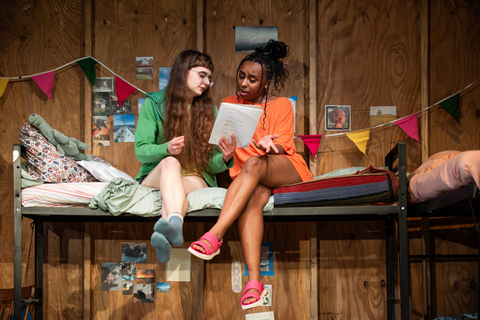
Maakike Laanstra-Corn as Blue and Renée-Nicole Powell as Olivia in a scene from Eliya Smith’s “Grief Camp” at Atlantic Theater Company’s Linda Gross Theater (Photo credit: Ahron R. Foster)
While it’s possible Smith erred on the extreme side of naturalism to avoid an accusation of exploiting her youthful characters’ vulnerability to generate easy tears, that charitable interpretation still leaves the audience mired in the type of dramatic inertia that makes patience eventually feel like a punishment rather than its own reward. That punitiveness becomes especially acute as Smith continues to fill the play with normal teenage dialogue, an approach that could have been interesting if more of it were interesting. But, apart from a few revealing exchanges and a final cathartic flourish, what Smith’s characters mostly utter is so intentionally incidental that Grief Camp registers as a willful refusal to imagine the deeper human connections that often form through shared sadness, not just between a play’s characters but also with the audience.
Of course, the expected interactions Smith considers theatrically artificial don’t get replaced by words that ring less false. If anything, they come across as a playwright padding her subject to avoid wrestling with it. Even then, this strangely sidetracked effort results in paper-thin characterizations. There’s the Duolingo-obsessed night owl, Bard (Arjun Athalye), who lets everyone mistakenly call him Brad and, for some reason, thinks that “old-timey” sailors couldn’t swim; Gideon (Dominic Gross), owner of a stuffed toy; Luna (Grace Brennan) and Esther (Lark White), the closest friends in the play and idolizers of a toenail; Esther’s big sister Olivia (Renée-Nicole Powell), a relentless flirt; Cade (Jack DiFalco), a former camper turned counselor who doesn’t possess the judgment to stay away from Olivia; and, finally, we have Blue (Maaike Laanstra-Corn), whose name says it all, in keeping with Smith’s more sterile tendencies that apparently exist to compensate for her exhaustingly opaque ones.
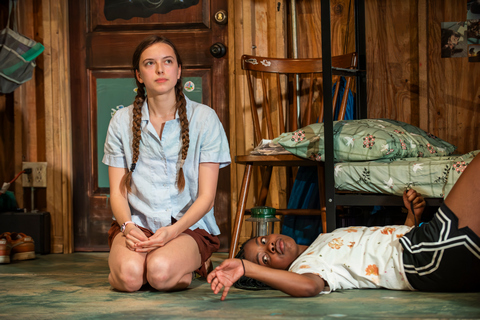
Grace Brennan as Luna and Lark White as Esther in a scene from Eliya Smith’s “Grief Camp” at Atlantic Theater Company’s Linda Gross Theater (Photo credit: Ahron R. Foster)
Essentially, Blue is sorrow incarnate, flitting around the camp as she composes a musical about someone doubly trapped in a glass mansion and on an island. Presumably, this imagery conforms to Blue’s emotional state, but, when Grief Camp and Blue’s musical finally collapse together in a storytelling free-for-all, that intelligible sense of lonely despair becomes idiosyncratic to a fault, with Blue singing, “I do not experience fullness/as a physical sensation/I have eaten the moon/my stomach teems.” These mysterious lyrics and the ones that follow clarify, if nothing else, that neither Blue nor Smith particularly want to be understood.
As for who is running the place, it’s a guy named Rocky (Danny Wolohan), and he’s a “trained childhood psychiatrist” who started the camp “out of his home.” I know these things about Rocky, who’s only present in the play as a disembodied voice heard through a PA system, because of Smith’s script notes, which provide a lot of important information that is not communicated in the characters’ dialogue. Given that non-critics probably won’t be sent the play, it’s unlikely they’ll be able to discern Rocky’s professional qualifications or the camp’s beginnings from his ramblings about “cave sex” and Alexander Graham Bell’s ironically deaf wife.

Dominic Gross as Gideon and Arjun Athalye as Bard in a scene from Eliya Smith’s “Grief Camp” at Atlantic Theater Company’s Linda Gross Theater (Photo credit: Ahron R. Foster)
Honestly, sans the play’s title and Louisa Thompson’s evocative cabin set, complete with bunk beds and other just-right details, one could easily think that some force–malevolent or its haughty opposite–had consigned the characters, and us, to purgatorial torment. That inkling is reinforced by the last adult at the camp: an unnamed, taciturn guitarist (Alden Harris-McCoy) with a fondness for spiritual mood music that might be intended to elicit purifying agony. He also, either because of improvisational genius or an unseen rehearsal, keeps Blue’s musical from being a solo endeavor, though, bizarrely, he doesn’t necessarily feel a part of it, either.
In a similar vein, Grief Camp often seems like an author speaking to herself. That’s too bad, because, sooner or later, we all become residents of the grief camp, which is absolutely horrible and absolutely beautiful, the former for obvious reasons and the latter because it’s a comfort to be forever marked by how much others mean to you: both those who are gone and those who remain. Smith argues–and, yes, there is a pretty decent chance I’m getting her wrong–that we can be free from grief, and that’s desirable. I’m not so sure, but I was willing to hear more.
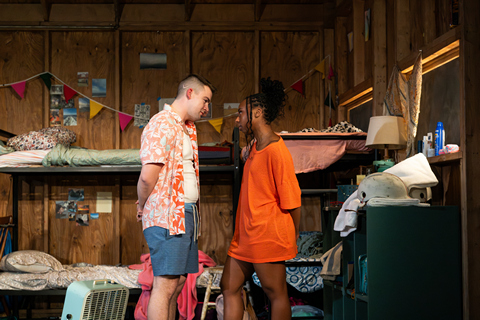
Jack DiFalco as Cade and Renée-Nicole Powell in a scene from Eliya Smith’s “Grief Camp” at Atlantic Theater Company’s Linda Gross Theater (Photo credit: Ahron R. Foster)
Grief Camp (through May 11, 2025)
Atlantic Theater Company
Linda Gross Theater, 336 West 20th Street, in Manhattan
For tickets, call 646-452-2220 or visit http://www.atlantictheater.org
Running time: one hour and 30 minutes without an intermission


Leave a comment