
REMEMBERING KEN PEPLOWSKI
Ken Peplowski was not just the greatest clarinet player of his generation; he was a friend I admired for some 46 years—beginning well before he became famous. Oh, he did a bit of work outside of jazz on his way to the top. (He told me he witnessed far more hijinks of every sort when he did the musical “Annie” than he ever witnessed in the supposedly dissolute world of jazz.) But jazz was his first love. I found his unflagging zest for life inspiring.
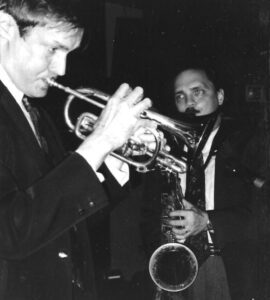
Peter Ecklund (cornet) and Ken Peplowski (tenor sax) — photo by Chip Deffaa
By Chip Deffaa
I’m still processing the passing of Ken Peplowski, whom I knew for some 46 years. He was widely recognized as the greatest clarinetist of his generation. He added so much to the nightlife of New York, his home for the past four decades. And he successfully took his music to all parts of the world.
As the New York Times noted, Peplowski was the guy who brought the clarinet back in jazz. In the big-band era of the 1930s and ‘40s, master clarinetists/bandleaders Benny Goodman and Artie Shaw made the clarinet one of the most popular instruments; but it fell out of favor in subsequent years. Peplowski helped bring it back.
He was equally accomplished on tenor sax. (You don’t often see that combination.) And audiences just took to him. He had a rare gift for communicating with an audience, both instrumentally and verbally–drawing audiences closer to him with his self-deprecating wit. Birdland Jazz Club gave him a base in New York City. But he traveled frequently, hopping off to play in Japan or in Europe as easily as if he were crossing the street to buy a bagel in NYC. He won loyal fans worldwide.
Ken delighted in the fact that, over the years, he got to work and record with so many artists he really admired: Benny Goodman, Rosemary Clooney, Peggy Lee, Mel Torme, Leon Redbone, Scott Hamilton, Ruby Braff, Kenny Davern, Hank Jones, George Shearing, Dick Hyman, Andy Stein, George Wein, Randy Sandke, Frank Vignola, Paula West, Charlie Byrd, Steve Allen, Jim Cullum Jr., Howard Alden, Dan Barrett, Terry Waldo, Marianne Faithful, Marty Grosz, Peter Ecklund, Barbara Lea, Loren Schoenberg, Lucie Arnaz, Jay Leonhart, Jake Hanna, Bucky and John Pizzarelli… the list goes on. He recorded prolifically, for Concord, Arbors, and Negel-Heyer Records. A gentle, unpretentious man, he was well-loved.
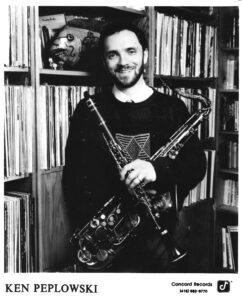
Ken Peplowski’s first publicity photo, taken when he signed with Concord Records (Chip Deffaa Collection)
He’d been diagnosed five years ago with multiple myeloma—a form of blood cancer for which he knew there was no cure; doctors could simply do their best to manage it. And both the illness and related medical expenses added stress to his life. It was disconcerting to have an oncologist remind him, “You’re doing pretty well right now, but we can’t predict the future; and things could become much worse, without warning, at any time.” He knew that there was, in effect, a sword over his head. (As someone who is dealing with significant health challenges myself, I took inspiration from his fortitude and his determination to keep doing what he loved so much.) He played brilliantly until literally the day he died. And his death took everyone by surprise.

Catherine Russell and Ken Peplowski — photo by John Pizzarelli — a few days before Ken’s passing
He performed on this year’s all-star Celebrity Summit Jazz Cruise, just as he did every year. After one successful performance, he went back to his cabin to rest for a bit. When he failed to show up for his next scheduled performance, someone went back to his cabin to get him and discovered that he’d passed away. But he died on a ship that was filled with fans and friends, and fellow top-notch musicians. Just a few days before his passing, he shared on his Facebook page a photo of himself (taken by guitarist/vocalist John Pizzarelli) with master jazz singer Catherine Russell. I’m sharing that photo here, with permission. He looks wan, but glad to be there, getting ready to work with a fellow artist he thought the world of.
Clarinetist John Blegen of Kansas City, who attended this year’s Jazz Cruise specifically so he could see his three favorite clarinetists—Ken Peplowski, Anat Cohen, and Pacquito D’Rivera—wrote me: “I was at the stunning concert featuring my three clarinet heroes in the theater on the Celebrity Summit, and I particularly loved the duet that Ken did with Shelly Berg on ‘It Never Entered My Mind.’ The next morning, my wife and I attended an interview that Ken conducted with Anat Cohen, so we saw Ken just hours before he left us. Though the struggle with cancer had left its marks, he looked well and happy, and he was funny and quick while chatting with Anat and answering questions from the audience. The news we received later in the day, that Ken had died, was hard to credit. “
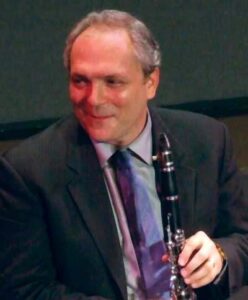
Ken Peplowski (courtesy of Wikipedia)
News of Ken’s passing spread quickly. I was out, buying groceries and such. When I got back home, I checked messages. The first message, from sax player Kevin Buster, was just two sentences long: “My condolences on Ken. I am glad you introduced me to his music.” That’s how I learned that Ken Peplowski had died. Although I’d known how ill Ken was (and had commiserated with him, because we were both dealing with related illnesses), he had seemed to be doing so well, I was just stunned.
* * *
I knew Ken for at least 46 years (he said it was 47 years), and would like to share some remembrances here. He was a great favorite of mine, both personally and professionally. I wrote liner notes or a couple of his albums. I profiled him in one of my books, “In the Mainstream.” For the past two decades, I considered him the greatest living clarinetist.
When I wrote my Off-Broadway show “George M. Cohan Tonight!,” I had a dream band in mind and he was part of it; my dream band was to include five players whom I especially liked, on piano, bass, drums, cornet, and clarinet/sax. I got charts prepared for all five players. When the producers of the show said the budget would only permit a three-piece band (Sterling Price-McKinley on piano, Vince Giordano on bass, and Rob Garcia on drums), I told Peter Ecklund (cornet) and Ken Peplowski (clarinet/sax) that they were still part of my “dream band,” and I was saving the charts that I’d prepared for them just in case we ever got a chance to do the show some place with a bigger budget. To my amazement, after our run at the intimate Irish Repertory Theatre, Off-Broadway in New York, we got booked to do the show before an audience of 6,000 at the huge PNC Bank Arts Center (the Garden State Arts Center) in Holmdel, NJ. And for this engagement, there was a budget for five musicians. Thus, Peter Ecklund and Ken Peplowski, who always sounded so great together (I’m sharing a photo I took of the two of them at a New Jersey jazz club), finally got to do my show. I told them they could improvise as much as they wanted. I was just so happy to have them—even if for simply one engagement—add their magic to my show.
* * *
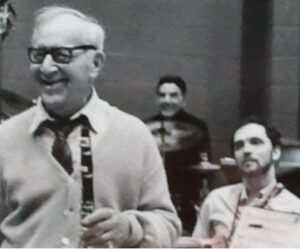
Benny Goodman (clarinet), Louie Bellson (drums) and Ken Peplowski (tenor sax), 1985 (photo by Chip Deffaa)
Ken approached life with a sense of wonder and appreciation that felt eternally youthful, and was great to be around. He liked to count his blessings. He looked for—and found—the good in people, in a way I found refreshing.
He was 66 when he passed, but the wide-eyed, enthusiastic, innocent young fellow from the Midwest whom I first chanced to meet back in 1980 was never too far from the surface. He was very easy to like.
His sound on clarinet was warm and instantly recognizable. He swung, and he had complete mastery of his instrument. He was equally strong on tenor sax. He could pick up that old Conn tenor sax, and play with such commitment and fire, you forgot everything else. (If you’re not familiar with his tenor sax playing, I think one album he made for Concord with Scott Hamilton and Spike Robinson, “Groovin’ High,” is a delight from start to finish.)
He knew well the whole history of jazz, and he loved the music.
* * *
I had great belief in Ken from the time I first met him. He was then a totally “unknown” 20-year-old who’d recently been hired by trombonist Buddy Morrow to play lead alto sax and clarinet in the Tommy Dorsey Orchestra. And even then, his clarinet work dazzled me.
Morrow had worked with top “name” leaders during the Swing Era—including Tommy Dorsey, Jimmy Dorsey, and Artie Shaw–before forming his own big band and later going on to long lead the Tommy Dorsey “ghost” band. And he was a consummate musician. He really cared about the music he played, and he made sure his musicians captured every nuance just right, as they played numbers Dorsey had made famous, such as “Song of India,” “Boogie Woogie,” “Opus One.” He really did an exceptional job in the years he led the Dorsey band. Most critics, alas, ignored the ”ghost bands.” But I went to see the Morrow-led Tommy Dorsey Band any chance I could; Morrow maintained impeccably high standards. (As he told me, his goal was always to make music; he didn’t want to lead a band that sounded like an automaton.)
Morrow had such great faith in Peplowski—Morrow could so clearly recognize his talent and potential, right from the start– he did something that I never saw him do with any other player, before or after Peplowski’s tenure in the band. In 1980, in the middle of a concert in New Jersey that I attended, Morrow brought Peplowski down in front of the band, and said that the stage was his. And then Morrow left the stage.
Peplowski, backed only by the rhythm section, swung into an extended rendition of “Oh, Lady be Good.” And it was clear he was a virtuoso. This wasn’t a Dorsey-associated number. It wasn’t a Dorsey Band arrangement. In fact, it wasn’t an arrangement at all; it was Peplowski, a jazz artist, improvising on a song he liked. And wowing us.
Morrow was giving Peplowski the time and freedom to play whatever he wanted. For a big “name” bandleader to give that kind of exposure to a 20-year-old “unknown” that he’d just hired was extraordinary. (When Peplowski worked for Benny Goodman, later in the decade, Goodman certainly didn’t let Peplowski do any clarinet soloing, or any kind of feature on his own.) But Peplowski’s playing that night, in the Dorsey Band’s concert, just knocked me out.
I wondered how it was possible that someone could play that well and still be unknown. It felt like a fully developed talent had suddenly emerged from out of nowhere. I asked him, after the concert, where he’d come from, who he’d worked with. He said this was his first big-name job. He and his brother Ted—two years older than him—had formed a polka band, the Harmony Kings, when he was about eight, in their home town of Garfield Heights, Ohio. He still had the first newspaper clipping mentioning the band he and his brother had. He told me he was thrilled to see, for the first time, his name in print—even if the reporter had spelled it wrong; he was identified as Ken “Replowski” not “Peplowski.”
I couldn’t imagine how playing in a polka band could help prepare him for a life in jazz; but he said that if his brother was playing the melody on trumpet, and he was improvising around the melody on clarinet, that was actually very good preparation for jazz. That’s exactly what he’d be doing in a Dixieland band, he noted. He was largely self-taught.
And he listened to all sorts of jazz records, growing up; and to the jazz musicians and big bands that came through the region, including Benny Goodman—his favorite—whom he saw “live” in small-group settings, and various touring big bands, such as Woody Herman’s and Stan Kenton’s, and the Dorsey band.
Ken played locally for about a dozen years. Morrow had chanced to hear him in Cleveland, offered him a job, and had been wonderfully supportive. I was impressed by all of this.
Peplowski always enjoyed chatting with Morrow—listening to stories from his long career—almost as much as playing in the band. He was learning a lot, just listening to Morrow reminisce. He wondered, had Morrow had any regrets? Morrow said he had very few regrets, but he shared one in case Peplowski might learn from what he felt was his mistake. Morrow said that back in the 1940s Benny Goodman had invited him to join his band. Morrow wanted to do it; Goodman was one of the greatest of all players. But he listened to some pals who’d been fired by Goodman; they told him: “Don’t join Benny’s band. He’s too tough on musicians. He won’t treat you well; you won’t like it.” So, he turned down Goodman and went instead with another bandleader who wasn’t as great a player. He always regretted that. Even if Goodman had been rough on him, he felt he could have learned a lot from him. And over the years, he’d met other musicians who’d had very good experiences with Goodman. Morrow’s reflections on Goodman gave Peplowski food for thought.
While touring with the Dorsey Band, Peplowski got to meet jazz saxist Sonny Stitt, and jam with him. And words Stitt told him stayed with him: “The bottom line is, if you’re at 100% and you’re playing for yourself, and you’re being completely honest with yourself and you’re making the best music you can make, that’s all that matters.” They got to re-connect a few times in the next year. Peplowski was impressed, too, that Stitt was playing so well, putting everything he could into his music, even though he acknowledged he was fighting cancer. “He played well, right to the end,” Peplowski noted; Stitt died in 1982.
Peplowski and Morrow grew very close as friends. Morrow encouraged him to move to New York, and try to make it as a freelance jazz musician. If Peplowski could save up the funds to make the move, Morrow felt, he would grow more as a musician freelancing in New York—the jazz capitol of the world–than staying with the band. Peplowski was impressed that Morrow really wanted what was best for him. The Dorsey band was laying off for the next month. Peplowski and Morrow both felt that he’d learned all he could playing in the band.
Peplowski took a job playing reeds in the national touring company of the popular Broadway musical “Annie,” in order to save up money to move to New York. The job paid more than the Dorsey Band, and he needed the funds. Morrow supported his decision and wished him well, noting that every job is a learning experience.
Within three days of touring with “Annie,” Ken told me, he felt he’d made a mistake. He HATED playing the exact same music, the exact same way, night after night. There was no room for creativity. And he learned that he simply was not cut out for this kind of work. He was totally bored. He stayed long enough with the “Annie” tour to save up the funds he needed to make the move, then set off for the Big Apple. (He added that when he took the job with the “Annie” tour, some people told him they were glad he was doing such “wholesome” work, being part of such a sweet, innocent family friendly show; they seemed to believe that musicians in the worlds of jazz and rock tended to lead dissolute lives, with drinking and drugs and sexual promiscuity, and so on. But he told me, with a laugh, that he actually witnessed far more hijinks on the tour with the family-friendly “Annie” than he ever did in the jazz world.)
New York did not initially seem like the most welcoming place to live. Someone broke into Peplowski’s car, to try to steal what little he had in the car, within two weeks of his arrival in New York City. But he was thrilled to be there. And little by little, he made friends, found like-minded musical cohorts, and began picking up gigs.
When he made his debut as a group leader in a club, I hailed him in the New York Post as a new “Clarinet King.” One of the other newspaper jazz critics–who’d never heard of Peplowski and thought Peplowski was playing in an “unimportant club”–gave me grief for praising a unknown so strongly, telling me: “It’s not our job to discover new talent.” I told him, “That’s ridiculous. Peplowski’s the best new clarinetist to hit New York in years–and OF COURSE it’s our job to discover new talent.”
I had an amazing editor back then at the New York Post, V. A. Musetto, who gave me absolute freedom to go to whatever clubs, halls, or theaters I wanted, and if I thought someone was worth writing about, I could write about them. He’d tell me: “You’re the expert. If you think somebody’s good, let us know.” If I felt like writing an article titled “Ten Unknowns Who Deserve Record Contracts,” Musetto would print it. And I hated the idea—which some writers and editors subscribed to–that some venues were “unimportant” and not deserving of any coverage. Often, those “unimportant” rooms were where you first saw important, emerging artist-to-watch. I never met another newspaper writer in New York who enjoyed the freedom I had in my 18 years writing for the Post. For me, it was a lot of fun.
Peplowski was playing wherever he could find work. The big “name” clubs, like the Blue Note and the Village Vanguard, weren’t going to book a total unknown. But if he got a gig at some much-less-well-known New York club (like, say, the long-gone “J’s,” run by Judy Barnet), he’d play his heart out, sometimes playing clarinet, tenor, and alto sax in the course of one night. I’d marvel at the way he might go from playing, say, an Irving Berlin number to an Ellington number, to a Coltrane number, and make it all flow so easily, so naturally, and somehow feel so connected.
I got to see him play with equal zest, whether he was somewhere playing one night for patrons who really were into the music (like at Eddie Condon’s Club, run by Ed Polcer) or for patrons who seemed more interested in eating and talking than in the music (as I witnessed one night at Cleopatra’s Needle).
I told Carl Jefferson, head of Concord Records, that he should sign Peplowski. He said he hadn’t yet seen Peplowski “live,” but he’d gotten the same recommendation from Scott Hamilton and Warren Vache–his label’s outstanding young jazz stars–and he was intrigued. We were just chatting over spaghetti and meatballs in midtown Manhattan; by dinner’s end, Carl was saying that maybe he’d record Peplowski as a sideman first, then give him a shot as a leader, and see how it went. He noted ruefully: “If I sign an unknown and let him record one album a year as a leader, I’m taking a big risk. Because it’ll usually take about five years before the albums he’s making will begin to pay for themselves. And once an unknown has made a good name for himself and his albums are finally beginning to sell, some bigger label with deeper pockets may well steal him away from me.” But if Jefferson liked an artist, he was willing to take such risks. It was his company, he alone made the decisions on who to record, and he wanted to record musicians he liked. He’d made his money owning a car dealership, and had initially gotten into the music business almost as a lark. But he had great instincts, and he made Concord Jazz an important independent record company.
Before too long, “Peps”—as Peplowski was nicknamed–was a star on the Concord label. I was delighted to write some liner notes for him. Jefferson was happily surprised to see how much radio airplay Peplowski’s albums were soon getting. And—just as Jefferson had predicted—other labels started making bids for Peplowski’s services. (One record company, which had previously rejected Peplowski, even offered to release as an album the demo tape that he’d sent them.)
But Peplowski was loyal, and stayed with Concord for as long as Jefferson lived, about a decade. He got to make small-group records and big-band records, and work with musicians he greatly admired. (He told me he always loved working with musicians he thought were better than him; he’d learn from them.)
Since Carl Jefferson’s passing in 1995, Concord has grown into a big corporate conglomerate, active in multiple fields of the entertainment business. (Concord’s theatrical division even publishes and licenses a couple of my plays.) It’s no longer the sort of place where one man can make a decision to offer a record contract to an unknown simply because a few people whose opinions he valued told him: “This player is great; he deserves a record deal.” It’s more bottom-line oriented. It’s a big, financially successful company. And I wish them well. But a part of me misses the Concord Records company that Carl Jefferson founded and headed, producing mainstream jazz records reflecting his own personal taste. Carl Jefferson brought together an incredible array of artists and helped them thrive. He deserves recognition and credit for all that he accomplished.
Peplowski subsequently enjoyed recording for Nagel Heyer, Stomp Off, Jazzology, Arbors, and other record companies. He liked working with independent labels run by individuals whom he felt really appreciated the music he and his colleagues were making. He greatly valued these independent labels, run by people who really loved mainstream and traditional jazz.
* * *
When Peplowski first moved to New York, he knew almost no one. Sax player/arranger Mark Lopeman , who had been his band mate in the Tommy Dorsey Band, had moved to New York a little before Peplowski, and helped open some doors for him, getting him work, for example, as a sub with a big band out on Long Island, Peplowski told me.
But Ken was such a good player, and so easy to work with, word of his abilities spread quickly among musicians. New York had a wonderful, sizable group of younger players who were into older styles of music (Scot Hamilton, Chris Flory, Mike LeDonne, Phil Flanagan, Warren Vache, Peter Ecklund, Mike Hashim, Jordan and Randy Sandke, Loren Schoenberg, Howard Alden, John Pizzarelli Jr., to name just a few), and he found work quicker than he’d anticipated. I’d see Ken turn up in all sorts of places. He became a member of Vince Giordano’s Nighthawks (then based at the Red Blazer Too on 46th Street); I’d enjoy seeing him in that terrific big band, faithfully re-creating arrangements (including classic solos) from the 1920s and ‘30s. I enjoyed seeing him play with the Orphan Newsboys, co-led by Mart Grosz and Peter Ecklund. (I took the photo of Ecklund and Peplowski playing an Orphan Newsboys date at the Cornerstone in Metuchen, New Jersey.) The Orphan Newsboys played numbers from the 1920s and ‘30s, originally recorded by Bix Beiderbecke, Louis Armstrong, and others, but made no attempt to re-create vintage arrangements; they offered their own fresh new takes on timeless older numbers like “I’ll Be a Friend with Pleasure,” “At the Jazz Band Ball,” ” and “Once in a While.”
Veteran musicians like Buck Clayton, Max Kaminsky, and Jimmy McPartland loved Peplowski. And he sounded great with their bands. Jimmy McPartland (1907-1991) was 52 years older than Peplowski. He liked the fact that Peplowski not only played brilliantly, he knew whatever songs McPartland wanted to play—even ones Jimmy had recorded some 30 years before Ken was born. I remember Jimmy beaming appreciatively as Ken soloed, when Jimmy was a guest on his wife, Marian McPartland’s “Piano Jazz” radio show; I attended that taping; Jimmy couldn’t have been happier. And he took Ken with him on a jazz cruise to Bermuda. And Buck Clayton always spoke so appreciatively of Peps.
Benny Goodman was Peplowski’s favorite clarinetist, Peplowski told me. But there were so many clarinetists he enjoyed, like Jimmy Hamilton (from the Ellington Orchestra), Jimmie Noone (a great favorite of Ken’s), Edmond Hall, Johnny Dodds, Don Murray (from Bix’s band), Jimmy Dorsey, Albert Nicholas, Pee Wee Russell, Buddy DeFranco. Listening to one record would make him listen to another; he enjoyed lots of New Orleans players, as well.
Curiously, he didn’t warm up to Artie Shaw when he first heard him; young Peplowski was firmly in the Benny Goodman camp. It took him time, he told me, to fully appreciate Shaw’s wholly different style and sound. He came to admire Shaw’s playing vey much, and recognize that Shaw’s best solos (like on “Stardust”) were among the greatest in jazz history.
Ken’s apartment was filled with recordings. I think he owned and knew by heart seemingly every recording Frank Sinatra ever made, including outtakes and rejected sides. And he was so enthusiastic about music he liked, I enjoyed being around him.
“Listen to this!” he’d tell me, before playing a Sinatra recording. “He’s such a good singer. I mean, really, just LISTEN to this. He’s really, really good!” He didn’t have to convince me, of course; I loved Sinatra. But I loved the sheer joy Ken could take in a recording. He spoke about Sinatra as if he’d just discovered some “unknown” whose talent amazed him, and he wanted everyone in the world to know about him. He’d listen to recordings of artists he liked with a kind of wonder. I can close my eyes and hear him telling me, regarding Sinatra: “I mean it, Chip; listen to what he does here; he’s REALLY good.”
He could wax equally enthusiastic about Billie Holiday, Dinah Washington, Rosemary Clooney, Jimmy Rushing, Bing Crosby…. And also early Elvis Presley, Chuck Berry, the Beatles. He had big ears.
He wanted to know the whole history of popular music and jazz, and he assumed that any good musician would feel the same way. He was sorely disappointed when he worked with some musicians—as occasionally happened—who didn’t share his knowledge or curiosity about music. I remember him telling me one time about a young trumpeter he’d hired as a last-minute replacement for a gig: “Chip, he had this great tone, and great chops. But he didn’t know any of the tunes I wanted to play—tunes EVERYONE knows, like ‘If I Had You,’ ‘What’s New?,’ ‘I’ll See You in my Dreams.’ He’d say: ‘I never heard of those songs; pick something else.’ I think he knows a total of, like, 12 songs.” Peplowski couldn’t understand how any player could have such great technical skills but not know a song like “If I Had You” or “I’ll See You in My Dreams.” Ken didn’t just know the melodies to the songs he loved; he could sing every word of them, and that added to the musicality of his playing.
* * *
He had strong work ethic, and he liked trying all different kinds of music. You never knew where he might be working next. He’d bring jazz programs to public schools. (He believed it was important to introduce jazz to young people.) He’d turn up on film and TV soundtracks (“Sweet and Lowdown,” “Six Feet Under,” “The Polka King,” “The Human Stain,” “The Curse of the Jade Scorpion,” “The Hangover-Pat Two”). He enjoyed playing hard-driving blues until two or three in the morning at Mr. Hicks, an all-Black club in Freeport, Long Island that booked Hammond B-3 organ / tenor sax / drum combinations. He’d often be the only white person in the room, he acknowledged; he always felt welcome.
Sax player Allen Lowe–who often worked with players considered avant-garde or experimental, such as Julius Hemphill, Hamiett Bluiett, Mark Ribot, Roswell Rudd, Matthew Shipp—chanced to meet Peplowski one time at the National Jazz Museum in Harlem. Lowe recalls, of his meeting with Peplowski: “I found myself sitting next to Ken who, to my surprise, had listened to some of my things with Julius Hemphill, plus a long piece I recorded for Enja. We started talking and he said: ‘You know, people think all I can do are Benny Goodman and Artie Shaw tributes. But I can do a lot of things. Call me if you are recording something, I like to stretch myself.’” Some years later, Lowe went to see Peplowsi playing at Smalls jazz club in New York City. He told Peplowski of a new recording project he was working on and asked if he’d like to be part of it. Lowe remembers: “He was happy to do it and we discussed times to rehearse and then record. That was the first of three or four recordings we made together and I am so happy I got the chance to get Ken into the studio. Not only was he a brilliant clarinetist — not to mention a wonderful tenor saxophonist — but he fit in with everything. He even recorded with Matt Shipp on an open piece I wrote. It was all just beautiful music. I will never forget Ken, who was kind and funny and an artist.”
* * *
Of all the gigs Peplowski got after moving to New York, none meant more to him than becoming a member of Benny Goodman’s last big band. He was in the Goodman band from 1984 to Goodman’s passing in 1986. Goodman initially took over Loren Schoenberg’s excellent rehearsal band; but he kept making personnel changes and rehearsing the band until it was clearly and unmistakably his own.
Goodman was a hard taskmasker, and so focused on his music that he could often seem insensitive to, or oblivious to, other people. He had plenty of detractors. But Peplowski was not one of them. Oh, Ken could see Goodman’s far-from-perfect social skills, and he understood why some musicians complained about how Goodman had treated them. But Peplowski stressed to me—both during his tenure with Goodman and in later years, reminiscing—that Goodman was always great to him. “He gave me raises; he called me daily; when I got married, he sent a lovely note and wedding present; and he tried to get me a record contract with the label he was working with—even offering to produce the album himself.”
Peplowski saw Goodman fire musicians as casually as he would discard a reed for his clarinet that didn’t meet his high standards. But Goodman kept Peplowski on, featuring him on tenor. And Peplowski admired Goodman’s skills as both a player and as a leader who wanted the best possible band.
I remember attending a rehearsal of Benny Goodman’s band, at the Marriott Marquis Hotel in NYC, October 7th 1985. Goodman was a bit late in arriving and pianist Dick Hyman was running the rehearsal in his absence. (I’ll share one of the photos I took that day; that’s Hyman, in the glasses, seated in front of the band; you’ll see Peplowski—sporting the beard he wore in those days—in the sax section, along with Jack Stuckey and Chuck Wilson; and that’s Bob Haggart on bass, James Chirillo on guitar.) Hyman would call a tune; the band would run through it a couple of times; Hyman would be pleased; and they’d move on to the next number. I thought the band sounded terrific.
When Goodman arrived, it was like there was electricity in the air. Everyone came to attention, like the boss had arrived and everyone had to be at their best. And he was extraordinarily exacting, as he rehearsed his musicians. He had the saxes play one phrase over and over, and over and over until he was satisfied they were playing it exactly as arranger Fletcher Henderson had intended, then he repeated the process with the next phrase. I was fascinated. I felt privileged to be there, sitting in as a guest at a closed rehearsal.
During a break, Goodman warmly hugged drummer Louie Bellson, chatting with him like an old fiend he had not seen in far too long. We spoke briefly. He was happy with the band, and with his decision to focus on Fletcher Henderson—his personal favorite of the arrangers he’d worked with. He wanted to re-record his old hits with this band, then do an album of Henderson arrangements that he’d never recorded. (Only his death in June of 1986 prevented him from realizing that latter dream.)
The band’s performance that night was taped for a public-television special. Peplowski got nice solo moments on numbers like “King Porter Stomp” and “I Would do Most Anything for You.” (I still enjoy listening to the “live” CD that was recorded that night: “Benny Goodman—Let’s Dance”).
When Benny died, the band had bookings stretching through the next year. The band played just one concert without Benny, in his memory, then broke up for good. And the musicians went their separate ways.
I’ve sung on a dozen albums. I’ve always felt comfortable in recording studios because I acted professionally as a child and did my first recording work when I was about 10. But it was Ken, more than anyone else, who influenced how I go about making a recording as an adult. He believed in creating recordings that, as he’d tell me, felt “organic”—recordings that were not over-rehearsed, not over-produced. Created by sympathetic artists performing in the same studio at the same time, where they could see and hear one another, and create together That was the way the early jazz records we both loved so much were made. That was the way he liked to record. He told me that the benefits of recording that way outweighed any potential drawbacks.
His philosophy, which I liked a lot, was different from those of some commercial pop record producers I’ve known; they wanted recordings as “clean” and precise and flaw-free as possible. But Ken felt that if you had each individual recording in a separate isolation booth, and everyone worrying about overdubbing “fixes” of anything that might conceivably be considered a blemish, you were liable to wound up with recordings that were bloodless and mechanical.
He told me that if I recorded, say, a vintage blues with musicians I liked, and we were all sort of feeding off of each others’ energy, we’d be more likely to create something filled with life than if we did a lot of overdubbing and inserts, and edits, to try to “perfect” every bar after-the-fact. He liked recordings that reflected what actually happened when artists got together to make music. And felt that trying to “fix” every imaginable blemish, via overdubs and edits, as some producers strived to do, was counter-productive; the music wound up feeling sanitized. He wanted music to feel vital and honest.
He’d tell me: “Listen to any old record that you like—Louis Armstrong, Benny, Charlie Parker, anybody—there’s mistakes all over the place. I like those rough edges. That’s why people like jazz, because everybody’s making things up on the spot; they don’t know what’s going to happen.” He could record a great album in five hours—just one or two takes for each number; no overdubs or edits. I liked that way of making music a lot. I found it inspirational.
“Music is my life,” he told one interviewer in Japan, a few years back. “Jazz is like poetry. I don’t need to think, but just express myself….. We can communicate and unite through music.”
Rest in peace, Ken Peplowski (May 23, 1959 – February 2, 2026). I’ll miss Ken. The things he’d say, the well-written blogs that he’d periodically create, and of course the music that he made. He left a rich legacy.
A memorial service for Ken Peplowski, featuring performances by artists who worked with him, will be held on May 19th at St. Peter’s Church.
Leave a comment