
News Ticker

Lake Simons

Have You Met Jane Goodall and her Mother?

March 16, 2025

Who knew that a biographical play could be so witty, entertaining and charming? The latest EST/Sloan Project science play, Michael Walek’s "Have You Met Jane Goodall and Her Mother?" is one of the most enjoyable and enlightening comedies of the season. Using the actual facts of Goodall’s first trip to Tanganyika’s Gombe Stream Reserve in 1960 to observe chimpanzees in the wild, Walek creates a play that sticks close to the well documented facts but fills in the missing information with often amusing supposition. The title refers to the fact that the Tanganyika government (then ruled by the British) only allowed Jane to study in their game park as a woman alone if she had a chaperone – so she brought along her mother. Jane Goodall’s trip was arranging by famed palaeoanthropologist Louis Leakey for her to find the missing link between humans and chimps which she finally does just before the end of her four month first trip. [more]

Symphonie Fantastique

April 8, 2018

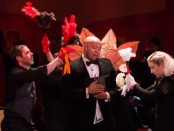
Twist’s “Creator’s Note” in the program alludes to Wassily Kandinsky’s musical metaphorical paintings and Twist’s youthful attraction to the possibility of using abstract puppetry in combination with music.  The five-part Symphonie, subtitled “Episode in the life of an Artist,” called to him for its color and storyline which vaguely guide his creation although only the changing moods, rhythms and colors of the score seem be the inspiration for the series of moving abstract images that were mostly treats for the eyes, if not the mind—seductive, clever, dreamy, sensually involving, but more a vacation for conscious thought than an intellectual challenge. [more]

The Carnival of the Animals, featuring the poetry of Ogden Nash

December 29, 2015

The gifted puppeteer-dancers – Kristen Kammermeyer, Brendan McMahon, Justin Perkins, Rachael Shane – were barefoot and dressed in black; they moved with graceful economy of movement and made themselves into a fantastic combination of invisibility and magisterial artistry. They manipulated more than two dozen every-day-object puppets in gorgeous worlds of sky for birds, water for fish, field and forest for all sorts of creatures large and small. All these animals – made of sticks, brooms, mops, feather-dusters, cardboard-cut-outs, fabric scraps, familiar bits of this-and-that, and unexpected parts of who-knows-what – were right there in front of us. They leapt and loped, swooped and soared; they teased and pleased, tested, tormented and befriended each other and the narrator; they made each person in the audience – old and young, big and little – feel individually included in the menagerie's movements. [more]