
Uncle Vanya, scenes from country life
Krymov Lab seizes upon Chekhov’s masterpiece and refashions it into something grotesque and mournful—a cracked elegy, a kind of vaudeville of the wasteland.
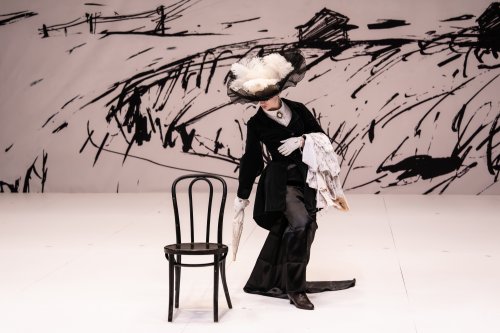
Shelby Flannery in a scene from Kyrmov Lab NYC’s production of “Uncle Vanya, scenes from country life” at La MaMa ETC) (Photo credit: Marina Levitskaya)
To encounter Krymov Lab NYC’s Uncle Vanya, scenes from country life at La MaMa’s Ellen Stewart Theatre is to undergo a subtle but irrevocable recalibration of one’s theatrical sensibilities; after it, Uncle Vanya can scarcely be apprehended in quite the same way again. The production is, in the fullest sense, transformative, a work that seems to prise open Anton Chekhov’s text and expose its trembling nerve endings to the air.
The narrative architecture of Vanya—its languors, its longings—is assumed, even beside the point. In its essence, this distilled adaptation unfolds less as a conventional staging than as a kind of theatrical mixtape, an assemblage both deliberate and mischievous, in which the familiar architecture of this oft-performed play is artfully dismantled and recomposed. Scenes arrive out of their expected sequence, as though guided by emotional rather than narrative logic, while character motivations are subjected to a searching reconsideration—some gently refracted, others boldly reconfigured—yielding a work that feels at once recognizably rooted and thrillingly unmoored. What Dmitry Krymov has fashioned instead is a kind of theatrical palimpsest, a dream-logic fantasia in which the gravitational center is unmistakably Yelena, that luminous and unwitting axis of desire (much to the dismay of Vanya). One might, without doing violence to the enterprise, retitle Krymov’s audacious, dreamlike reimagining of Chekhov’s inexhaustible classic evening: All Roads Lead to Yelena.
The visual field alone announces a radical departure. Complemented by Krista Smith’s astute lighting, Emona Stoykova’s production design is rendered as a vast, unbroken plane of white, stretching back until it meets a looming wall upon which is scrawled, in bold, black, impressionistic strokes, the ghost of a countryside—structures, fences, roads—less a place than a memory of place. It is both austere and exuberant, a blankness charged with potential. Into this void trundles, with an almost Beckettian deadpan, a faceless contraption of scrap wood: a small, makeshift robot bearing a placard that reads, with disarming literalism, “Empty stage.” It exits, returns, revises the terms—“Summer,” “Countryside”—as though the production were constructing its own ontology before our eyes. The audience laughs, but the laughter is edged with recognition; we are being instructed, gently but firmly, in how to see.
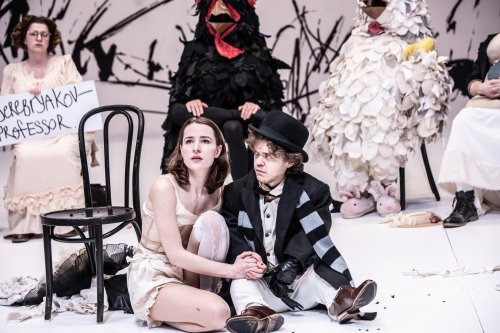
Shelby Flannery and Colin Buckingham (front); Anya Zicer, Sasha Drey, MaryKate Glenn and Tim Eliot (back) in a scene from Kyrmov Lab NYC’s production of “Uncle Vanya, scenes from country life” at La MaMa ETC) (Photo credit: Marina Levitskaya)
Perhaps the production’s most audacious and delightfully surreal flourish lies in the improbable presence of two additional characters: a hen and a rooster, denizens of the estate, literally embodied by actors MaryKate Glenn and Sasha Drey encased in Luna Gomberg’s elaborately wrought avian costumes. At first, their appearance elicits laughter—an almost instinctive response to the visual absurdity—but Krymov, in his characteristic subtlety, transforms this comedic novelty into something far weightier. The misadventures and small tragedies of these feathered figures emerge as some of the most searingly poignant moments of the evening, their plights refracting the human despair around them and delivering, with uncanny economy, an emotional resonance that lingers long after the actors have exited. In this gesture, Krymov demonstrates a mastery of tonal legerdemain: what begins as whimsy evolves into profound, almost operatic pathos, reminding us that even the ostensibly absurd can carry the deepest human truths.
The hen enters, accompanied by a mechanical chick, which she tends with an almost devotional seriousness. It is an image at once bizarre and oddly tender, a prelude to the arrival of Yelena (the radiant Shelby Flannery), who, clad in traveling attire, announces—through sign—that she intends to change into summer clothes then and there, in this notional field.
What follows is a coup de théâtre of exquisite cruelty. As Yelena begins to undress, she is ambushed—not physically, but emotionally—by the full company: Astrov, Vanya, Sonya, Serebryakov, and the rest, who arrange themselves as spectators to her vulnerability. One by one, they press upon her their grievances, their thwarted desires, their need for consolation. Yelena, half-dressed, becomes both object and witness, a figure caught in the crosshairs of everyone else’s yearning.
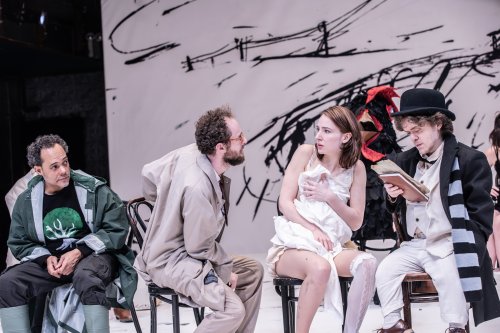
Javier Molina, Zach Fike Hodges, Shelby Flannery and Colin Buckingham (front); Sasha Drey (back) in a scene from Kyrmov Lab NYC’s production of “Uncle Vanya, scenes from country life” at La MaMa ETC) (Photo credit: Marina Levitskaya)
In this single, bravura sequence, Krymov distills the entire tragicomedy of Chekhov’s world: the helplessness of those who can neither act nor desist, the peculiar violence of need. The production proceeds in this vein, dismantling any residual illusion of bucolic stability and replacing it with a jagged, often hilarious, and ultimately devastating collage of human impulses—love unreturned, lives misspent, ecological anxiety (Astrov’s forests flicker here in uncanny ways), and the small, gnawing selfishnesses that accumulate into despair.
Krymov sustains our attention not through restraint but through a kind of gleeful outrageousness, a refusal to let the stage settle into anything resembling complacency. The return of the Professor and his wife from St. Petersburg lands upon the estate like a social and spiritual disturbance, throwing its rhythms into disarray. Idleness seeps into every corner: ledgers lie neglected, routines dissolve, and the air itself seems thickened with the persistent annoyance of flies.
Within this unraveling, performances are pitched with a knowingly exaggerated clarity. Colin Buckingham renders Serebryakov as the small man he is—petty, diminished—despite the character’s own grandiose self-conception. By contrast, Amen Igbinosun’s Telegin, nicknamed Waffles, looms as a kind of shambling giant, his physical presence at odds with his emotional meekness. If it is possible to have a romantic moment it is Telegin’s as he waltzes with Yelena after hysterically throwing his collection of treasured photographs into the air. Natalie Battistone’s Sonya appears here with a touching sweetness, almost luminously endearing, though the echo of her self-lacerating insistence on her own plainness lingers like a bruise beneath the surface. The family’s Nanny, embodied with brusque practicality by Tim Eliot, delivers one of the evening’s most startling gestures, dispatching the small chick—so recently the object of tender attention—with a sudden, almost offhand brutality, all in service of a soup the Professor will not even deign to consume.
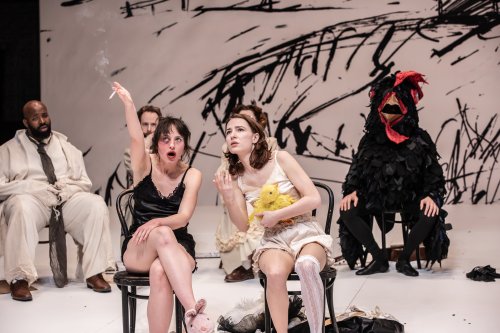
MaryKate Glenn and Shelby Flannery (front); Amen Igbinosun, Zach Fike Hodges, Anya Zicer and Sasha Drey (back) in a scene from Kyrmov Lab NYC’s production of “Uncle Vanya, scenes from country life” at La MaMa ETC) (Photo credit: Marina Levitskaya)
Around them, domestic rituals falter into absurdity. Anya Zicer’s Mama offers tea that sits untouched, a symbol of hospitality rendered meaningless. The men drink excessively, their indulgence both symptom and evasion. Javier Molina’s Astrov, once animated by ecological fervor, now finds his energies diverted into an all-consuming fixation on the Professor’s wife. And she, in turn, becomes the gravitational center of the room: the object of a restless, ungovernable gaze, not least from her husband’s brother-in-law, Vanya—played by Zach Fike Hodges with a restless intensity that borders on the febrile. And then—suddenly, explosively—Vanya detonates. His rage feels less like a moral reckoning than a tantrum of neglect: he is furious, unmistakably, because no one is looking at him. This, after all, is the title character, and yet he finds himself displaced, orbiting the periphery of his own story, clamoring to be seen.
Krymov orchestrates these elements with a precise sense of imbalance, allowing the grotesque and the intimate to coexist. What might, in another register, read as caricature instead accrues a disquieting truth: a household undone not by catastrophe, but by the slow, absurd erosion of purpose, dignity, and desire.
What is most astonishing is the tonal dexterity. The evening ricochets between the absurd and the sublime: a black rooster may strut through a scene of existential confession; a gag may curdle, almost imperceptibly, into heartbreak. Krymov’s method is one of accumulation and rupture, each image both undercutting and deepening the last, until the spectator finds themselves disarmed, defenseless before the play’s emotional onslaught.
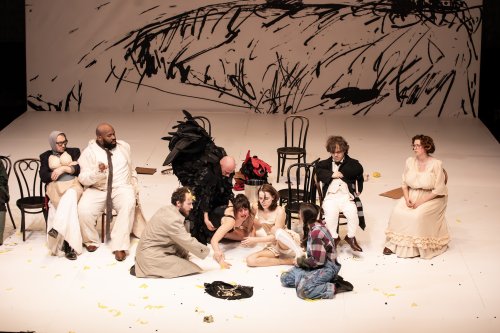
Tim Eliot, Amen Igbinosun, Zach Fike Hodges, Sasha Drey, MaryKate Glenn, Shelby Flannery, Natalie Battistone, Colin Buckingham and Anya Zicer in a scene from Kyrmov Lab NYC’s production of “Uncle Vanya, scenes from country life” at La MaMa ETC) (Photo credit: Marina Levitskaya)
To call the production “deleterious” is not to diminish it, but to honor its rigor. It dismantles the edifice of “country life” so often draped, like a comforting shawl, over Chekhov’s work, and reveals instead a raw, person-to-person encounter: unmediated, unadorned, and, in its way, more faithful to the playwright’s spirit than any scrupulous naturalism. The result is theatre that feels not only immediate but necessary.
Taken in its totality, Krymov’s staging—realized with breathtaking commitment by an ensemble of remarkable daring and abandon—emerges as a work of piercing social insight, one that contemplates the present moment without ever succumbing to the blunt instruments of didacticism. Krymov resists the easy sermon. Instead, he conjures a theatrical language at once playful and exacting, through which seep, almost imperceptibly at first, currents of sadness and bewilderment that gather into something far more harrowing: a vision of humanity caught in the undertow of its own making. What astonishes is the delicacy of the descent. The production does not announce its gravity; it accrues it. A gesture here, an image there—each rendered with a kind of offhand virtuosity—until the cumulative effect is one of quiet devastation. By the time the full emotional weight reveals itself, it is already too late to resist.
One leaves with the uncanny sensation of having been altered—of having glimpsed, through the distorting yet clarifying lens of Krymov’s imagination, something essential about the human condition. It is, quite simply, the kind of production that lodges itself in the mind and refuses to dislodge.
Uncle Vanya, scenes from country life (through April 12, 2026)
Ellen Stewart Theatre, La MaMa Experimental Theatre Club, 66 East 4th Street, in Manhattan
For tickets, visit www.lamama.org
Running time: 90 minutes without an intermission


Leave a comment