
Entangled: 12 Scenes in a Circle K off the I-40 in New Mexico
Playwrights Zemba and Mansour elicit every possible shard of humor from the concept of quantum entanglement in a highway convenience store.
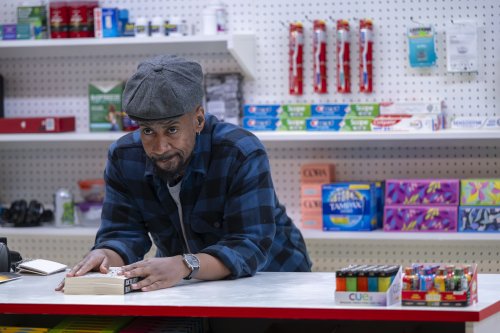
Joseph David Robinson in a scene from Mona Mansour and Emily Zemba’s “Entangled: 12 Scenes in a Circle K off the I-40 in New Mexico” at HERE Arts Center (Photo credit: Ashley Garnett)
In Entangled:12 Scenes in a Circle K off the I-40 in New Mexico, the beguiling and philosophically mischievous collaboration between Mona Mansour and Emily Zemba, the American desert becomes less a landscape than a condition of thought—a place where the ordinary laws governing time, consequence, and human attachment appear to have loosened their grip. Set in the fluorescent limbo of a Circle K somewhere in the New Mexico expanse—30 miles from the nearest outpost of civilization, and perilously close to both an atomic testing site and a nuclear laboratory—the play hums with a low-grade metaphysical dread that it wears, with admirable restraint, as comedy.
There is something delightfully perverse about locating the anxieties of the universe not in a laboratory, nor in the cloistered halls of academia, but beneath the humming fluorescence of a roadside convenience store, where the coffee is burnt, the bathroom is unspeakable, and eternity seems—if not exactly within reach—then at least available for purchase alongside Fritos, Slim Jims and a rack of off-brand sunglasses. This sly, shape-shifting work conceived by the playwright-driven theatre company known as SOCIETY, and directed with a conspiratorial wink by Scott Illingworth conjures an unlikely theatrical cosmos from the most banal of American landscapes, and in doing so transforms a Circle K off Interstate 40 into a site of philosophical inquiry as expansive as any particle accelerator.
The premise alone carries a kind of puckish audacity. Over the course of 12 brisk, interlocking scenes, a cashier/franchise owner played as part oracle, part non-plussed bystander by the charmingly deadpan Joshua David Robinson presides over a parade of passersby: a bickering couple, a gaggle of baseball players, a cluster of scientists, a traveling physics teacher, a real estate agent peddling dreams of permanence in an impermanent world. These figures, Robinson’s versatile colleagues Brian Bock, Hiram Delgado, Christy Escobar, Annie Fox, Leslie Fray, Meredith Garretson, Rosa Gilmore, Caroline Grogan, Keren Lugo, Alexandra Templer, and Shpend Xani arrive not so much as fully independent characters but as flickering possibilities, their lives overlapping and refracting one another in a dramaturgy that mirrors, with surprising rigor, the slippery logic of quantum entanglement. Time folds in on itself; conversations echo across unseen distances; cause and effect appear less like a sequence than a simultaneous condition.
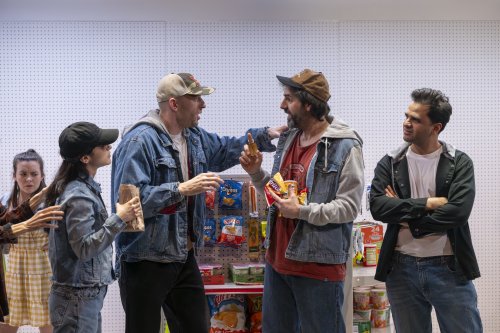
Caroline Grogan, Annie Fox, Brian Bock, Shpend Xani and Hiram Delgado in a scene from Mona Mansour and Emily Zemba’s “Entangled: 12 Scenes in a Circle K off the I-40 in New Mexico” at HERE Arts Center (Photo credit: Ashley Garnett)
Zemba, whose dramaturgy delights in whimsy without surrendering rigor, here finds in Mansour a collaborator equally attuned to the porous border between the abstract and the humane. The conceit is as simple as it is disorienting: a convenience-store clerk presides over a parade of travelers whose fleeting presence constitutes the entirety of his social world. For them, he is negligible—a transactional pause between destinations—but for him, they are the substance of time itself. In a virtuoso opening sequence, several days’ worth of customers collapse into simultaneity, their overlapping conversations forming a kind of human fugue. Time, the clerk insists, behaves differently here. There may even be a portal in the bathroom. People go in. Some do not come out.
What follows is less an unraveling of this mystery than a series of variations upon it. The travelers—families, couples, a cheerfully self-aware throuple—arrive bearing with them the half-digested language of science, which they deploy with comic earnestness to justify desire, coincidence, and commerce. A marriage proposal leans on a garbled understanding of statistical improbability; housewarming party guests with practically all the men present named John shopping for chips and dip and ice elevates nominative coincidence into cosmic significance. In one deliriously stylized interlude, a Laugh-In-esque barrage of jokes reduces scientific discourse to punchlines and jargon, as though the Enlightenment itself had been processed through a Rowan & Martin variety show.
Hovering over the proceedings, like a benevolent ghost of rational inquiry, is Carl Sagan, whose recorded voice reminds us that the most destabilizing scientific discoveries are those that decenter us—that reveal our smallness, our contingency, our profound lack of specialness in the universe. And yet, Entangled suggests, we persist in bending those discoveries back toward our own narratives, our own needs. A slickly affable time-share salesman from Las Vegas—who alone seems to share any sustained temporal bandwidth with the clerk—dreams of building a variation on a timeshare property nearby, an enterprise that would, in its way, literalize the commodification of time itself.
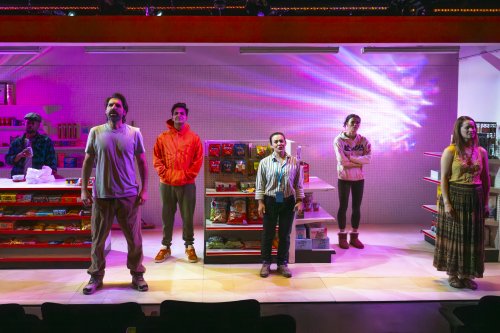
Joshua David Robinson, Shpend Xani, Hiram Dlegado, Caroline Grogan, Meredith Garretson and Christy Escobar in a scene from Mona Mansour and Emily Zemba’s “Entangled: 12 Scenes in a Circle K off the I-40 in New Mexico” at HERE Arts Center (Photo credit: Ashley Garnett)
The set, designed by Jacob Bers, is a work of almost anthropological precision, crammed to the brink with the sad abundance of roadside commerce—rows of overbright packaging, the quiet despair of impulse purchases, the unmistakable patina of a place that never truly closes. It is, in its fidelity, faintly unnerving. Most triumphantly (or perhaps most damningly), it includes a bathroom of such grimy conviction that one can practically smell it before the door even swings open—a portal not merely to inconvenience, but to another, less hospitable dimension.
That door, when it opens, unleashes a ghastly brilliance: a lurid, interrogative glare shaped by the lighting and projections of Lauren Nychelle, whose ever-present fluorescent wash renders the stage in a sickly, suspended now. The effect is both banal and otherworldly, as if the actors were caught inside a malfunctioning terrarium. Nychelle’s design does not simply illuminate the action; it destabilizes it, transforming the familiar into something faintly menacing, a convenience store refracted through the aesthetics of a low-budget horror film and the metaphysics of a fever dream.
Against this queasy glow, Sandrina Sparagna’s costumes flare with eccentric vitality, their colors pushing insistently against the drabness of the environment. They seem to belong to a slightly different reality—one in which personality, even identity itself, is in constant flux—thus reinforcing the play’s fascination with multiplicity and misrecognition. And beneath it all hums the insinuating work of sound designer Avi Amon, whose inventive sound design and original music suffuse the space with a low-grade dread. The familiar rhythms of roadside life—the beep of a register, the distant whoosh of passing cars—are subtly distorted, stretched into something uncanny, until the simple act of stopping for gas begins to feel like an initiation into the unknown.
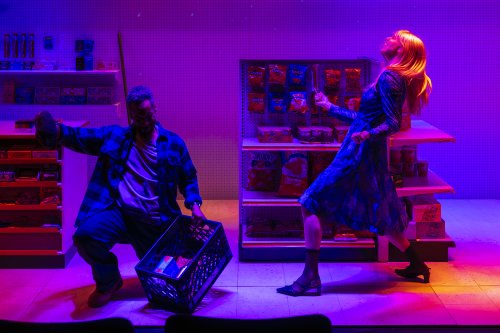
Joshua David Robinson and Alexandre Temper in a scene from Mona Mansour and Emily Zemba’s “Entangled: 12 Scenes in a Circle K off the I-40 in New Mexico” at HERE Arts Center (Photo credit: Ashley Garnett)
If the play has a quiet thesis, it is that both laypeople and institutions alike are guilty of weaponizing knowledge: we turn science into salesmanship, while scientists, in darker chapters, have turned it into annihilation. But Zemba and Mansour are less interested in indictment than in observation. Their tone is one of wry, almost tender amusement at our collective tendency to misunderstand the very systems that govern us.
And yet, beneath the play’s buoyant surface, something more unsettling stirs. The disappearances—those customers who enter the bathroom and never return—are treated with a chilling casualness. No one raises an alarm. No one goes looking. The omission feels deliberate, a negative space in the play’s moral architecture. What does it mean to vanish without consequence? Who, if anyone, notices our absence? The question lingers, unanswered, like a faint echo in the aisles.
Entangled does not resolve its paradoxes so much as invite us to sit with them. Its meditation on cyclical time and human connection resists easy articulation, but its emotional residue is unmistakable: a quiet, persistent melancholy at our failure to perceive the significance of our intersections with others. The clerk, fixed in his temporal eddy, understands something the travelers do not—that even the briefest encounters accrue meaning, if only we had the patience, or the courage, to see it.
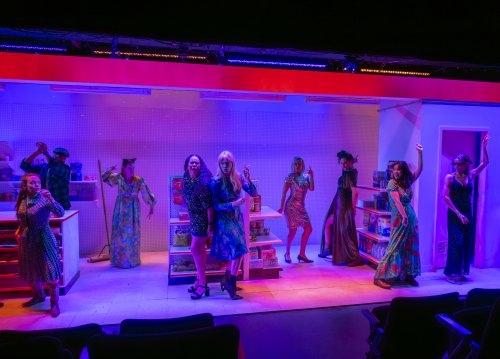
The cast of Mona Mansour and Emily Zemba’s “Entangled: 12 Scenes in a Circle K off the I-40 in New Mexico” at HERE Arts Center (Photo credit: Ashley Garnett)
One leaves the theater not with conclusions but with a heightened sensitivity to the strange elasticity of time and the fragile, often invisible threads that bind us. The play may concern itself with blips—those passing, negligible moments—but it lingers, unexpectedly and insistently, as something far more enduring.
Entangled: 12 Scenes in a Circle K off the I-40 in New Mexico (through March 28, 2026)
SOCIETY Theatre Company
Mainstage Theatre at HERE Arts Center, 145 Sixth Avenue, in Manhattan
For tickets, visit www.https://here.org
Running time: one hour and 40 minutes without an intermission


Leave a comment