
Every Brilliant Thing
A delightful Daniel Radcliffe leads a Broadway therapy session.
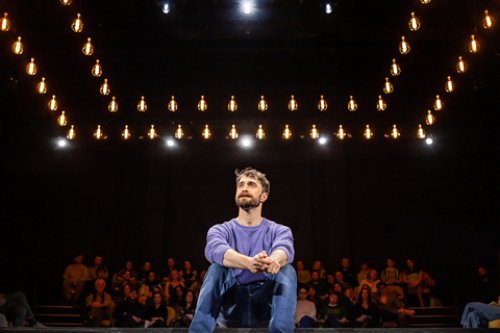
Daniel Radcliffe in a scene from Duncan Macmillan and Johnny Donahoe’s “Every Brilliant Thing” at the Hudson Theatre (Photo credit: Matthew Murphy)
Less a play than a secular sermon on soul-wrenching subjects, Every Brilliant Thing is the product of well-meaning hands. The principal storytelling fingerprints belong to writer Duncan Macmillan, a co-director of the current Broadway premiere with Jeremy Herrin, and to comedian Jonny Donahoe, who originally performed the show’s single interactive monologue in the United Kingdom and also earned long-ago credit for shaping the script into a punchier form. Donahoe has since ceded his pulpit to starrier names like Phoebe Waller-Bridge and, for the West End debut, Minnie Driver. But the show’s raised platform now elevates its ideal revivalist preacher, Daniel Radcliffe, whose mere presence is, in some wondrous way, a charming comfort.
Granted, Radcliffe’s quarter century of pop-cultural ubiquity has resulted in the usual effect: a false sense of closeness. But, if everyone involved in the production were impeccably honest, that is the show’s prevailing hook: not its words but, rather, our forever feelings about a certain scarred boy who lived. Of course, the brutally orphaned Harry Potter, who Radcliffe cinematically embodied throughout his adolescence, had magic to beat back the world’s cruelties. By stark contrast, Radcliffe’s character from Every Brilliant Thing is as supernaturally powerless as the rest of us.

Daniel Radcliffe in a scene from Duncan Macmillan and Johnny Donahoe’s “Every Brilliant Thing” at the Hudson Theatre (Photo credit: Matthew Murphy)
Daniel Radcliffe in a scene from Duncan Macmillan and Johnny Donahoe’s “Every Brilliant Thing” at the Hudson Theatre (Photo credit: Matthew Murphy)
In the program, Radcliffe is winkingly billed as “cast,” but an early arriver to the theater will quickly clock the ruse while watching the incessantly hospitable Radcliffe and a band of merry assistants frolic high and low to welcome audience members to the show and recruit a batch of them for it. This gently and consensually secured participation might mean being invited onstage to ad-lib a key person from the memories of Radcliffe’s character, or it could involve receiving a numbered index card with more printed underneath: “333 Tea and biscuits”; “5 Rollercoasters”; “2440 The fact that any group of strangers can, albeit briefly, become a choir.” After Radcliffe supposedly shifts from greeter to performer, we learn that the cards each contain a single entry from a gigantic life-affirming list his character has obsessively compiled since childhood to steadfastly combat his mother’s suicidal depression, until it eventually assumes a secondary role as a growing bulwark against our nameless narrator’s own mental health struggles.
When numerically prompted by Radcliffe, the possessor of the corresponding card reads it out loud. In the necessarily abridged aggregate, it is indeed a wonderful life that nobody should throw away. But, as one brilliant thing after another is shouted (or, unfortunately, mumbled), Macmillan and Donahoe unintentionally emphasize the surfeit of joys that are needed to battle each overwhelming sorrow. Bent toward positivity, the show, as written, is little more than a sentimental call-and-response, so it isn’t prepared to address such gnawing, countervailing thoughts.

Daniel Radcliffe in a scene from Duncan Macmillan and Johnny Donahoe’s “Every Brilliant Thing” at the Hudson Theatre (Photo credit: Matthew Murphy)
In persistently hopeful defiance of its heavy subject matter, the show strives for lightness. That’s largely achieved thanks to Radcliffe’s affability, which also swiftly inoculates the audience against his celebrity and lessens the chance for the type of slack-jawed fawning that might grind the proceedings to a halt. But Radcliffe isn’t permitted to completely shed his fame, because, in lieu of a fully-fledged character, Every Brilliant Thing desperately needs it as the engaging force to both form and conduct the “choir.” That means, to some unknowable extent, Radcliffe must remain Radcliffe.
Considering that the show is decidedly not autobiographical, Radcliffe’s acting assignment normally would indicate abject dramatic failure. This criticism of Every Brilliant Thing, though, entirely misses the point. Predicated on emotional resonance, the show, for 70 minutes or so, features Radcliffe quixotically attempting to create an impromptu community of roughly a thousand people, with the greater aim of getting them to take heart during perpetually troubling times. While discerning a total ratio of recently engendered cheeriness wasn’t feasible, visible smiles did almost immediately predominate the theater. Chronically undervalued for his stage work, despite a Tony Award for the seismically successful remounting of Merrily We Roll Along, it’s ironic that Radcliffe might finally get the appreciation he deserves for simply being himself.
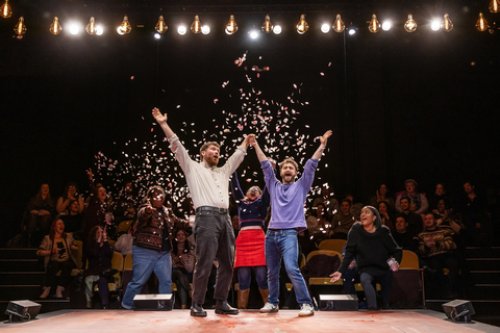
Daniel Radcliffe in a scene from Duncan Macmillan and Johnny Donahoe’s “Every Brilliant Thing” at the Hudson Theatre (Photo credit: Matthew Murphy)
Leaning into the truth or deception of Radcliffe’s personal authenticity, costume designer Vicki Mortimer dresses Radcliffe in clothes possibly from the actor’s home closet, though, if not for the reputational baggage, another appropriate sartorial choice would have been to garb Radcliffe like an evangelist. Exhibiting the same frenzied energy as Burt Lancaster’s Elmer Gantry, Radcliffe runs offstage to high-five an impressively substantial portion of the audience; however, he is definitely less Gantry-like when inciting a dance party that, as Radcliffe himself wryly observes, concludes anticlimactically with a sadly departing disco ball. Pulling double duty as scenic designer, Mortimer also aids Radcliffe’s uplifting efforts by thoroughly obliterating the fourth wall, affixing a wide flight of stairs from the orchestra to the stage, where blocks of seats surround Radcliffe on three sides.
While the show’s lighting and sound design, from Jack Knowles and Tom Gibbons respectively, serve Radcliffe well, there isn’t much their talents can do to help the scattered acting novices in the audience. That’s especially the case for a few of the nervous, sotto voce card readers. One hopes that this floundering group didn’t include an excited theater critic assigned the card numbered 777,777. Having plenty of time to memorize its words, he recalls saying them in a thunderously clear and calm voice. Even if he didn’t, his scene partner, Daniel Radcliffe, made him feel like that’s what happened. It was an absolute joy!
Every Brilliant Thing (through May 24, 2026)
The Hudson Theatre, 141 West 44th Street, in Manhattan
For tickets, call 855-801-5876 or visit http://www.everybrilliantthing.com
Running time: one hour and ten minutes without an intermission


Leave a comment