
Becky Shaw
A blind date with bite: Gina Gionfriddo’s play turns romantic comedy into a ruthlessly funny autopsy of modern relationships.
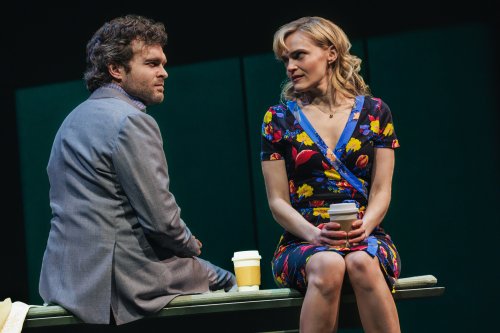
Alden Ehrenreich and Madeline Brewer in a scene from Gina Gionfriddo’s “Becky Shaw” at The Helen Hayes Theater (Photo credit: Marc J. Franklin)
It’s not every day that a play arrives on Broadway trailing the distinction of being a finalist for the Pulitzer Prize for Drama and yet feels, in a curious way, like a delayed guest to its own party. That’s the case with Gina Gionfriddo’s Becky Shaw, first seen Off Broadway in 2008, widely admired, much discussed, and, until now, conspicuously absent from the main stem. Why it has taken nearly two decades to reach Broadway is a question worth pondering, especially in an era hungry for plays that dissect contemporary relationships with both scalpel-sharp wit and unnerving psychological precision. Whatever the reason, its arrival now feels less like a revival than a long-overdue reckoning.
Gionfriddo’s play, which runs nearly two and a half hours, is directed with finely calibrated control by Trip Cullman. It’s a tart, unsettling, and often wickedly funny examination of the emotional minefields that define modern intimacy. At its center is the seemingly innocuous act of a blind date, but as in so many comedies of manners, what begins as social ritual quickly metastasizes into something darker, probing the uneasy intersections of manipulation, vulnerability, and power.
The plot pivots around Suzanna Slater (Lauren Patten, Jagged Little Pill), a psychology grad student, still reeling from the recent death of her father, and her well-meaning, acid-tongued, but perhaps not entirely perceptive adoptive brother Max (Alden Ehrenreich, Weapons), a money manager, with whom sexual tensions are disguised by familial appropriateness. Money management of the depleted Slater estate is a running subtheme.
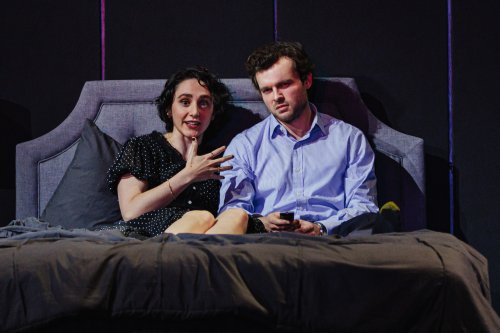
Lauren Patten and Alden Ehrenreich in a scene from Gina Gionfriddo’s “Becky Shaw” at The Helen Hayes Theater (Photo credit: Marc J. Franklin)
Suzanna arranges for the reluctant, cynical, bone-chillingly blunt Max to have a blind date with temp office worker Becky Shaw (Madeline Brewer, The Handmaid’s Tale), a name alluding to the socially ambitious Becky Sharp of Thackeray’s 1848 Vanity Fair. Becky’s a woman whose surface awkwardness—complicated by employment, educational, and financial drawbacks—masks a far more troubling interior life. Tongue-tied by social awkwardness at first (Max calls her frilly dress “a birthday cake”), it’s not long before her acuity makes itself known. Becky is the kind of woman who announces herself as an outsider while simultaneously insisting on her own normalcy, a contradiction that becomes increasingly disquieting as the play unfolds.
What follows, when Becky refuses to allow Max to end their one-date relationship, is less a conventional romantic comedy than a series of emotional chess matches, in which alliances shift, truths are shaded, and the question of who is manipulating whom becomes maddeningly elusive.
The play’s preoccupation with relationships extends beyond the central pairing to encompass a broader network of connections, each defined by its own peculiar balance of power. Suzanna’s marriage to Andrew (Patrick Ball, The Pitt), a compassionate, struggling novelist with a feminist bent whom she met on a ski trip, reveals fault lines that are at once recognizable and deeply uncomfortable; financial dependence, professional frustration, and unspoken resentments come bubbling to the surface.
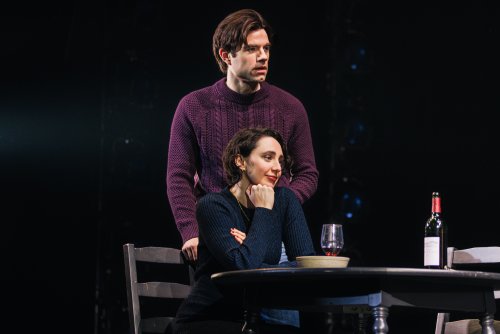
Patrick Ball and Lauren Patten in a scene from Gina Gionfriddo’s “Becky Shaw” at The Helen Hayes Theater (Photo credit: Marc J. Franklin)
Crucial to this network is Susan (Linda Emond, Cabaret), Suzanna’s mother and a straight-shooting, formidable presence whose wealth, authority, and emotional opacity make her both a stabilizing force and a disruptive one. Susan occupies that familiar but always fascinating theatrical territory of the older, powerful woman whose apparent control masks private fissures, and Emond seizes the role with commanding assurance. In what amounts to a scene-stealing turn (she’s offstage a good portion of the time), she delivers her lines with a precision and authority that sharpen the play’s exploration of power dynamics, particularly along gendered lines, while also revealing flashes of vulnerability that prevent the character from hardening into mere type.
What distinguishes Becky Shaw from more conventional relationship dramas is its insistence on confronting the audience with the raw mechanics of human interaction. Gionfriddo’s dialogue is at once hyper-articulate and brutally honest, capable of eliciting laughter one moment and a wince the next. I confess that I did not find the play quite the laugh riot that some of its advance notices had led me to expect; the humor here is often too edged with discomfort to produce sustained hilarity.
Yet there is something exhilarating about the way the playwright allows her characters to say the unsayable, to articulate thoughts that most of us would bury beneath layers of social nicety. The result is a kind of comedy that operates on multiple frequencies, its most painful moments often doubling as its funniest.
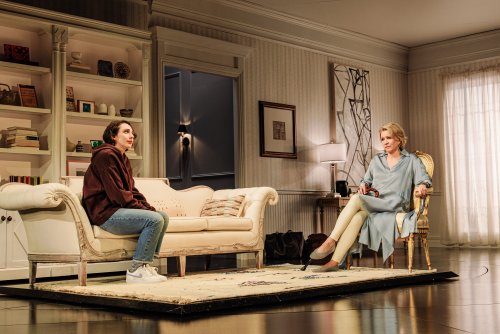
Lauren Patten and Linda Emond in a scene from Gina Gionfriddo’s “Becky Shaw” at The Helen Hayes Theater (Photo credit: Marc J. Franklin)
The characters themselves are drawn with a clarity that borders on the forensic. Becky, as embodied by Brewer, becomes the gravitational center, a figure both pitiable and alarming, whose capacity for self-delusion is matched only by her uncanny ability to expose the weaknesses of those around her. Patten’s Suzanna is all brittle composure, her grief and confusion manifesting in a defensive sharpness that both repels and attracts. Ball’s Andrew serves as a kind of intermediary, his affability masking a deeper uncertainty about his own place in the world, while Ehrenreich’s Max embodies a more overtly toxic form of masculine authority, one gradually revealed to be far less stable than it initially appears.
Visually, the production is equally assured. David Zinn’s scenic design employs a turntable arrangement that allows a more or less neutral environment to give way to a strikingly different one with eye-opening immediacy, a device reminiscent of the current Broadway staging of Dog Day Afternoon. Stacey Derosier’s lighting subtly modulates the atmosphere, sharpening moments of confrontation while softening those of uneasy intimacy, and Kaye Voyce’s costumes offer telling insights into each character’s social positioning and self-presentation without calling undue attention to themselves.
As so often, black-clad, headphone-wearing stagehands appear to facilitate scene changes. Normally, such visible mechanics in otherwise realistic plays break the illusion of the theatrical world, reminding us of the artifice at play. Here, however, the device is handled with a lightness of touch bordering on the playful. At one point, the actors themselves seem to acknowledge the presence of these silent figures, a moment that transforms what might have been a distraction into a shared joke between performers and audience, creating just the right balance between illusion and reality.
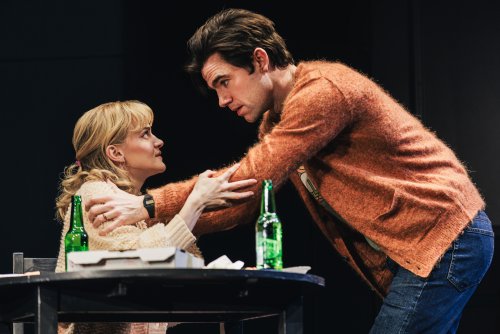
Madeline Brewer and Patrick Ball in a scene from Gina Gionfriddo’s “Becky Shaw” at The Helen Hayes Theater (Photo credit: Marc J. Franklin)
If Becky Shaw ultimately leaves us with more questions than answers that seems entirely in keeping with its vision of human relationships as inherently unstable, subject to forces that are as often internal as external. It’s not a comfortable play, nor is it an unambiguously entertaining one in the conventional sense. But it’s a bracingly intelligent and deeply engaging work, one that justifies its long journey to Broadway by reminding us of the theater’s unique capacity to hold a mirror up to our most intimate—and most unsettling—selves.
Becky Shaw (through June 14, 2026)
The Second Stage
The Helen Hayes Theater, 240 W. 44th Street, in Manhattan
For tickets, call 212-541-4516 or visit http://www.2st.com
Running time: two hours and 30 minutes including one intermission


Leave a comment