
Marcel on the Train
Ethan Slater shines as the legendary mime Marcel Marceau in a moving tale of humanity and heroism in the shadow of Hitler's reign of terror.
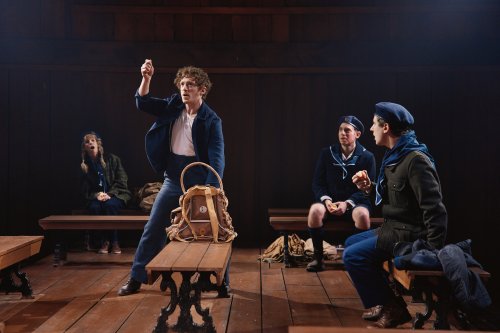
Maddie Corman, Ethan Slater, Max Gordon Moore and Alex Wyse in a scene from Marshall Pailet and Slater’s “Marcel on the Train” at Classic Stage Company (Photo credit: Emilio Madrid)
In Marcel on the Train, the new play by Marshall Pailet and Ethan Slater, presented by Classic Stage Company, time is not merely a dramatic device but a moral imperative. In this searching homage to Marcel Marceau, imitation will not suffice; survival itself becomes the ultimate act of performance.
Pailet, who also directs with a meticulous, almost musical attention to tonal modulation, frames the evening as a memory play in motion. His staging resists bombast. Instead, he favors accumulation—of gesture, of silence, of dread—allowing the audience to feel the tightening vise of history even as he makes room for playfulness. It is a delicate equilibrium, this oscillation between terror and theatrical delight, and Pailet proves himself an assured steward of both registers.
The historical marrow of the piece is bracing. Before Marceau became the white-faced poet of silence, he was Marcel Mangel, a young Jewish man in Nazi-occupied France who joined the Resistance. Between 1942 and 1945, he helped shepherd Jewish children across the Swiss border to safety, reportedly saving nearly a hundred lives. His father, Charles Mangel, would be deported to Auschwitz and murdered there. The play treats these facts not as adornments to an artistic legend but as the crucible in which that legend was forged.
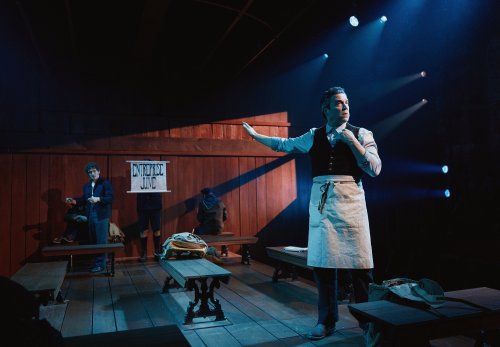
Ethan Slater and Aaron Serotsky in a scene from Marshall Pailet and Slater’s “Marcel on the Train” at Classic Stage Company (Photo credit: Emilio Madrid)
The drama proper unfolds during a single train journey in 1943. Marceau, posing as a boy scout leader, escorts four Jewish children from Limoges toward Switzerland, their forged papers tucked close, the Alps a distant rumor of safety. The compartment in which they sit becomes both refuge and trap, a narrow wooden ark rattling through occupied territory.
Slater’s performance is a revelation of synthesis. Known for his buoyant athleticism in Broadway’s SpongeBob SquarePants and his chilling portrayal of the Balladeer and Lee Harvey Oswald in Classic Stage’s brilliant Assassins, he here channels that dexterity into something at once lighter yet more harrowing. His Marceau moves with balletic precision: fingers unfurl like petals; wrists trace invisible architecture; the torso leans into unseen walls. Butterflies tremble from his cupped hands, a flower blossoms and droops along the line of his arm. Guided by movement consultant Lorenzo Pisoni, Slater achieves an embodiment so exacting it appears to suspend the laws of bone and gravity.
Yet virtuosity alone does not sustain the portrayal. Slater braids mischief with melancholy, allowing youthful optimism to shimmer against despair. In glimpses of Marceau’s iconic persona Bip—spiritually indebted to Charlie Chaplin’s Little Tramp—he locates the clown’s essential paradox: the grin poised over the abyss. Humor, in this rendering, is not escape but defiance. The emotional tension resides in the contrast. The children’s grief has the density of something already sedimented by history—weighty, inescapable, enduring—while Marceau’s joy feels improvised in the moment, a fragile construction assembled from breath and will. His optimism reads by turns as bravery, denial, and tactical necessity; perhaps it is all three at once. In this crucible, performance becomes a shield—gossamer and provisional, yet, in certain miraculous instances, sufficient.
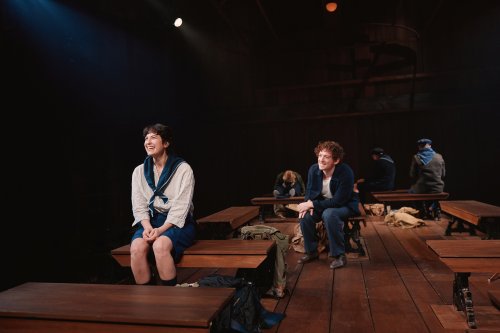
Tedra Millan and Ethan Slater in a scene from Marshall Pailet and Slater’s “Marcel on the Train” at Classic Stage Company (Photo credit: Emilio Madrid)
The children, portrayed by adult actors in a choice that refracts the narrative through memory’s lens, are sharply individualized. Henri (Alex Wyse) is quicksilver and cocky; Adolphe (Max Gordon Moore) counters with flinty realism; Berthe (Tedra Millan), ill and caustic, meets Marceau’s whimsy with skepticism until it gently undoes her; Etiennette (Maddie Corman), silent and shaken, finds in mime a language for what speech cannot hold. Orphans, their adolescence has already been scorched; innocence is no longer available to them as a dramatic convenience.
Indeed, if the evening rightfully orbits around Slater’s incandescent turn, its acting laurels are shared—resoundingly—with Aaron Serotsky. Serotsky undertakes a small repertory company’s worth of roles and distinguishes each with such clarity of physical and vocal delineation that one scarcely registers the doubling. As Marceau’s father, he is all granite and wounded pride, a man whose refusal to flee again feels less like obstinacy than like a final assertion of dignity. As Georges, the loyal cousin who draws Marceau into the perilous work of rescue with the OSE (Oeuvre de Secours aux Enfants), he radiates urgency tempered by camaraderie. Most riveting, however, is his turn as the French-born Nazi soldier who intrudes upon the children’s compartment. Serotsky plays the scene with an unnerving, almost languid eccentricity—lingering over forged papers, rummaging through belongings, circling the mayonnaise sandwiches with a curiosity that borders on the absurd. The offbeat tempo destabilizes the air in the theater; we are never certain whether this man will expose the ruse or silently abet it. In that prolonged ambiguity, Serotsky locates something chillingly human: the caprice of power, the terror of not knowing which way it will tilt.
Marceau’s attempts to shield his charges with games and pantomime inevitably recall the tonal high wire of the film Life Is Beautiful, yet the children here are under no illusion about the stakes. They understand enough. When the French Nazi guard enters their compartment to interrogate them—handling papers, prodding sandwiches, allowing suspicion to stretch into near-theatrical cruelty—the silence becomes thunderous. Pailet stages the sequence with unnerving patience, trusting stillness to do its work.
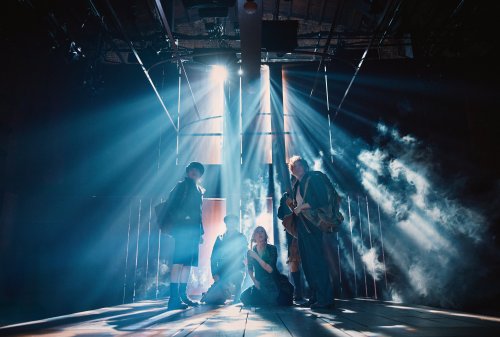
Tedra Millan, Max Gordon Moore, Maddie Corman and Ethan Slater in a scene from Marshall Pailet and Slater’s “Marcel on the Train” at Classic Stage Company (Photo credit: Emilio Madrid)
The script is punctuated by memory sequences—“What Charles Remembers,” among them—that slide backward and forward in time. Marceau’s father reappears, steadfast in his refusal to flee again; the children’s postwar futures flicker into view; Marceau’s later renown glimmers at the margins. These interludes propose that memory is not passive recall but curation. “Wouldn’t it be better if we chose a ridiculous memory instead?” Marceau asks, articulating an ethic of survival that is at once comic and profound.
Scott Davis’ ingenious scenic design transforms the theater into a wooden train carriage whose hard benches and arched ceiling evoke, without literalizing, the specter of deportation, later morphing into an Alpine forest for their trek on foot across the border into Switzerland. Studio Luna’s lighting sculpts menace from shadow; Jill BC Du Boff’s sound design keeps the murmur of Nazi authority vibrating just beyond the compartment walls. The train’s grind of wheels and the hiss of brakes thrum beneath the action, a metallic heartbeat that refuses to let the audience forget the perilous machinery propelling these lives forward. Sarah Laux’s costumes pivot deftly across eras, and the shadows cast by Slater’s mime become transient landscapes of their own.
If the structure occasionally courts diffuseness in its ambition, the cumulative effect is enveloping rather than attenuated. Pailet’s direction sustains a taut line between historical gravity and theatrical buoyancy, and the adult casting of the children underscores the play’s ultimate assertion: survival extends beyond the moment of rescue into a lifetime of remembering.
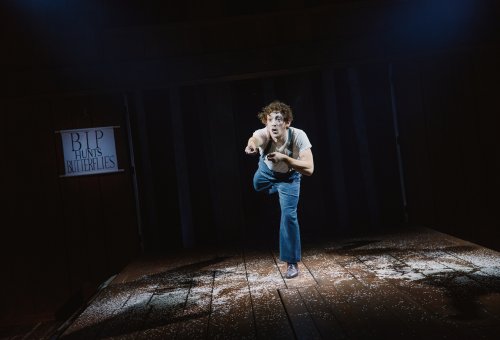
Ethan Slater recreates Marcel Marceau’s “Bip Hunts Butterflies,” a scene from Marshall Pailet and Slater’s “Marcel on the Train” at Classic Stage Company (Photo credit: Emilio Madrid)
What lingers is the sight of Slater alone in a shaft of light, coaxing a drooping flower upright with nothing but breath and will. In that simple illusion resides the play’s thesis. The discipline required to hold an audience rapt without words mirrors the discipline required to shepherd frightened children across a border: control of body, of fear, of hope.
Marcel on the Train emerges as both portrait and parable—an account of an artist formed in extremis, and a reminder that the most resonant acts of resistance are sometimes performed in silence. By centering a man who did not initially conceive of himself as heroic but stepped forward nonetheless, the play advances a subtler thesis about moral courage. It suggests that bravery is often situational, even accidental—a series of decisions made in cramped compartments, in whispers, in the space between heartbeats. And in evoking those darkened corridors of history, the play reminds us that someone, always, must decide to move forward, even when the path ahead is invisible.
Marcel on the Train (through March 22, 2026)
Classic Stage Company
Lynn F. Angelson Theater, 136 East 13th Street, in Manhattan
For tickets, visit www.classicstage.org
Running time: 105 minutes without an intermission


Leave a comment