
Da
A splendid revival of Hugh Leonard's bittersweet, modern classic Irish memory play about a middle-aged man haunted by his quarrelsome deceased parents.
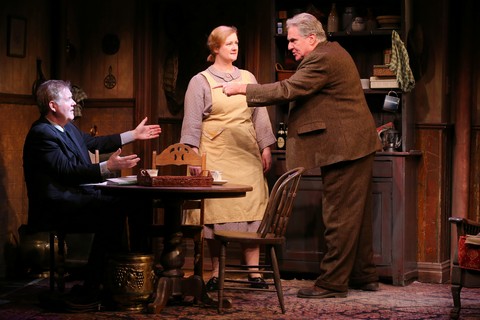
Ciarán O’Reilly, Fiana Toibin and Paul O’Brien in a scene from The Irish Repertory Theatre’s revival of Hugh Leonard’s “Da” (Photo credit: Carol Rosegg)
[avatar user=”Darryl Reilly” size=”96″ align=”left” ] Darryl Reilly, Critic[/avatar] “The black dog was the only intelligent member of the family. He died a few years later. He was poisoned, and no one will convince me it wasn’t suicide,” is a childhood reminiscence by Charlie, a middle-aged Irish man in the play Da. It originally opened on Broadway in 1978 and ran for 20 months. The Irish Repertory Theatre is now giving it a splendid revival.
It is May of 1968, and Charlie has traveled from London to suburban Dublin for the funeral of his 83-year-old adopted father. His adopted mother died three years earlier. While sorting through the old man’s possessions, he is flooded with memories of his troubled childhood and adolescence. We see a collage of significant moments in his life that seamlessly shift repeatedly and where the past and the present are in perpetual collision.
Da (an Irish diminutive for father) is an amiable gardener who has long been married to Mother. She is a battle-axe with a good heart that keeps the household running on his meager salary. After a series of stillbirths, the couple adopted Charlie, an illegitimate infant. They raise him with the hard-edged love common to their environment.
The author, Hugh Leonard (1926–2009) was a prolific and well-known Irish dramatist and journalist. Da was his most successful work and is heavily autobiographical. In addition to it’s long Broadway run, it won the Tony Award for Best Play and then it toured the United States for 10 months. In 1988, it was adapted into a feature film starring Martin Sheen as Charlie, and Barnard Hughes recreating his Tony Award-winning role from the Broadway production as the father.
This finely constructed memory piece is characterized by comedy and melancholy. Overcoming parental dysfunction is it’s universal theme. It’s rendered with complexity, as the characters are often shown at their most vindictive but also with their good qualities that they often repress. The dialogue is crisp and filled with mordant Irish wit:
“The Irish national disease.” “Bad manners?” “No manners.”
“Throw you a crumb and you’d call it a banquet.”
“She died an Irishwoman’s death, drinking a cup of tea.”
Charlotte Moore’s direction wonderfully realizes the often rapid temporal transitions with great results that are all expertly staged in such a tight playing area. It’s always clear where in time the actions are taking place. The cast of eight she has assembled and the performances she has gotten from them are excellent.
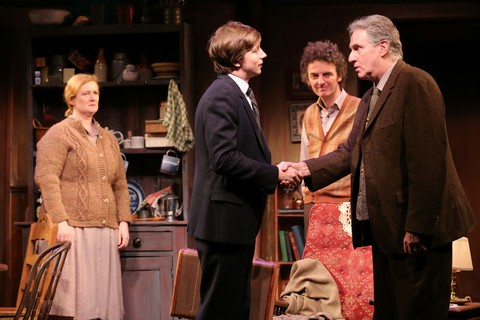
Fiana Toibin, Adam Petherbridge, John Keating and Paul O’Brien in a scene from Hugh Leonard’s “Da” (Photo credit: Carol Rosegg)
In the pivotal role of Charlie, Ciarán O’Reilly is breezy, easygoing, and very humorous during the lighthearted portions. At one point he winningly appears as himself as a seven-year-old. In the darker exchanges, he is filled with explosive rage that he forcefully expresses. His seemingly effortless balancing of the two extremes makes for a powerful performance.
As the irrepressible Da, Paul O’Brien is charmingly sweet and befuddled. When necessary he conveys disappointment and anger with subtlety. The one real moment of unbridled fury he has is chilling coming after his nearly constant cheerfulness.
Fiana Toibin plays the abrasive Mother with fierce flair. She offers a compelling portrait of chilly maternal domination that ably conveys the character’s steadfast belief that she’s doing right with the few very effective moments of warmth the part has.
Adam Petherbridge is appealingly animated as Young Charlie and very skillfully displays the youth’s adolescent joys and torments. Sean Gormley’s sly rigidity and coldness, makes the imperiousness of the young man’s civil service mentor even funnier. John Keating mischievously and gracefully plays Charlie and Young Charlie’s sidekick.
Nicola Murphy makes a lovely and touching appearance as a young townswoman the young man lusts after. Kristin Griffith as Da’s haughty upper-class employer is dryly hilarious.
Smoke from a steaming teakettle on an old kitchen stove is visible to the audience before the play begins. James Morgan’s detailed set design inventively suggests various rooms of a working class household as well as other locations that are a marvel in relation to the contained space. Michael Gottlieb’s lighting design and Zachary Williamson’s sound design both contribute immensely to the veering sense of the past and present. The cast all look appropriate due to Linda Fisher’s artful period costume design.
The Irish Repertory Theatre last revived Da Off-Broadway in 1996, and this accomplished production is a testament to the play’s enduring resonance.
One the most poignant scenes is Charlie being confronted by his younger self:
“I mean, I’d hoped I’d done better meself.”
“What had you in mind?”
“Don’t get huffy. It’s not that I amn’t glad to see you: at least it means I’ll live till I’m forty. That’s something…I suppose I could have done worse: but you can’t deny you’re a bit ordinary. It gives a fellow the creeps, seeing himself at your age: everything behind him and nothing to look forward to.”
Da (extended through April 5, 2015)
The Irish Repertory Theatre at DR2 Theatre, 103 East 15th Street, in Manhattan
For tickets, call 212-727-2737 or visit http://www.irishrep.org
Running time: two hours and 15 minutes with one intermission


Leave a comment